Derived Demand for Labour
Definition
Derived demand: demand for a factor of production, such as labour, that arises not for its own sake but from the demand for the good or service the factor helps to produce.
Meaning of Derived Demand
- So the demand for labour depends on the demand for the final product → no product sales, no reason to employ.
- When product demand is strong, extra output can be sold profitably, so firms want more workers to expand output.
Example
- Demand for restaurant meals rises sharply in a fast-growing city.
- Restaurants serve more customers, so each extra chef and waiter adds to revenue.
- Owners respond by hiring more kitchen and service staff, so employment rises with meal demand.
- If diners later switch to cooking at home, meal demand falls, revenue per worker drops and staff are laid off.
Downward-Sloping Demand Curve
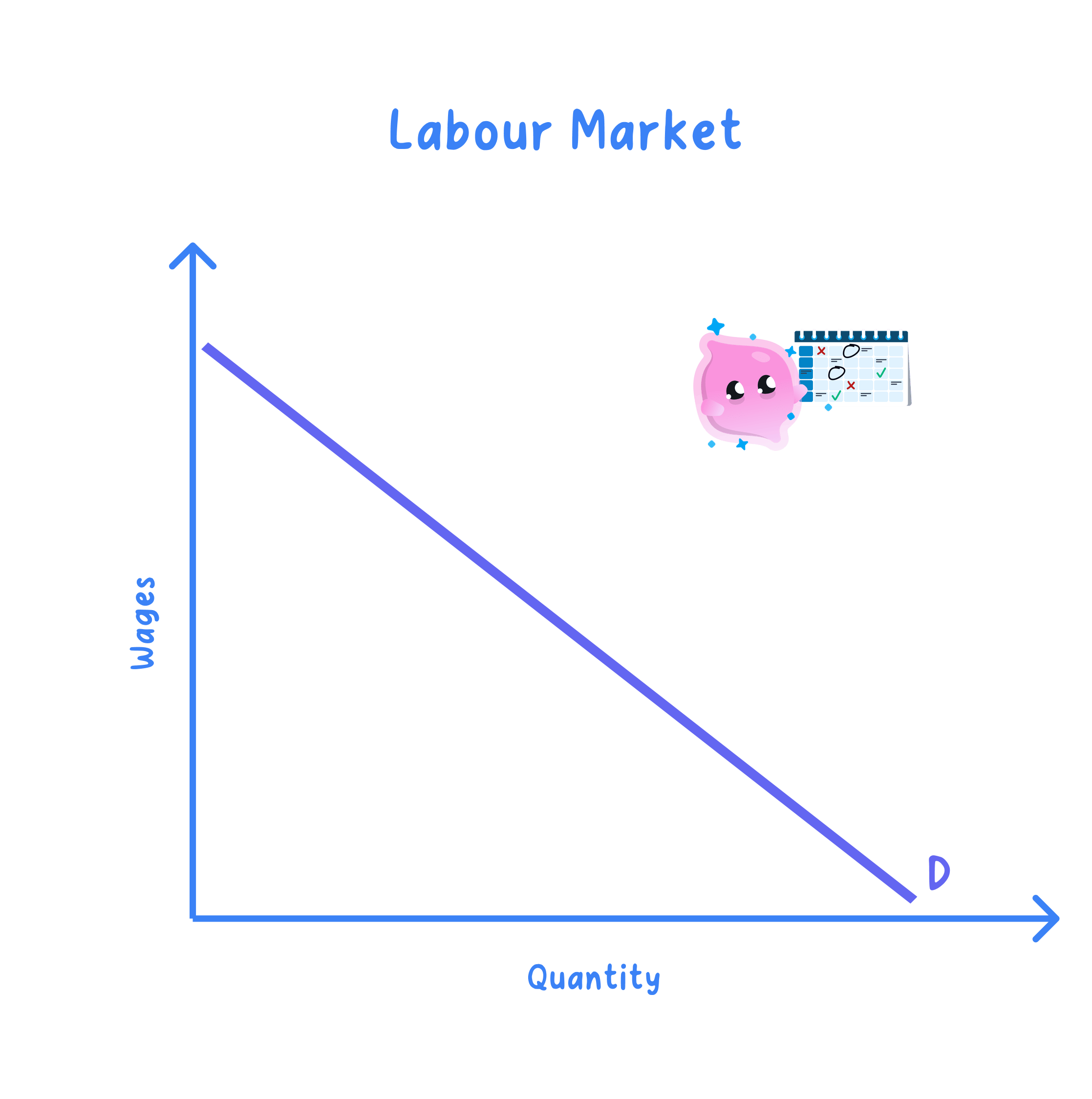
- The labour demand curve plots the wage rate on the vertical axis against the quantity of labour on the horizontal axis.
- A higher wage raises the cost of employing each worker relative to the revenue that worker brings in.
- So firms cut back the number employed as the wage rises → the curve slopes downward.
- A lower wage makes labour cheaper relative to its output, so firms employ more workers.
Key Idea
- Labour demand is derived from the demand for the good or service labour produces.
- The labour demand curve slopes downward, plotting the wage rate against the quantity of labour.
Why the Link Matters
- Because demand is derived, changes in a product market pass straight through to jobs, even with wages unchanged.
- A boom in final demand raises the value of output per worker, so employment in the supplying industries rises.
- A slump in final demand cuts the revenue each worker generates, so firms shed labour despite unchanged wages.
- The size of the jobs effect depends on how labour-intensive production is and whether machines can be substituted for workers.
Note
- Derived demand explains why a whole supply chain can share the same fortunes.
- A fall in car sales reduces demand for steelworkers, tyre-makers and component assemblers alike.
Exam technique
- Always state that labour demand is derived from the demand for the final product.
- Label the axes as wage rate and quantity of labour when you draw the curve.
Common Mistake
- Do not treat the demand for labour as an ordinary demand wanted for its own sake.
- A change in the wage causes a movement along the curve, not a shift of it.
Self review
- What is meant by a derived demand?
- Why do firms demand labour?
- Why does the labour demand curve slope downward?
- How does a fall in product demand affect employment in that industry?
