The Money Supply
- The money supply measures the total stock of money in an economy, so it shapes how much spending can occur.
- Because some money is easier to spend than others, economists classify it by liquidity.
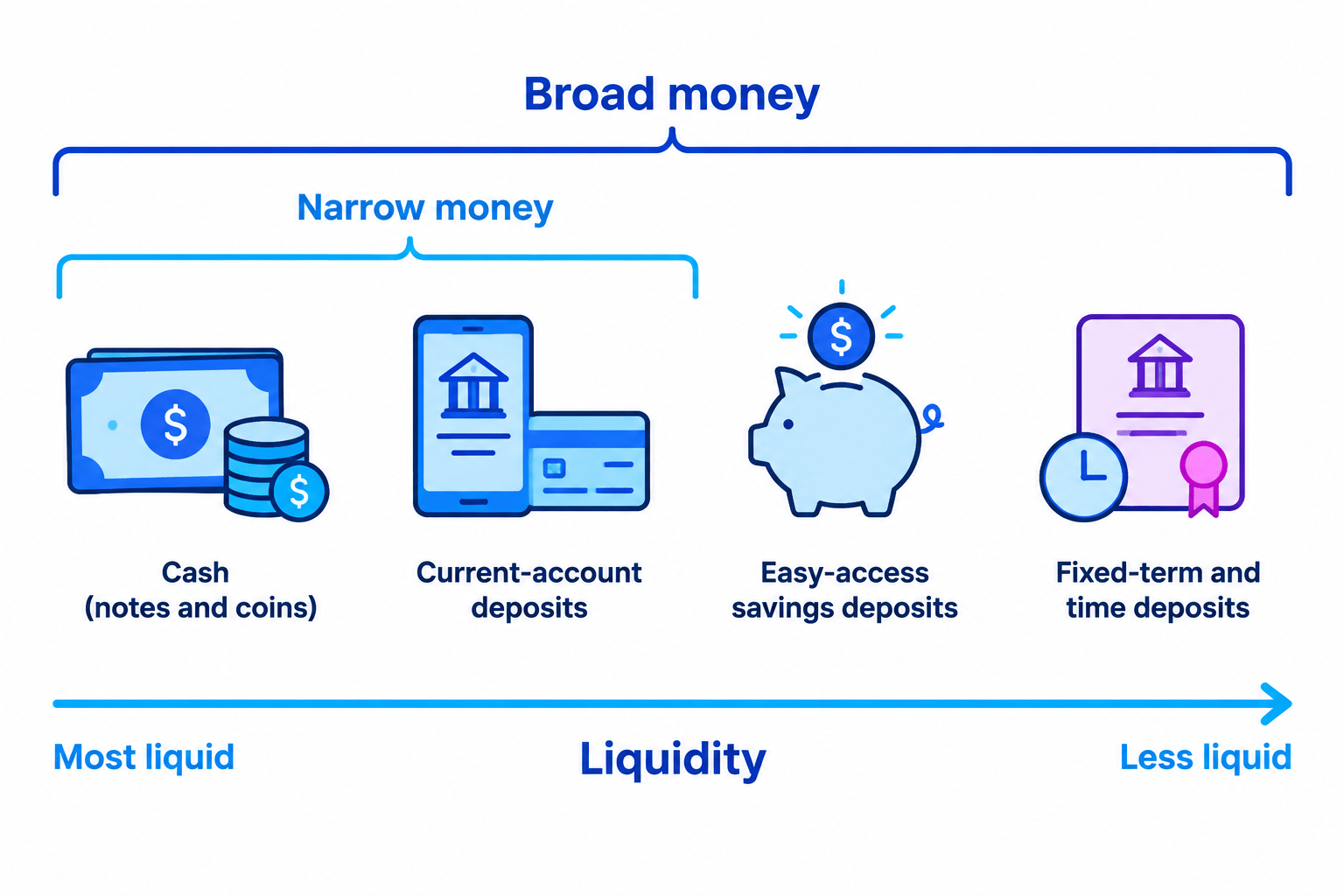
- The most liquid holdings form narrow money; adding less-liquid deposits gives broad money.
- Most of the money supply is not cash but bank deposits created when banks lend.
Definition
Money supply: the total stock of money in circulation in an economy at a given time.
Narrow money: notes, coins and operational deposits held mainly as a medium of exchange.
Broad money: narrow money + less-liquid savings and time deposits held as a store of value.
Liquidity: the ease and speed with which an asset can be turned into cash without loss of value.
Key Idea
- Narrow money is the most liquid; broad money is less so.
- Broad money is harder to control, because banks create most of it.
- The two aggregates send different signals about spending and lending.
Ranking Money by Liquidity
- Cash and current-account balances can be spent at once, so they are the most liquid money.
- A £2,000 fixed-term savings account cannot be spent until notice is given or the term matures, so it is less liquid.
- Ranking deposits from most to least liquid shows a spectrum, not a single type of money.
- Narrow money captures only the top of this spectrum; broad money captures a wider set.
Example
- Suppose an economy has £200bn of narrow money within £800bn of broad money.
- So only 25% of broad money is highly liquid, and physical cash is a smaller share still.
Why the Distinction Matters
- Narrow money is closest to actual spending, so it signals short-run demand pressure.
- Broad money reflects the banking system's lending, so fast growth can warn of future inflation.
- Broad money is hard to control directly, because commercial banks create deposits when they lend.
- It depends which aggregate you watch: they can move differently, so each tells only part of the story.
Note
- Most broad money is created by commercial banks when they lend, not printed by the state.
- Only a small share of the money supply is physical cash.
- This makes broad money hard for the central bank to control directly.
Classifying the Aggregates
- Place the most liquid items, cash and current accounts, in narrow money.
- Add less-liquid savings and time deposits to reach broad money.
- Rank deposits by liquidity rather than treating them as identical.
- So the classification follows liquidity from the most to the least spendable.
Exam technique
- Define narrow and broad money in terms of liquidity, not just examples.
- Explain why broad money is harder to control, linking it to bank lending.
- Classify a given deposit into the correct aggregate and justify it.
Common Mistake
- Do not treat all bank deposits as identical; rank them by liquidity.
- Do not say the central bank simply prints the money supply; banks create most of it.
Self review
- What is the money supply?
- What is narrow money?
- What is broad money?
- Why is broad money harder to control?
- On what basis are the two distinguished?