Conditions for Efficiency
Definition
Marginal cost (MC): the addition to total cost from producing one more unit of output.
Average cost (AC): total cost ÷ quantity produced, i.e. the cost per unit of output.
- Each type of efficiency has its own precise condition to test against.
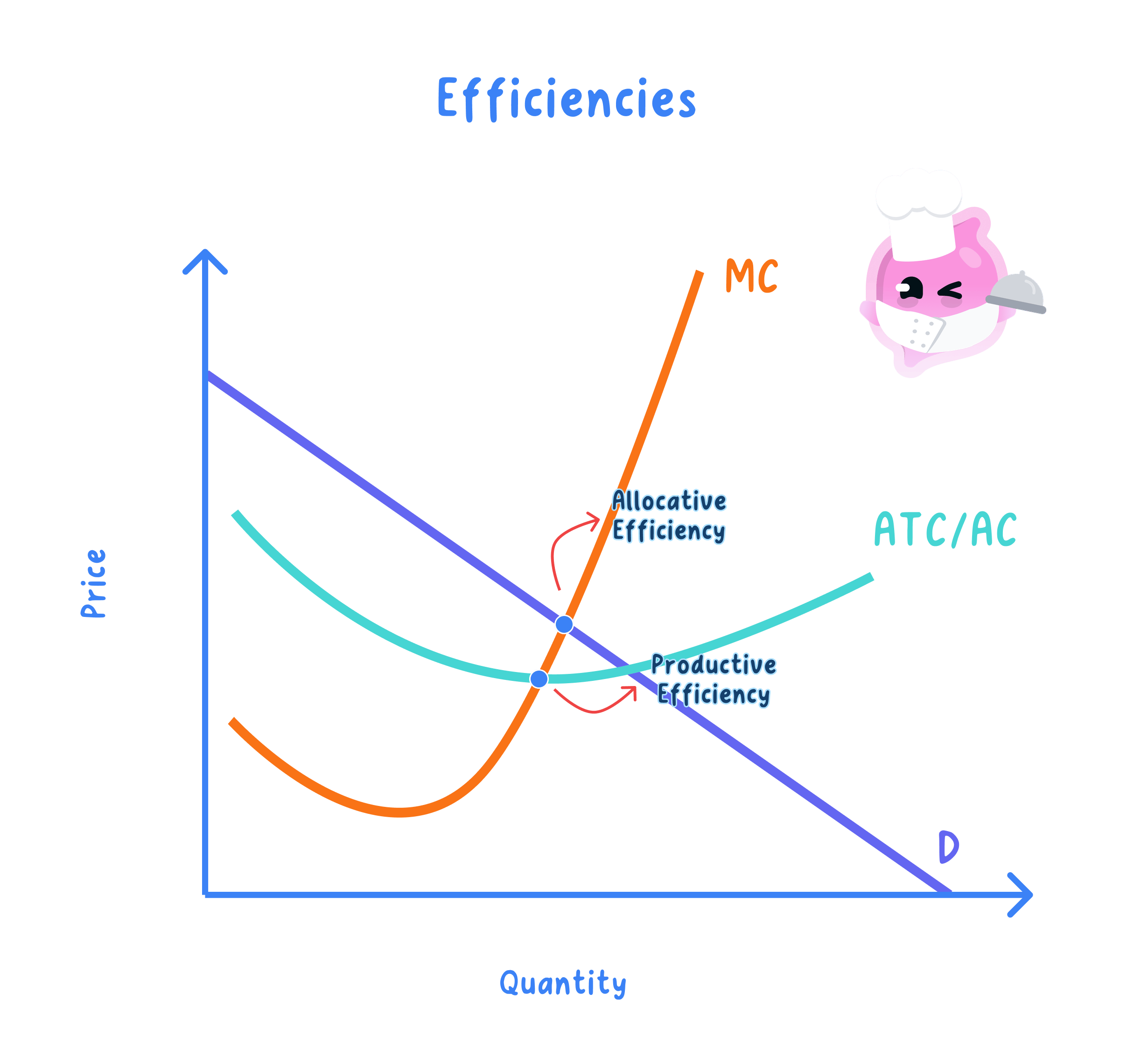
- Productive efficiency requires production at the minimum point of the average cost curve, where MC = AC.
- For the whole economy this means producing on the production possibility curve (PPC).
- Allocative efficiency requires that price = marginal cost (P = MC).
- A market may satisfy one condition without satisfying the other.
Key Idea
- Test productive efficiency by finding the bottom of the average cost curve (MC = AC).
- Test allocative efficiency by checking whether price = marginal cost.
Productive Condition
- As output rises, average cost first falls as fixed costs are spread over more units, then rises as diminishing returns set in.
- The lowest point of that U-shaped curve is the productively efficient level of output.
- At that point marginal cost = average cost, because MC always cuts AC at its minimum: while MC < AC, AC is falling; once MC > AC, AC is rising.
Example
- A bakery's average cost is £1.20 a loaf at 400 loaves, falls to £0.90 at 700 loaves as its fixed oven and rent costs are spread, then rises to £1.05 at 900 loaves as overtime pay and congestion set in.
- The productively efficient output is 700 loaves, where average cost is lowest at £0.90 and MC = AC; producing 400 or 900 wastes resources per loaf.
Allocative Condition
- The demand curve shows the price consumers will pay, which reflects the value of each extra unit.
- The supply, or marginal cost, curve shows the cost of producing each extra unit.
- Where the two curves cross, price = marginal cost and the market is allocatively efficient.
Example
- In a near-competitive market such as UK wholesale wheat, many sellers take the market price, so each produces where price = marginal cost and the allocative condition holds.
- A sole regional rail operator instead sets a £15 fare while the marginal cost of one more passenger is £9, so P > MC, the allocative condition fails and output is too low.
- The £6 gap between price and marginal cost measures the value of trips that passengers wanted but the monopoly did not supply.
Why Both Matter
- Meeting the productive condition avoids wasting inputs on any given output.
- Meeting the allocative condition matches that output to what consumers value most.
- Only when both hold are the economy's scarce resources used as well as possible — though it depends on the market: a firm at min AC that still sets P > MC is productively but not allocatively efficient.
Exam technique
- State the exact condition (MC = AC or P = MC), not a vague description, for each type.
- Use a diagram to show where price = marginal cost, or where average cost is at its minimum.
Common Mistake
- Do not blur the two conditions together.
- Productive efficiency is least-cost output (MC = AC), while allocative efficiency is price = marginal cost.
Self review
- State the condition for productive efficiency.
- State the condition for allocative efficiency.
- Why does marginal cost = average cost at the productively efficient output?
- Can a market meet one condition and fail the other?
