Supply-side policy in AD/AS
Definition
Long-run aggregate supply (LRAS): the economy's potential output when all resources are fully employed, drawn as a vertical curve.
Non-inflationary growth: a rise in real output that does not push up the average price level.
The rightward shift
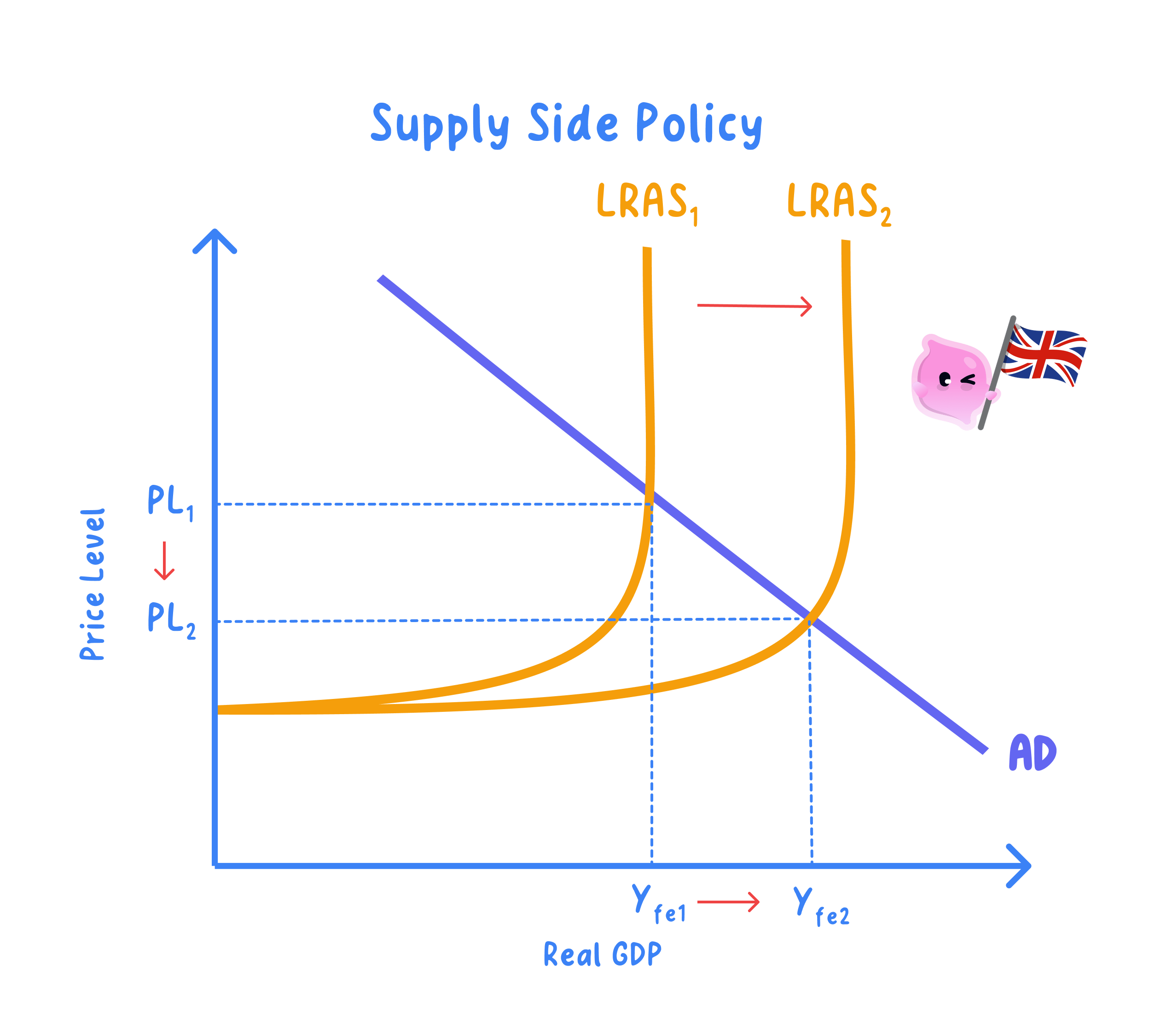
- A successful supply-side policy raises productive capacity, shifting long-run aggregate supply (LRAS) to the right.
- It usually shifts short-run aggregate supply (SRAS) to the right as well.
- The economy moves to a new equilibrium where aggregate demand crosses the new LRAS.
- This new equilibrium is at a higher level of real output.
Impact on the economy
- Equilibrium real output and national income rise.
- Employment rises as firms expand production to use the extra capacity.
- The average price level falls, or rises more slowly than it otherwise would.
- The size of each effect depends on how far LRAS shifts.
Key Idea
- Supply-side policy shifts LRAS right, unlike demand-side policy which shifts AD.
- This raises output and employment while easing the price level.
Non-inflationary growth
- Higher capacity lets output grow without hitting supply constraints.
- The extra supply eases upward pressure on the price level.
- So the economy can achieve non-inflationary growth.
Comparison with demand-side
- A demand-side policy raises real output by shifting aggregate demand (AD) to the right.
- But expanding AD also tends to raise the average price level.
- Supply-side policy instead raises output while easing the price level.
- So the source of growth shapes the inflation outcome.
Example
- Suppose a £5 billion training and investment programme raises productive capacity.
- Draw AD/AS with average price level on the vertical axis and real output on the horizontal axis.
- LRAS shifts right from LRAS1 to LRAS2 while AD stays fixed.
- Equilibrium moves down the AD curve to meet the new LRAS.
- Real output rises from Y1 to Y2 and the price level falls from P1 to P2.
- Employment rises as firms hire to produce the extra output, giving non-inflationary growth.
How effective is supply-side policy at raising output?
- Supply-side policy is the one approach that can raise real output and employment while easing the price level, unlike a demand expansion which lifts output only at the cost of higher prices, so where the binding constraint is genuinely low productivity or capacity the gains can be large and lasting.
- However, the gains appear only in the long run and after long time lags, because training, infrastructure and new technology take years to raise capacity, so supply-side policy is no help against a short-run demand shortfall that needs a quick response.
- The policies are also costly to fund, carrying a high opportunity cost, and their success is not guaranteed: LRAS shifts right only if new skills match what employers need, if firms actually invest and if the extra spending is well targeted rather than wasted.
- On balance, supply-side policy is most effective as a long-term route to higher trend output and non-inflationary growth when the economy's main weakness lies on the supply side and the government can afford to fund it and wait; where the problem is a short-run demand gap or the public finances are tight, demand-side policy will act faster. Its effectiveness therefore depends on the size of the LRAS shift, the time horizon and the fiscal room available.
Exam technique
- Draw a rightward LRAS shift that raises real output and eases the price level.
- Label both equilibria and comment on output, price level and employment.
- Contrast it with a demand-side expansion that shifts AD.
Common Mistake
- Do not show supply-side policy raising the price level the way a demand expansion does.
- A rightward LRAS shift eases price pressure rather than adding to it.
- Do not assume the gains are instant, since they take time and are uncertain.
Self review
- What does a successful supply-side policy shift, and in which direction?
- What happens to equilibrium real output and national income?
- What happens to the average price level and employment?
- Why does supply-side policy allow non-inflationary growth?
- How can supply-side policy raise output while easing inflationary pressure?
