Exchange rates and AD/AS
Definition
Depreciation: a market-driven fall in the value of a floating currency against another currency.
Imported inflation: a rise in the domestic price level caused by dearer imported raw materials, energy and components after a currency falls.
Depreciation and AD/AS
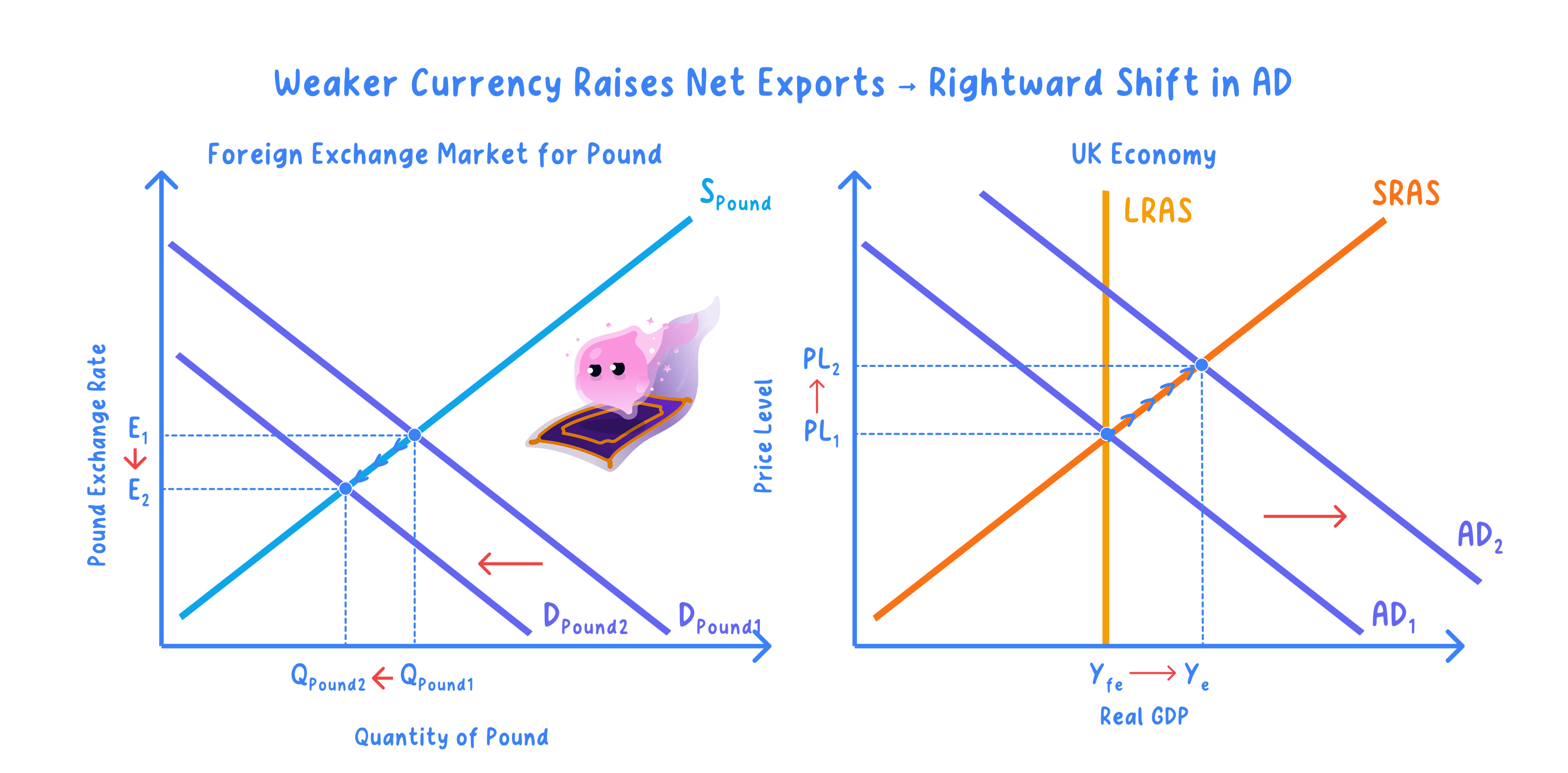
- A depreciation lowers the foreign-currency price of exports and raises the domestic-currency price of imports.
- Cheaper exports and dearer imports tend to raise net exports (X − M), a key component of aggregate demand.
- Higher net exports shift aggregate demand (AD) to the right.
- Dearer imported raw materials, energy and components raise firms' costs, which can also shift short-run aggregate supply (SRAS) to the left (shift of SRAS is not shown below).
Key Idea
- A depreciation raises net exports, shifting AD right and pulling up both real output and the price level (demand-pull).
- It also makes imported inputs dearer, adding cost-push, or imported, inflation.
Impact on the economy
- The rightward AD shift raises the economy's equilibrium national income and real output.
- As firms expand production they hire more workers, so employment rises and unemployment falls.
- The price level rises, both from stronger demand (demand-pull) and from dearer imported inputs (cost-push).
- On the diagram the average price level sits on the vertical axis and real output on the horizontal axis, with AD shifting right to a new macroeconomic equilibrium.
Note
- A depreciation can raise growth and employment while at the same time raising inflation.
- So a depreciation is not automatically good for the domestic economy; it depends on which effect dominates.
Appreciation in reverse
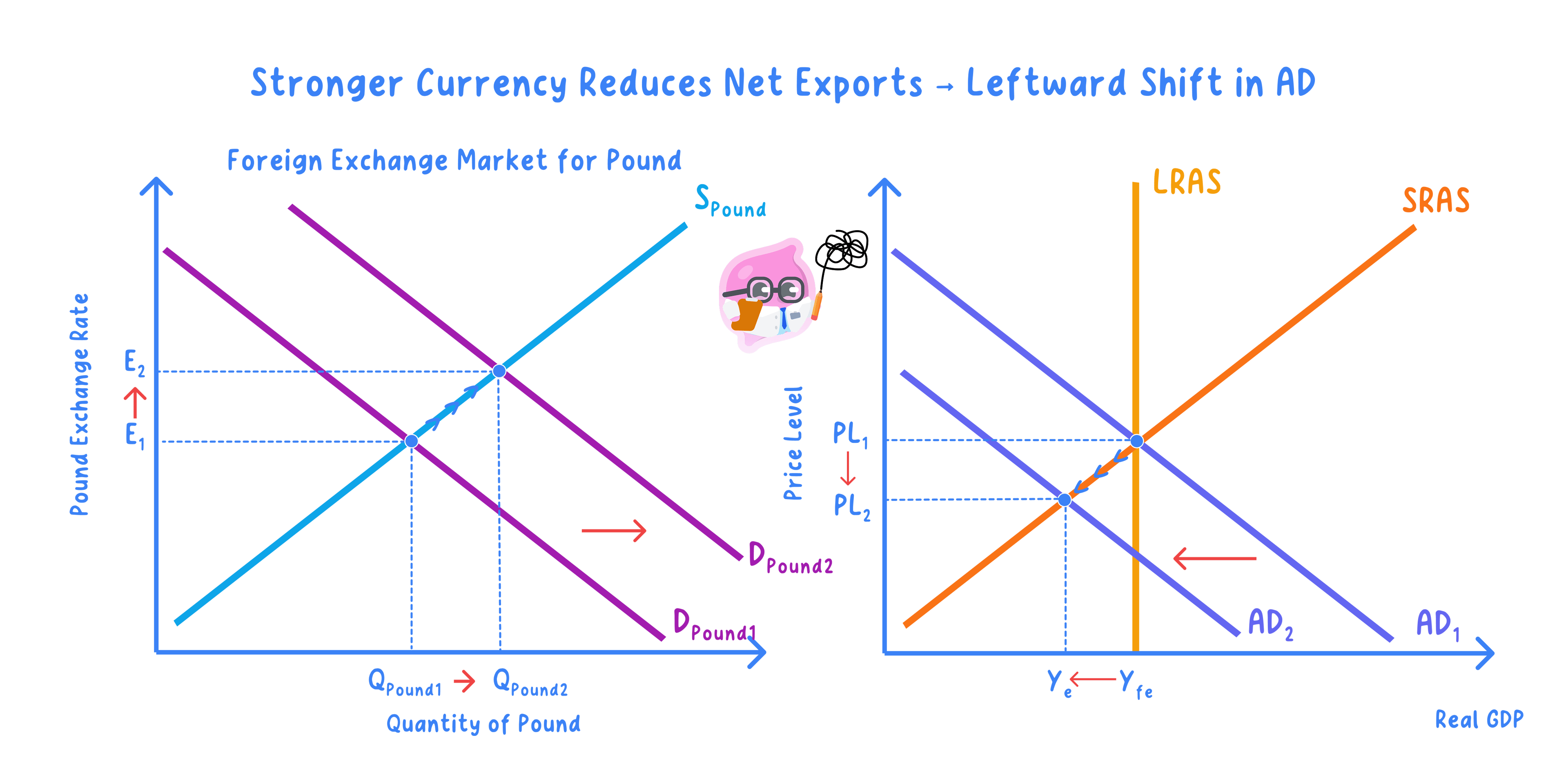
- An appreciation raises the foreign price of exports and lowers the domestic price of imports.
- Net exports tend to fall, so AD shifts to the left.
- Equilibrium national income, real output and employment fall as demand weakens.
- Cheaper imports ease cost pressures, so inflationary pressure is reduced.
Example
- Suppose the pound depreciates so that UK export orders rise and factories take on extra staff.
- Higher net exports shift AD right, raising real output and employment.
- At the same time households pay more for imported fuel and food priced in dollars, so the cost of living climbs.
- This dearer-input effect is the cost-push, or imported, inflation that accompanies the depreciation.
What determines the size
- The price elasticities of demand for exports and imports determine whether the trade balance actually improves.
- If demand is unresponsive the rise in net exports may be small, so the outcome depends on responsiveness.
- The amount of spare capacity, or the output gap, shapes how much real output can rise.
- With plenty of spare capacity output rises easily (the Keynesian range of AS), but near full capacity extra demand mainly raises the price level (the classical range).
- The economy's dependence on imported inputs determines how strong the cost-push inflation is.
Does a depreciation always improve the economy?
- A depreciation can improve the economy when demand for exports and imports is price elastic: cheaper exports and dearer imports then raise net exports strongly, shifting AD right and lifting real output and employment, especially where spare capacity lets firms expand.
- But the gain is not automatic. If demand for exports and imports is price inelastic, the value of net exports may barely rise, or even fall at first, because dearer imports are still bought in much the same quantity; and even a favourable move often shows up only slowly, as buyers take time to switch suppliers.
- A depreciation also raises the cost of imported energy, raw materials and components, feeding imported inflation; near full capacity the extra demand mainly pushes up the price level rather than output, so growth is limited while inflation worsens and real incomes are squeezed.
- On balance, a depreciation is most likely to help when demand for exports and imports is elastic, spare capacity exists and reliance on imported inputs is low, and most likely to harm the economy when demand is inelastic and inflation is already high. Whether it improves the economy therefore depends on elasticities, the output gap and import dependence.
Exam technique
- Label the macro axes as the average price level (vertical) and real output (horizontal), never price and quantity.
- Show net exports shifting AD to the right for a depreciation, or to the left for an appreciation.
- Add an SRAS shift only when imported input costs are clearly significant.
- Evaluate using the responsiveness of exports and imports, the size of the output gap and import dependence.
Common Mistake
- Do not treat a depreciation as automatically good for the economy.
- It raises output and employment but also raises the price level through imported inflation.
- Do not assume the trade balance improves straight away.
- The gain depends on how responsive demand for exports and imports is.
Self review
- How does a depreciation change the foreign price of exports and the domestic price of imports?
- Which way does a depreciation shift AD, and what happens to national income, real output and employment?
- Why can a depreciation raise the price level through two different routes?
- What happens to the domestic economy after a currency appreciation?
- Name two factors that determine the size of a depreciation's effect.
