Choosing Covert or Overt for a New Study
- This skill asks you to choose covert or overt observation for a study you have not met before.
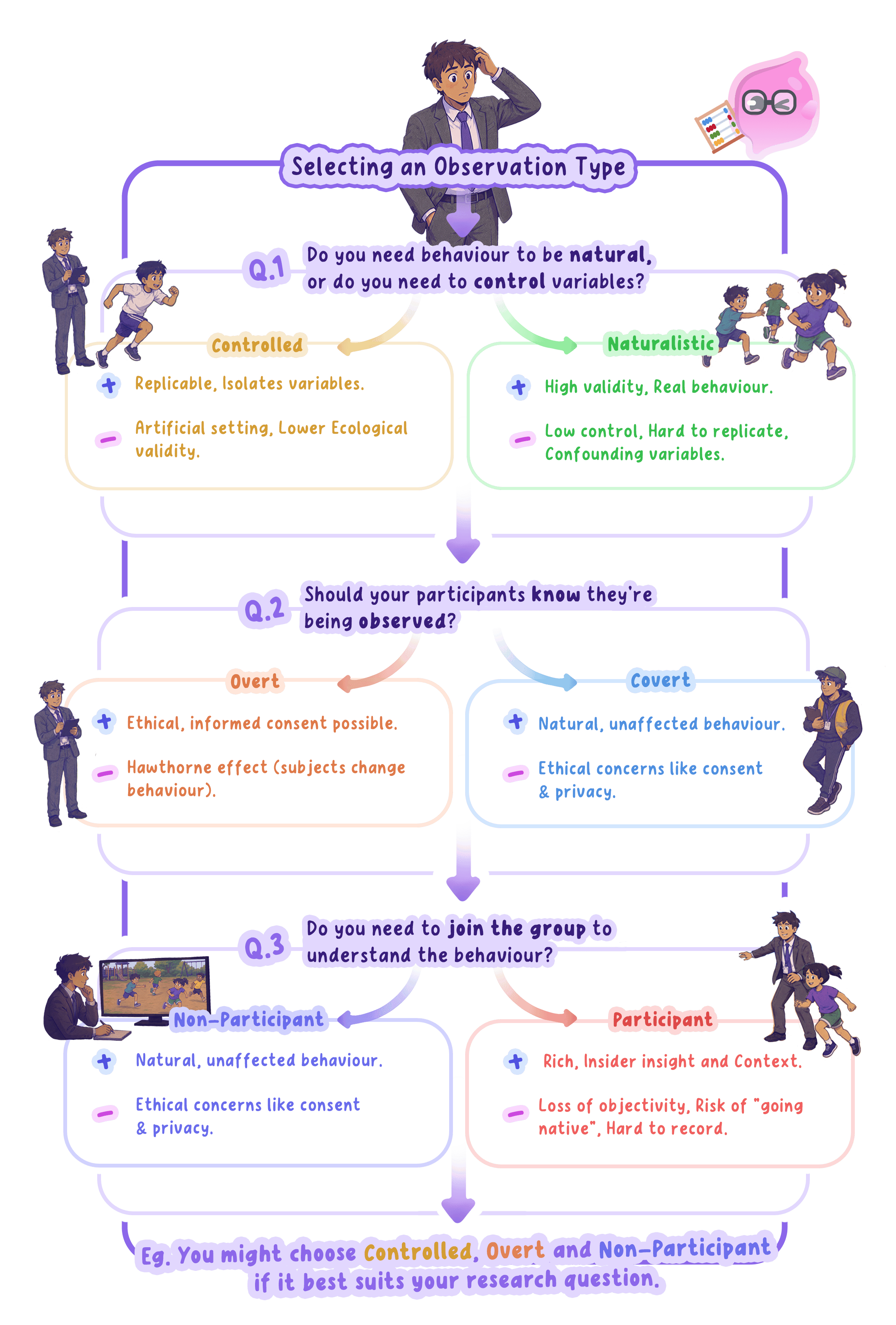
- Weigh how natural the behaviour needs to be against the need for consent.
- Then think about the setting and how sensitive the behaviour is.
Key Idea
- Natural behaviour matters most and the setting is public? Covert may fit.
- Consent matters most or the setting is private? Overt fits better.
A Worked Example
- Suppose you want to see how often shoppers hold the door open for the person behind them at a shopping-centre entrance.
- If shoppers knew they were being watched, they would hold the door more often than usual.
- So a covert observation gives you more honest behaviour here.
- Because the entrance is a public place, privacy concerns are lower.
Example
- Observing shoppers at a public entrance can be covert.
- Observing pupils in their own classroom would usually be overt, with consent.
Weighing the Choice
- Ask whether knowing they are watched would change the behaviour.
- Ask whether the setting is public or private.
- Name a choice and justify it on both grounds.
Common Mistake
- Do not choose covert for a private setting without thinking hard about ethics.
- Do not ignore that overt observation may change the behaviour you want to study.
A Step-by-Step Routine
- Judge whether being watched would change the behaviour in this scenario.
- Judge whether the setting is public or private, so you can weigh consent.
- Choose covert or overt and justify it on both grounds from the scenario; that justification scores separately from the choice.
Self review
- When might covert observation be the better choice?
- When is overt observation more appropriate?
- For studying whether drivers stop at a pedestrian crossing, which would you choose and why?
- Why does a public or private setting affect the choice?
