Observation
Definition
Observation
A method that collects data by watching and recording what participants do, rather than asking them about it.
- An observation collects data by watching what participants do.
- You record behaviour rather than asking people about it.
- Counting each behaviour turns what you see into quantitative data.
Key Idea
- Observation captures what people actually do, not what they say they do.
- To record it fairly, you need a clear plan of exactly what to look for.
Behavioural Categories
- Behavioural categories break a behaviour into clear, separate actions to record.
- Each category must be operationalised, so it is obvious what does and does not count.
- Observers tick or tally each category on a checklist or tally chart.
Example
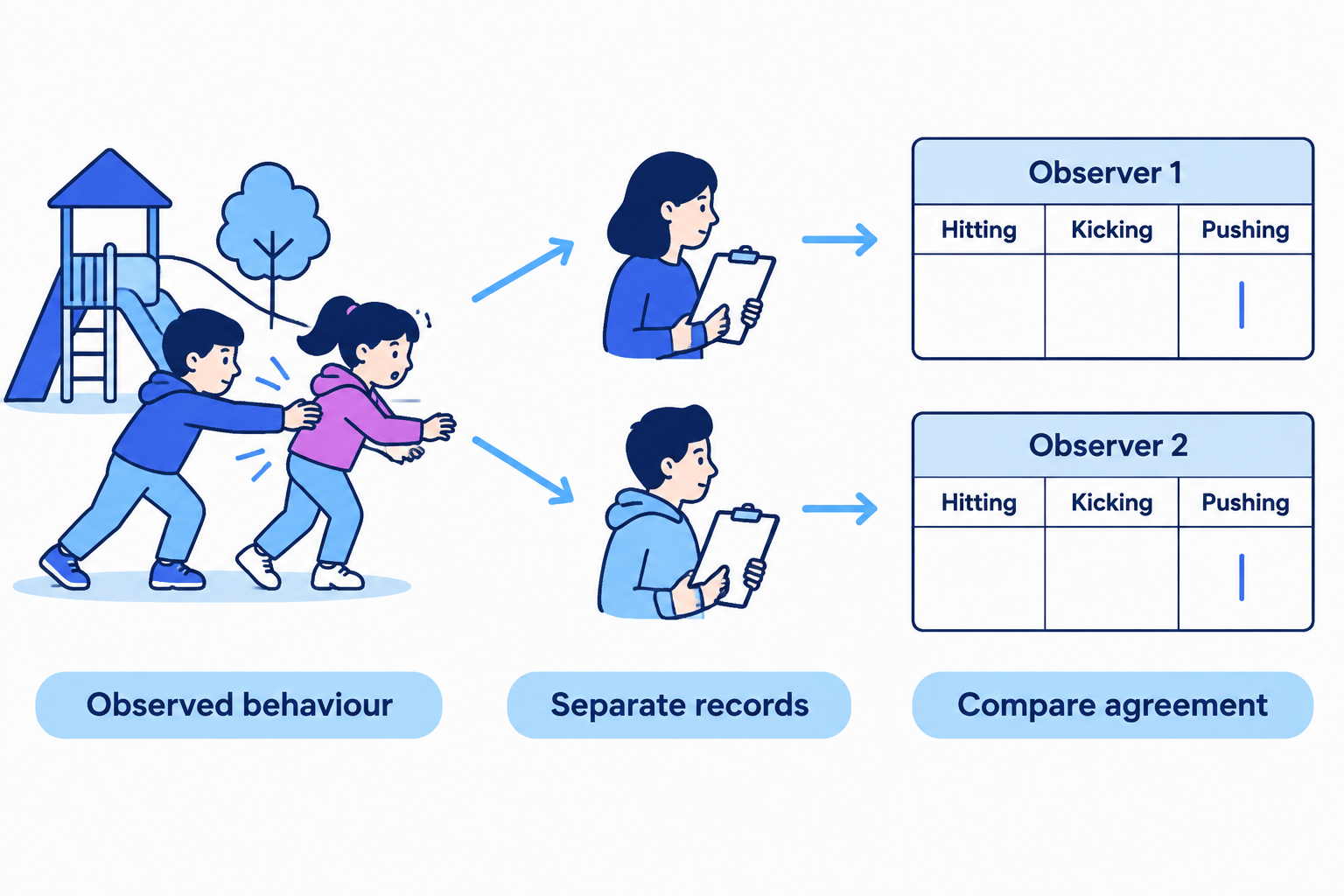
- To study aggression in the playground, your categories might be hitting, kicking and pushing.
- Each time one happens, you add a tally in that column.
Inter-Observer Reliability
- Inter-observer reliability is how far two observers agree on what they record.
- Two observers watch the same behaviour and record it separately.
- If their records closely match, the observation is more reliable.
Common Mistake
- Do not leave categories vague; unclear categories make observers disagree.
- Do not rely on a single observer if you want to check reliability.
Setting Up an Observation
- Decide the exact behaviour to record, such as aggression.
- Write operationalised behavioural categories, so it is clear what does and does not count, and tally each on a checklist.
- Use two observers recording separately to check inter-observer reliability.
Self review
- What is the observation method?
- What are behavioural categories, and why must they be clear?
- What is inter-observer reliability?
- How would you check that two observers agree?