Definition
Independent measures design
An experimental design in which different participants take part in each condition, so each person experiences only one level of the independent variable.
- In an independent measures design different participants take part in each condition.
- Each person meets only one level of the independent variable.
- You then compare the scores of one group against the scores of the other.
Key Idea
- Different people, one condition each.
- Because nobody does both conditions, there are no order effects to worry about.
Strengths and Weaknesses
- Strengths
- There are no order effects, because each person does only one condition.
- People are less likely to guess the aim, as they never see the other condition.
- Weaknesses
- Participant variables may differ between the groups and muddy the results.
- You need more participants than a repeated measures study, as each person is used once.
Example
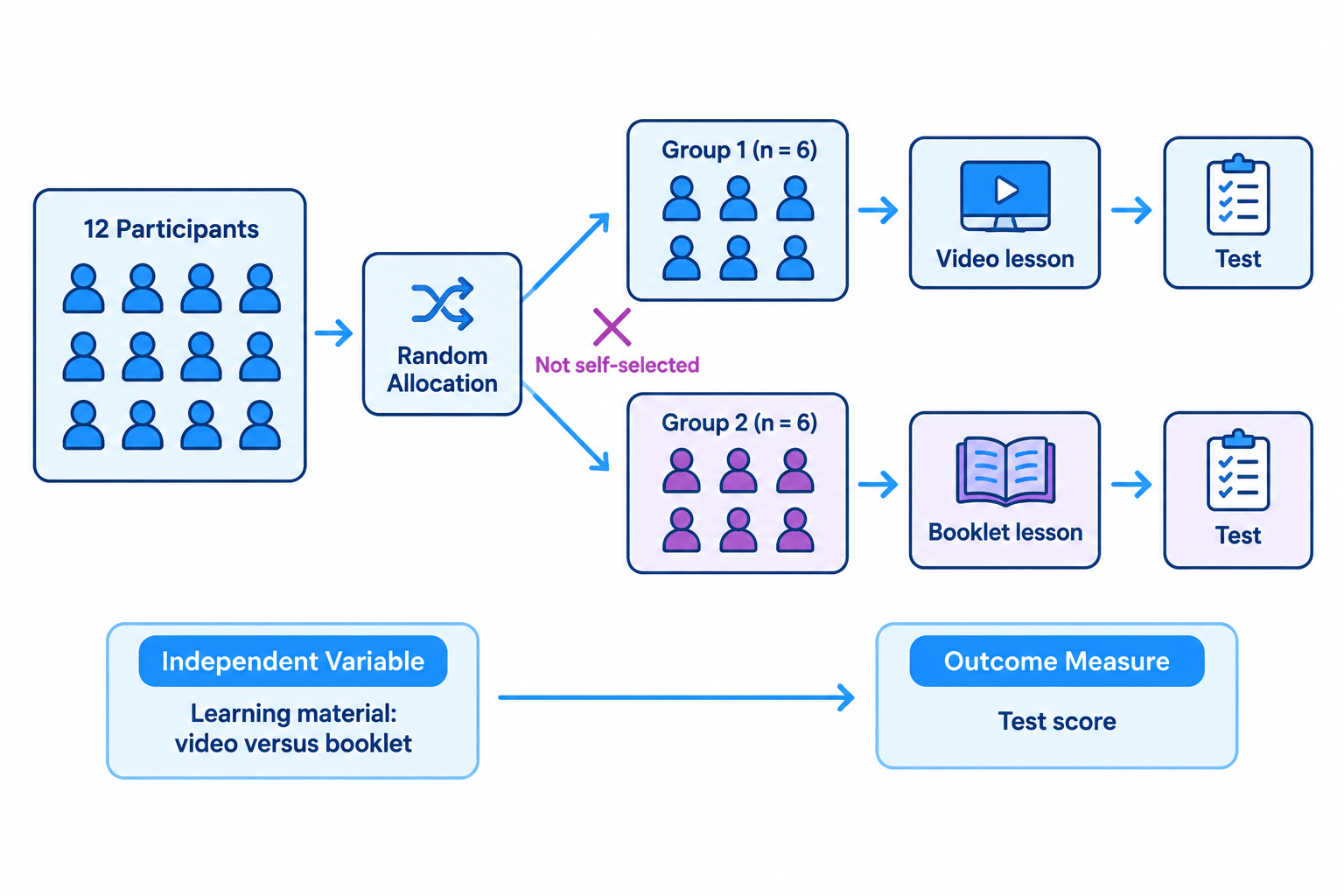
- Say one tutor group learns a topic from a video and another learns it from a booklet.
- If the video group simply happens to contain the stronger students, their higher test scores prove nothing.
- This is the participant-variable problem that random allocation is designed to reduce.
Random Allocation
Definition
Random allocation
Assigning participants to the conditions of an experiment by chance, so that every participant has an equal chance of ending up in each condition.
- Random allocation uses chance to decide which condition each participant goes into.
- You might draw names from a hat or give everyone a random number and split by odd and even.
- Over a decent-sized sample this spreads features like ability and age evenly across the groups.
Common Mistake
- Do not let people pick their own condition, because that is not random and lets bias back in.
- Do not claim random allocation makes the groups identical: it lowers the risk of a lopsided group, it does not remove it.
Using Independent Measures Well
- Choose it when doing both conditions would spoil the second, so order effects rule out repeated measures.
- Control participant variables by random allocation: draw names from a hat or split by odd and even random numbers, not by choice.
- Keep everything but the IV the same across conditions; random allocation reduces a lopsided group but cannot remove it.
Self review
- What is an independent measures design?
- Give one strength and one weakness of independent measures.
- What is random allocation, and what does it control?
- Why does this design avoid order effects?