Definition
Reinforcement
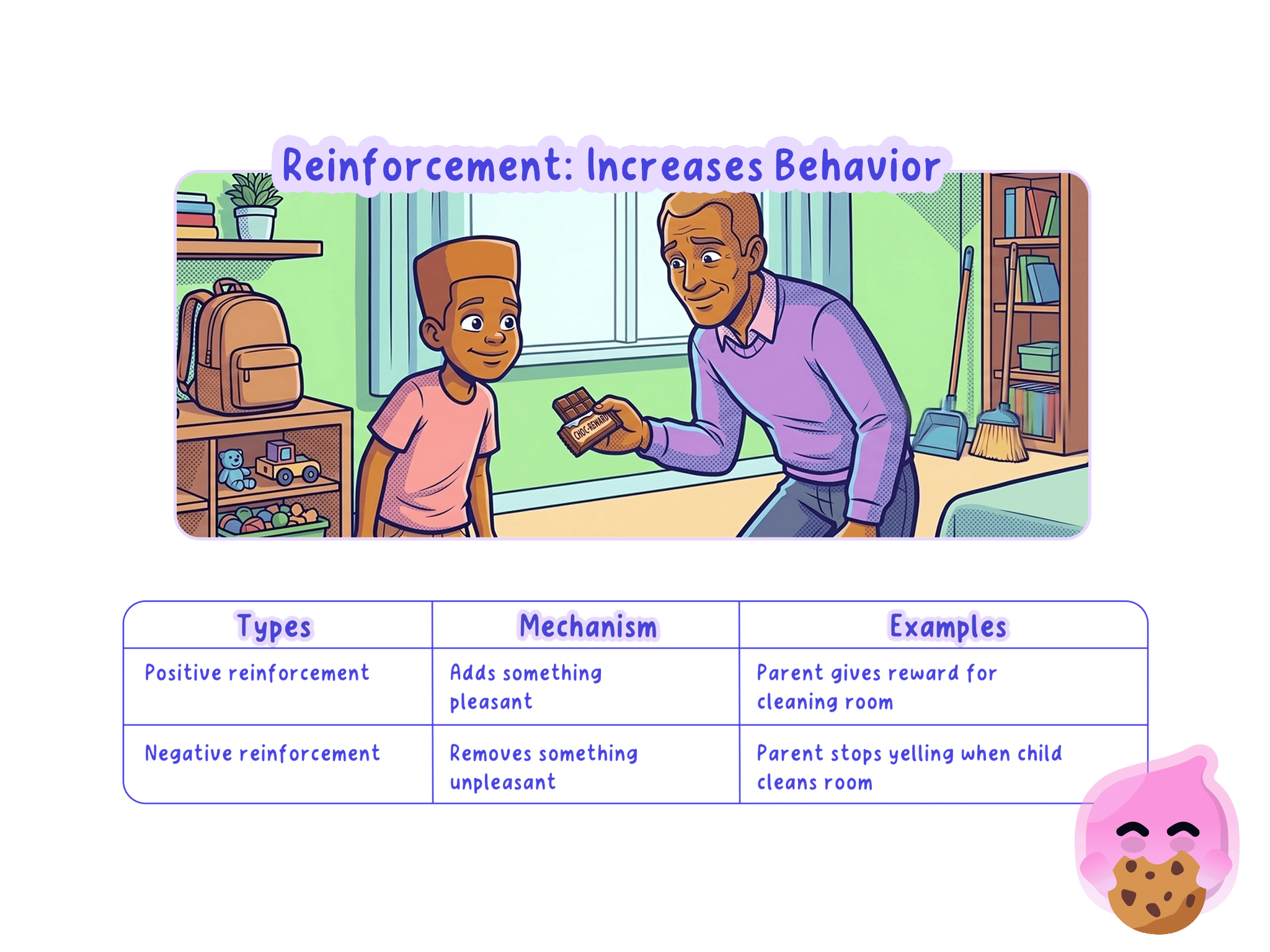
Anything that follows a behaviour and makes that behaviour more likely to happen again. Positive reinforcement adds something pleasant, such as praise, while negative reinforcement removes something unpleasant.
- Positive reinforcement means adding something pleasant straight after a behaviour.
- That pleasant thing acts as a reward, so you link it to what you have just done.
- Because the behaviour felt worth it, you are more likely to repeat it.
Key Idea
- A reward that follows a behaviour strengthens that behaviour.
- Take the reward away and the behaviour usually fades.
The Reward Loop
- First you carry out a behaviour, such as finishing a reading task.
- Then a reward arrives quickly, perhaps a word of praise.
- The sooner the reward comes, the more tightly it ties to the behaviour.
- Run the loop enough times and the behaviour hardens into a habit.
Example
- In a Year 2 classroom, a pupil earns a gold sticker the moment they finish their reading.
- The sticker feels good, so the next day the pupil hurries to finish reading again.
External Rewards and Shaping
- External rewards come from outside you, such as praise, house points, prizes or tokens.
- Shaping means rewarding small steps that lead towards a bigger target behaviour.
- It works like coaching a netball shot: you praise a decent throw first, then only a clean goal, so the skill is built up gradually.
Common Mistake
- Do not confuse positive reinforcement with punishment.
- Positive reinforcement adds something pleasant to increase a behaviour, while punishment adds something unpleasant to stop one.
Explaining It in the Exam
- State that a reward follows the behaviour.
- Explain that this increases how often the behaviour happens.
- Finish with a clear example, and name shaping if the question asks how a behaviour is built up.
Self review
- What is positive reinforcement?
- What effect does a reward have on a behaviour?
- What is shaping?
- Give one everyday example of positive reinforcement.
