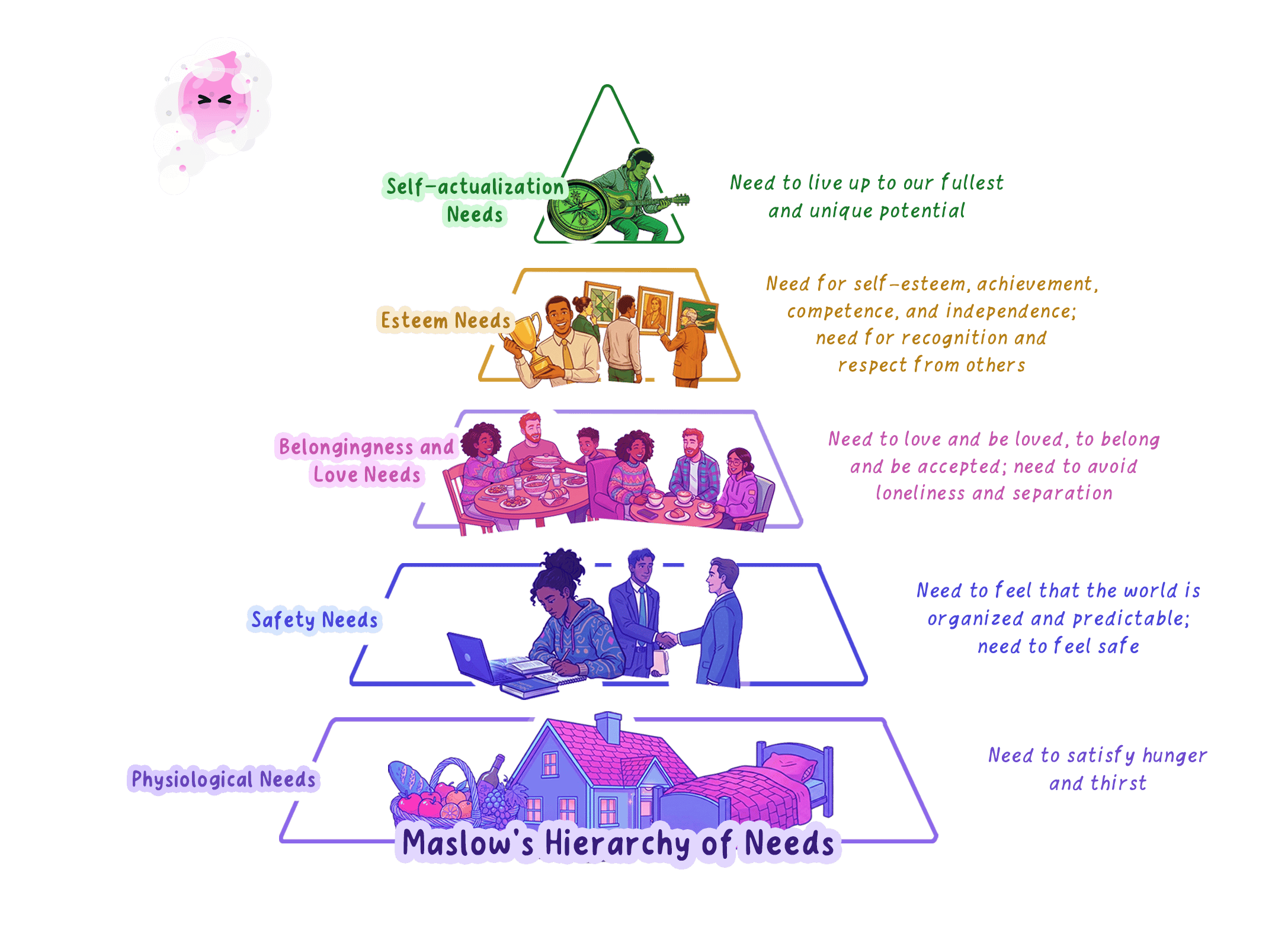
- Maslow's hierarchy of needs arranges human needs as five levels, from basic to advanced.
- You are motivated to satisfy the lowest unmet level before any of the ones above it.
- The four lower levels are deficiency needs; the top level is a growth need.
Key Idea
- Needs are stacked in order, so you work up the levels rather than skipping them.
- A higher need only motivates you once the needs below it are met.
The Five Levels, From the Bottom Up
- Physiological needs
- The base level: food, water, warmth and sleep to keep the body alive.
- Safety needs
- Feeling secure, with shelter, stability and freedom from danger.
- Love and belonging needs
- Friendship, family and feeling accepted by a group.
- Esteem needs
- Respect from others and self-respect, feeling capable and valued.
- Self-actualisation
- The top level: reaching your full potential and becoming all you can be.
Example
- Picture a Year 11 student the night before a GCSE exam who has skipped dinner.
- Hunger, a physiological need, keeps hijacking their attention, so revising for the grade barely happens.
- Feed them first and the higher esteem need to do well can finally take over.
Deficiency Needs Versus the Growth Need
- The lower four levels are deficiency needs, because they motivate you only when something is missing.
- Meet a deficiency need and the motivation coming from it switches off.
- Self-actualisation is a growth need, so it keeps drawing you on even after it is partly reached.
Common Mistake
- Do not imagine you climb the hierarchy once and then stay at the top.
- If a lower need returns, such as going hungry, your attention drops straight back down to it.
How the Hierarchy Explains Motivation
- The hierarchy predicts which need will drive your behaviour at any moment.
- It is always the lowest level that is not yet satisfied.
Self review
- List Maslow's five levels from bottom to top.
- What is a deficiency need?
- What is self-actualisation?
- Why must lower needs be met before higher ones?
