Two Kinds of Motivation
- Motivation splits into two types depending on where the reward comes from.
- If the reward comes from outside you, the motivation is extrinsic.
- If the reward comes from inside you, the motivation is intrinsic.
- This split runs through the rest of the topic, so it is worth fixing now.
Key Idea
- Extrinsic motivation is powered by an outside reward such as pay or a prize.
- Intrinsic motivation is powered by the enjoyment or satisfaction the activity itself gives you.
Extrinsic Motivation
- Extrinsic motivation drives you to act for a benefit that comes from outside the activity.
- That benefit might be money, a grade, a trophy or praise from someone else.
- The activity is only a means to the reward, not the reward itself.
Intrinsic Motivation
- Intrinsic motivation drives you to act for the enjoyment or satisfaction the activity itself brings.
- There is no outside prize; the good feeling is the whole point.
- A sense of belonging or personal pride can make a task intrinsically motivating too.
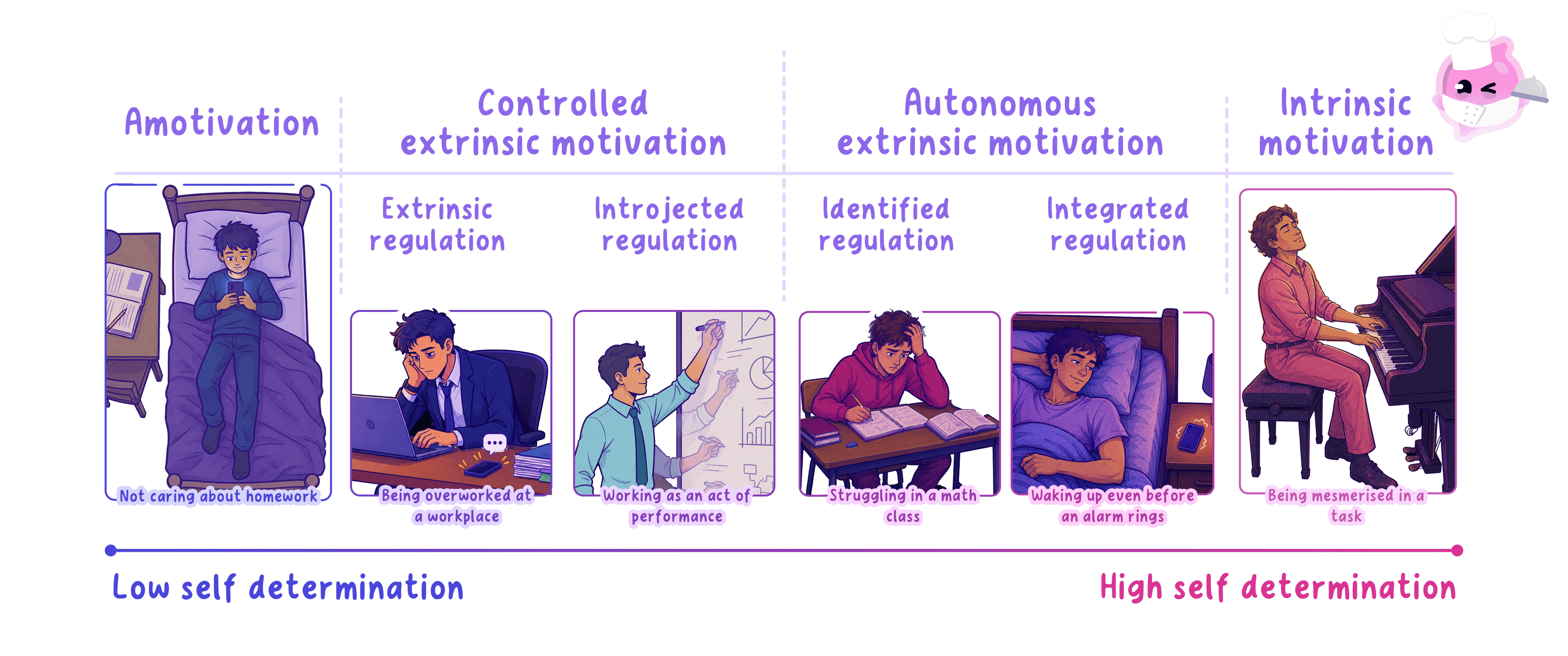
Example
- You take on a paper round because it pays £20 a week, which is extrinsic motivation.
- You play five-a-side football every Sunday because you love the game, which is intrinsic motivation.
- Same effort, but one is chased for the money and the other for the enjoyment.
Classifying an Example
- First, find the reward the behaviour is aimed at.
- If that reward comes from outside the person, label it extrinsic.
- If it comes from inside the person, label it intrinsic.
Common Mistake
- Do not assume a task is fixed as one type for everyone.
- The same action can be extrinsic for one person and intrinsic for another.
- Judge it by where that person's reward comes from, not by the activity alone.
The Distinction in Later Theories
- Later theories ask whether behaviour is driven from outside or from inside.
- Spotting extrinsic and intrinsic motivation quickly will make those theories easier to follow.
Self review
- What is extrinsic motivation?
- What is intrinsic motivation?
- Give one everyday example of each type.
- What question do you ask to classify an example?
