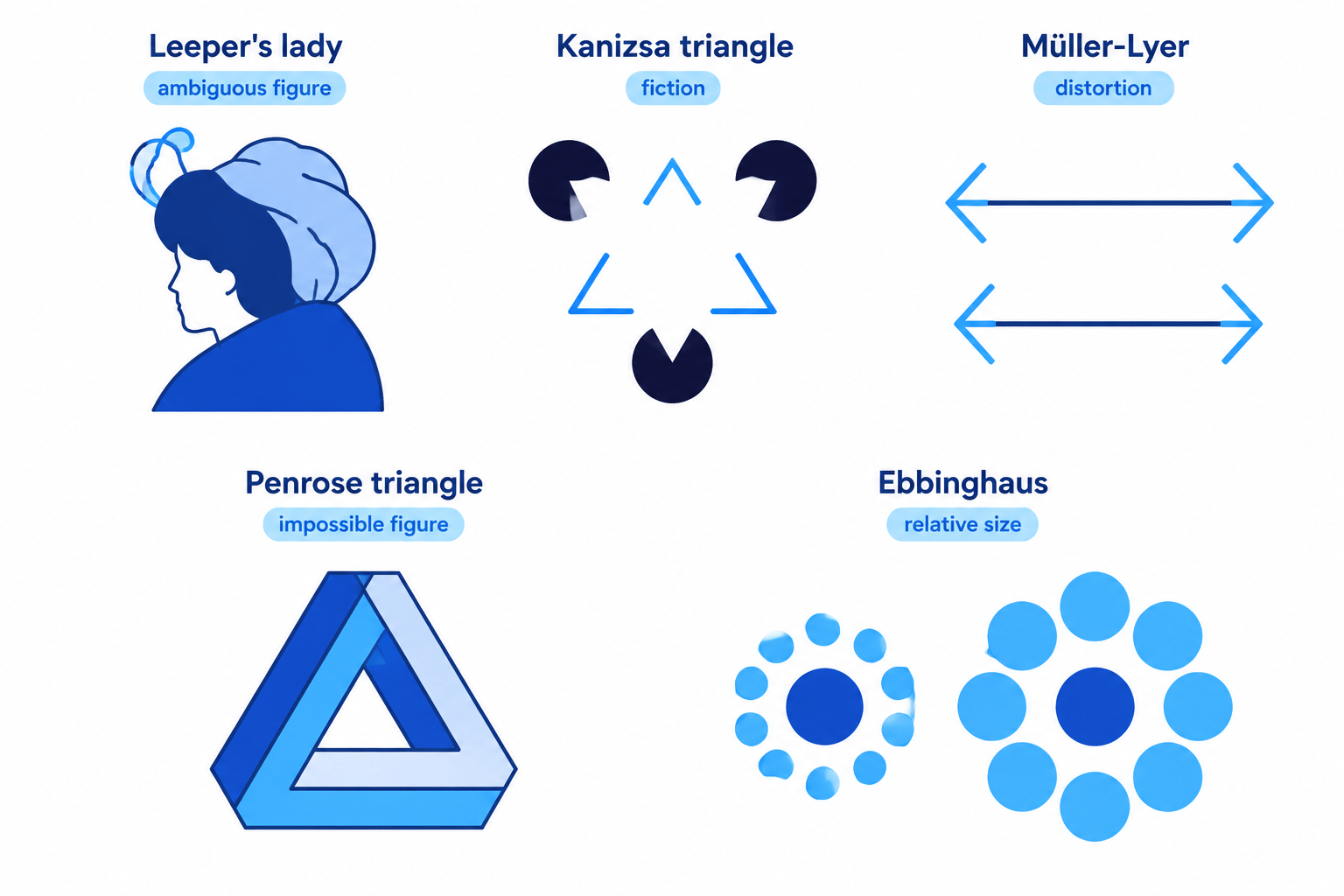
Five Kinds of 2D Illusion
Definition
Visual illusion
A perception that does not match the physical reality in front of you, so you reliably see size, shape, depth or an edge that is not actually there.
- A visual illusion is any case where what you perceive does not match the physical reality in front of you.
- You need to know five types of 2D illusion, each with one named example.
- Learn each one as a pair: the type, and the single illusion the syllabus links to it.
Key Idea
- The type tells you what goes wrong; the named example is the illusion that shows it.
- In every case the image itself is fixed, so the mismatch is created by your brain, not the page.
The Five Types and Their Named Examples
- Ambiguous figures - Leeper's lady
- One image can be seen in two equally valid ways, so perception flips between them; Leeper's lady can be read as a young woman or an old woman.
- Fictions - Kanizsa triangle
- You see a shape or edges that are not physically there; three notched circles make you see a bright white triangle whose sides are never drawn.
- Distortions - Müller-Lyer
- You recognise the figure but misjudge one of its features; two equal lines look unequal because one has outward fins and the other inward arrowheads.
- Impossible figures - Penrose triangle
- A figure is drawn so it looks like a solid 3D object, yet it could never actually exist; the Penrose triangle seems to join up impossibly.
- Relative size - Ebbinghaus
- An object's size is misjudged because of what surrounds it; the same central circle looks larger ringed by small circles and smaller ringed by large ones.
Example
- Show a friend two central circles of exactly the same size, one ringed by tiny circles and one by big circles.
- They will insist the one among the tiny circles is bigger, which is the Ebbinghaus relative-size illusion at work.
Classifying an Illusion in the Exam
- Name the illusion and say what the viewer actually perceives.
- Put it in its type: ambiguous figure, fiction, distortion, impossible figure or relative size.
- Pair each type with its named example, since a question may give you the type and ask for the example or the other way round.
Self review
- Which named illusion is an ambiguous figure?
- What does the Müller-Lyer illusion make you misjudge, and what type is it?
- Which type is the Penrose triangle, and why?
- Which illusion shows relative size, and how does it work?