Definition
Perception
The brain's process of organising and interpreting sensory information so that it becomes a meaningful experience, such as recognising a face or judging a distance.
- Perception is your brain's interpretation of the sensory input it receives.
- It organises scattered raw signals into a single, meaningful experience.
- That is the step that turns patterns of light into a face you recognise or a gap you can safely step into.
Key Idea
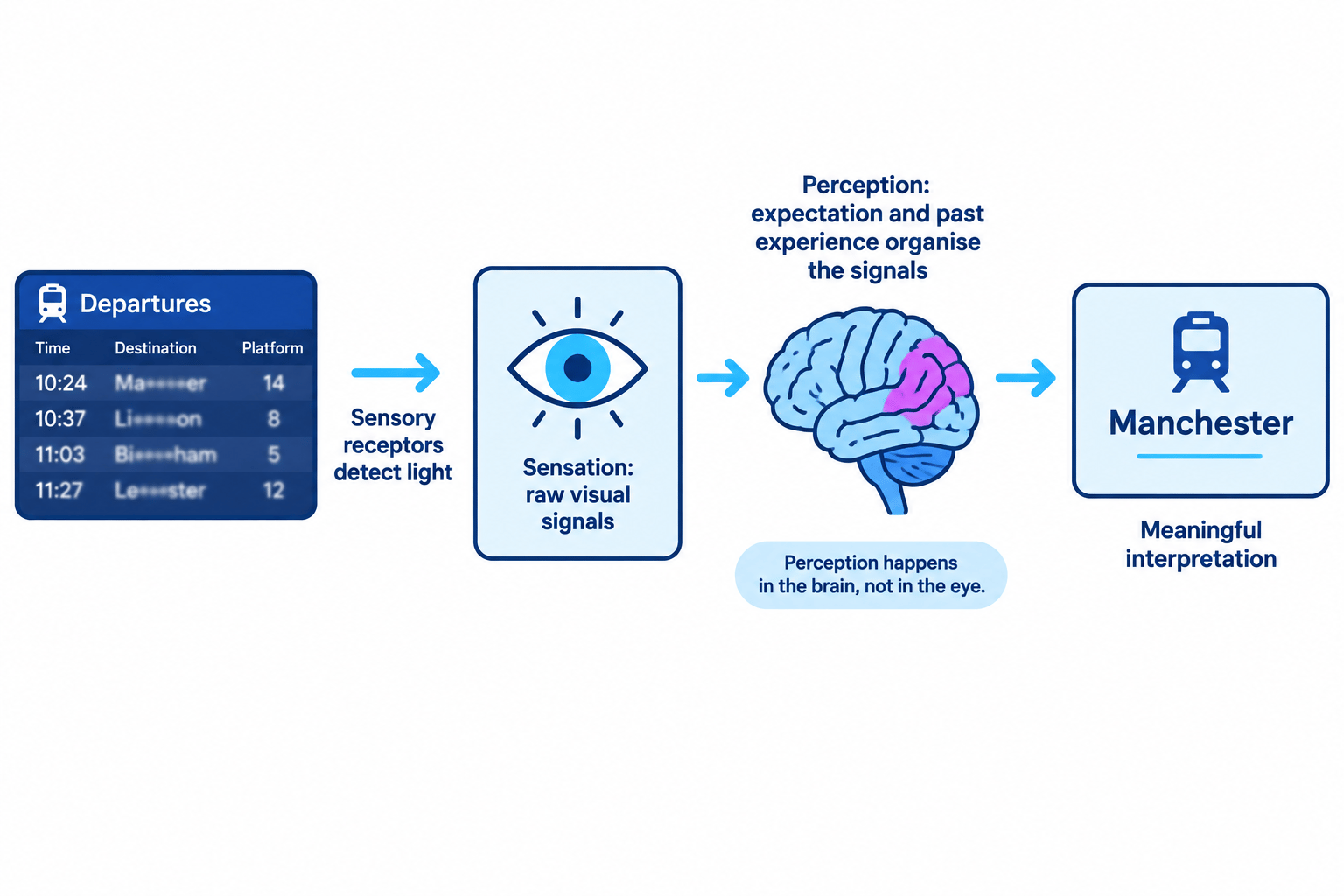
- Perception happens in the brain, not in the sense organs.
- It adds meaning to input rather than simply recording it.
Sensation and Perception
- Sensation is the raw detection of stimulus energy by your receptors.
- Perception is the meaning your brain builds from that detected input.
- Because interpretation is a separate step, the same sensation can be perceived in more than one way.
Example
- You glance up at a blurry departures board at a busy train station.
- The light hitting your eye is the sensation.
- Reading Manchester before every letter is sharp is perception, because your brain uses expectation to fill in the gaps.
Why Perception Varies Between People
- Your brain does not interpret input from scratch each time; it draws on past experience and expectation.
- Two people bring different experiences, so they can read the same input in different ways.
- This is exactly why perception is more than passive sensing.
Common Mistake
- Do not use sensation and perception as if they mean the same thing; one is detection, the other is interpretation.
- Do not say perception simply records the input; it actively adds meaning to it.
Comparing Sensation and Perception in the Exam
- Define both terms, then make the contrast explicit: detection versus interpretation.
- The mark students miss is the link, so state that sensation must happen first and perception acts on its output.
Self review
- What is perception?
- How does perception differ from sensation?
- Where in the body does perception take place?
- Why can two people perceive the same scene differently?