Social Identity Theory
- Social identity theory, developed by Tajfel and Turner, explains how group membership shapes the way you treat people.
- It says you gain self-esteem from the groups you belong to.
- To protect that self-esteem, you end up favouring your own group over others.
Key Idea
- The theory has three stages: social categorisation, social identification and social comparison.
- Together they explain why you favour your in-group over the out-group.
The Three Stages
- Social categorisation is the first stage, where you sort yourself and others into groups such as your school and other schools.
- Social identification is the second stage, where you take on the identity of a group you have joined and start to act like its members.
- Social comparison is the third stage, where you weigh up your group against others and look for ways your group comes out on top.
- Because a favourable comparison makes your group look good, it lifts your own self-esteem.
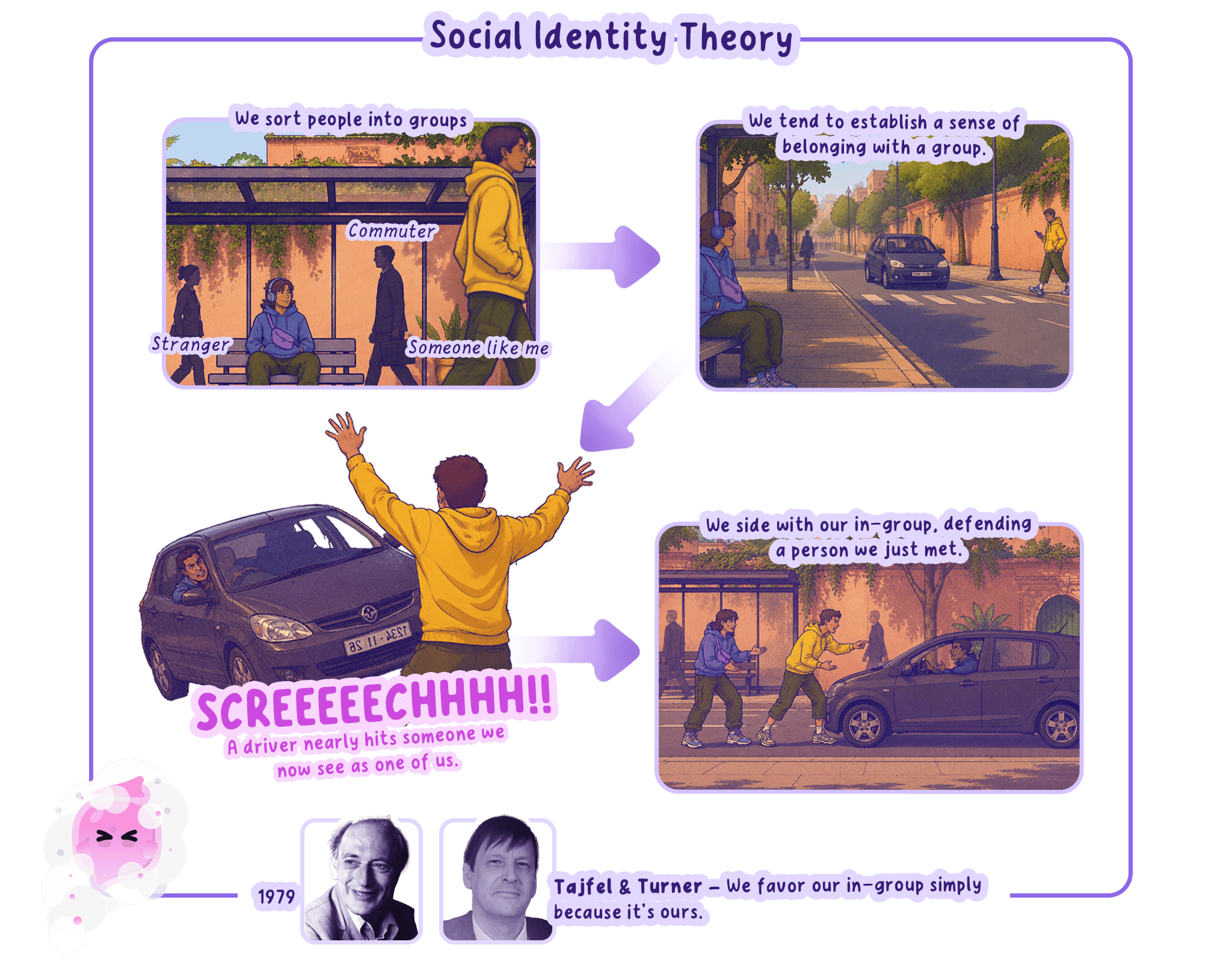
Example
- A netball player splits the world into her own club and rival clubs, sees herself as part of her club, then rates it above a team they have just beaten.
- Coming out on top in that comparison is what lifts her self-esteem.
In-groups, Out-groups and Self-esteem
Definition
In-group
A group you see yourself as belonging to, whose members you tend to favour and are more willing to help.
- Your in-group is any group you see yourself as belonging to.
- An out-group is any group you see yourself as outside of.
- To keep your self-esteem high, you talk up the in-group and play down the out-group.
- This bias in favour of your own group is called in-group favouritism.
Common Mistake
- Do not muddle the three stages; learn them in the order categorisation, identification, comparison.
- Remember the payoff is self-esteem, which is what drives the favouritism.
Explaining the Theory
- Name the three stages in order, categorisation, identification then comparison, and say what happens at each, since each stage is a separate mark.
- Define in-group and out-group.
- Explain how the drive for self-esteem leads to group favouritism.
Self review
- Name the three stages of social identity theory in order.
- What is an in-group and what is an out-group?
- Why does favouring your group raise your self-esteem?
- What is in-group favouritism?
