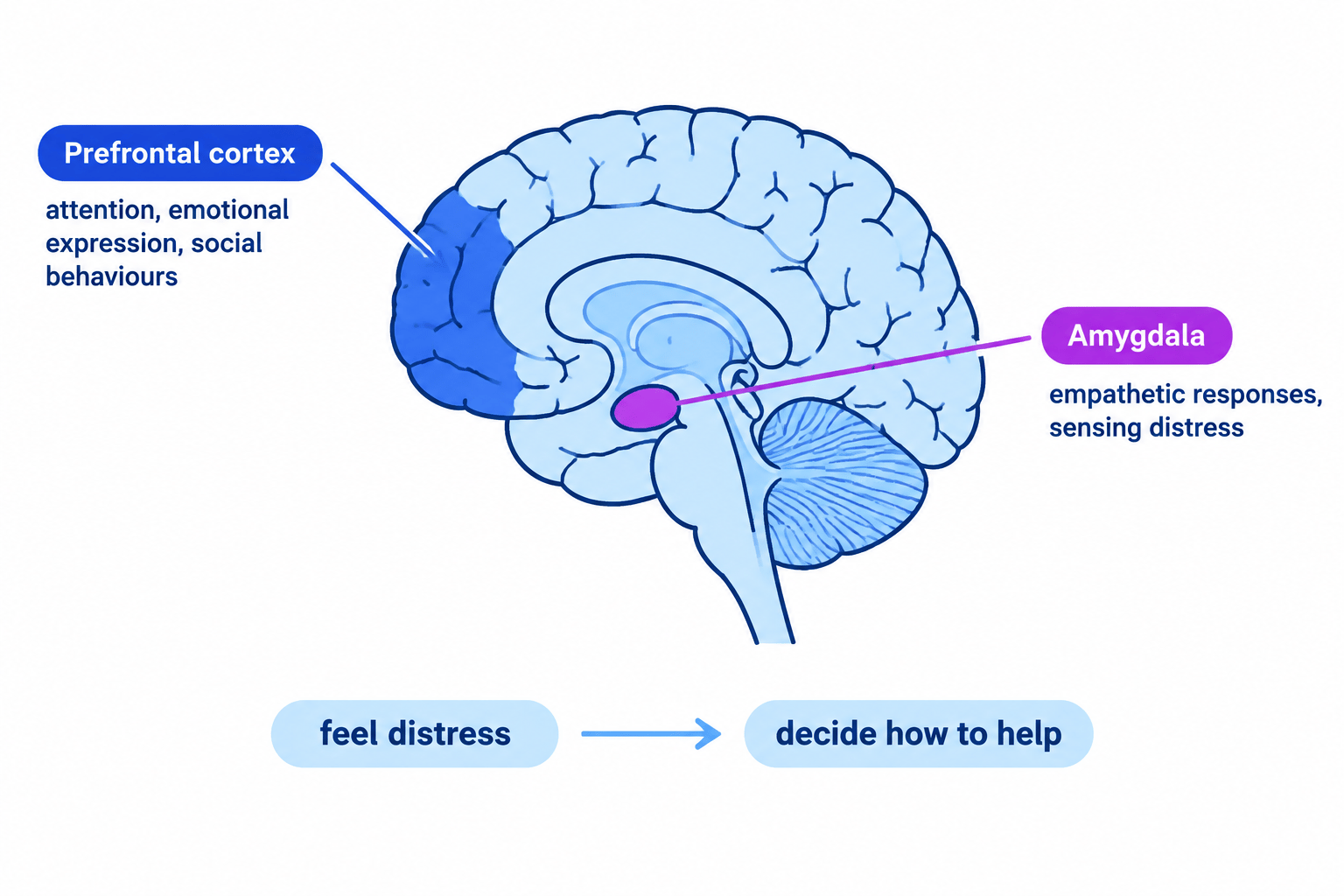
The Prefrontal Cortex and Amygdala
- Two brain areas matter most for prosocial behaviour.
- They are the prefrontal cortex and the amygdala.
- Each plays a different part in turning a feeling into a helping act.
Key Idea
- The amygdala helps you feel another person's distress.
- The prefrontal cortex then helps you decide what to do about it.
Where Each Area Is and What It Does
- The prefrontal cortex
- It sits at the front of the brain, just behind your forehead, as part of the cerebral cortex.
- It handles attention, emotional expression and social behaviours, so it lets you plan and control how you help.
- The amygdala
- It sits deep inside the brain as part of the emotional system.
- It is active during empathetic responses, so it lets you pick up and share what someone else is feeling.
Example
- You spot someone crying alone at a bus stop, and your amygdala fires as you feel their upset.
- Your prefrontal cortex then works out the socially right move, so you go over and ask if they are okay.
How These Areas Support the Biological Explanation
- Helping draws on both areas at once: the amygdala lets you feel another person's distress, and the prefrontal cortex guides what you do about it.
- The prefrontal cortex handles attention, emotional expression and social behaviours, so it turns that felt empathy into a considered, socially appropriate act of help.
- Because helping depends on activity in these specific brain areas, it has a physical basis in the brain, which is exactly what the biological explanation claims.
Common Mistake
- Do not swap the two around, because it costs an easy mark.
- Remember the amygdala for empathy and the prefrontal cortex for attention, emotional expression and social behaviours.
Linking an Area to Helping in an Answer
- Name the area with its exact function, the amygdala for empathetic responses or the prefrontal cortex for attention, emotional expression and social behaviours, since a vague "it helps" wins nothing.
- Then link that function to helping, such as the amygdala driving the empathy that gets you to act.
- The mark students drop is the link, so never leave the function floating without tying it to helping.
Self review
- What does the prefrontal cortex do, and where is it?
- What is the amygdala active in?
- How do these two areas work together to produce a helping act?
- How do these two areas give helping a physical basis in the brain?