How Sleep Changes With Age
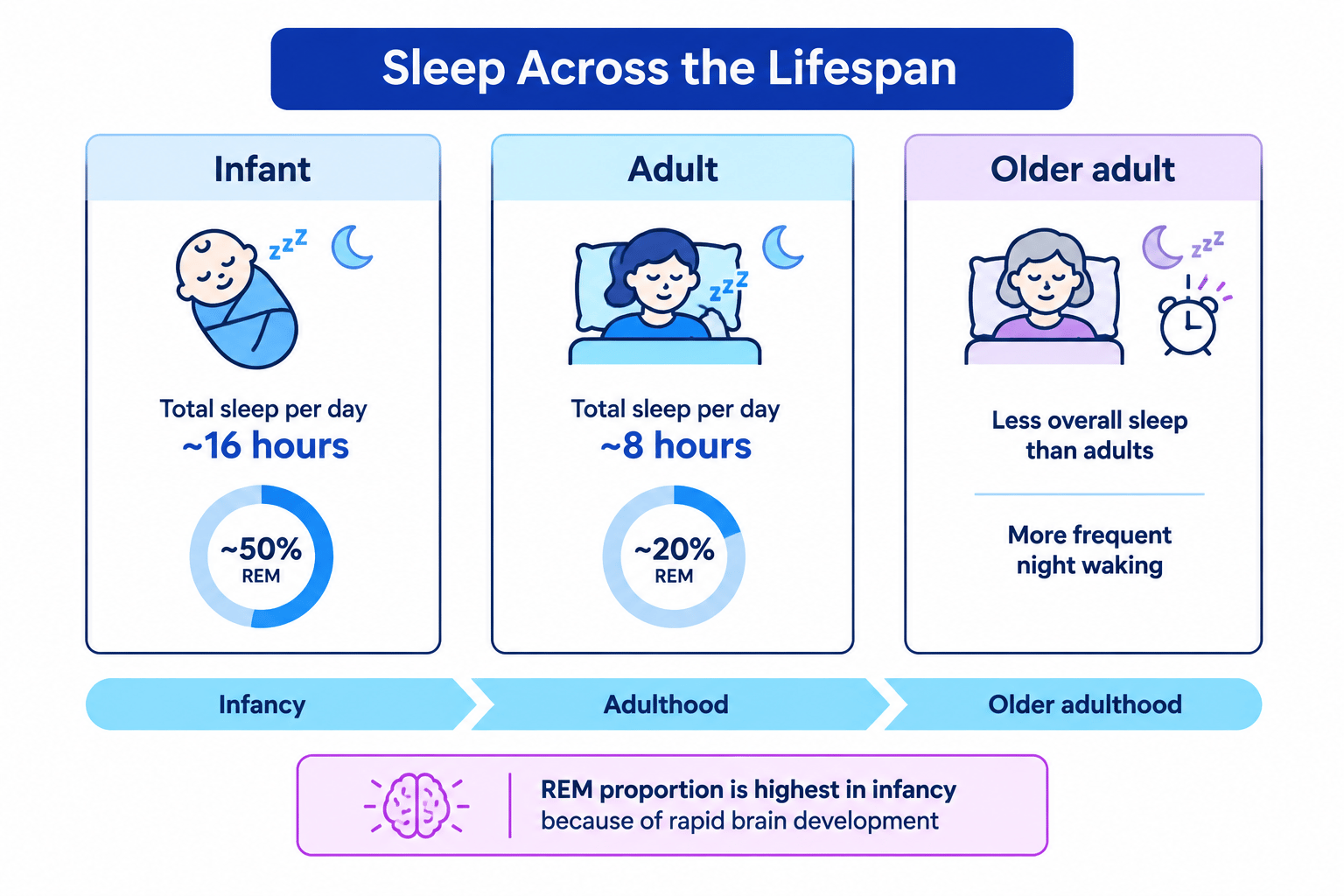
- Your sleep changes across life, both in amount and in type.
- Both how long you sleep and how much of it is REM shift as you grow older.
- The sharpest change is in the share of sleep spent in REM.
Key Idea
- Infants spend a far higher proportion of sleep in REM than adults do.
- Total sleep also falls steadily from infancy through to old age.
Infants, Adults and Older Adults
- Infants
- Sleep for around sixteen hours a day, with roughly half of it spent in REM sleep.
- Adults
- Sleep for about eight hours, with only around a fifth of it in REM.
- Older adults
- Often sleep less overall and wake more often during the night.
Example
- A newborn in a Moses basket may sleep around sixteen hours a day, much of it in active, twitchy REM sleep.
- Their parent, by contrast, sleeps far less and spends proportionally less of the night in REM.
Why the Ratio Shifts
- Infants have so much REM because their brains are growing and wiring up at speed.
- As the brain matures, less REM sleep is needed, so its share falls.
- This fits the idea that REM sleep supports brain development, not just daily recovery.
Common Mistake
- It is the REM proportion that is higher in infancy, not the total; do not say adults get more REM.
- If the item says explain, add why infant REM is so high: rapid brain development.
Describing the Pattern
- State that total sleep falls with age, about sixteen hours in infancy to about eight in adults; the figures earn the mark.
- State the REM proportion is highest in infancy, about half, against roughly a fifth in adults.
- Link that high infant REM to rapid brain development, which lifts a Describe into an Explain.
Self review
- How does total sleep change from infancy to adulthood?
- Who has a higher proportion of REM sleep, infants or adults?
- Why might infants need so much REM sleep?
- How does sleep often change in older adults?