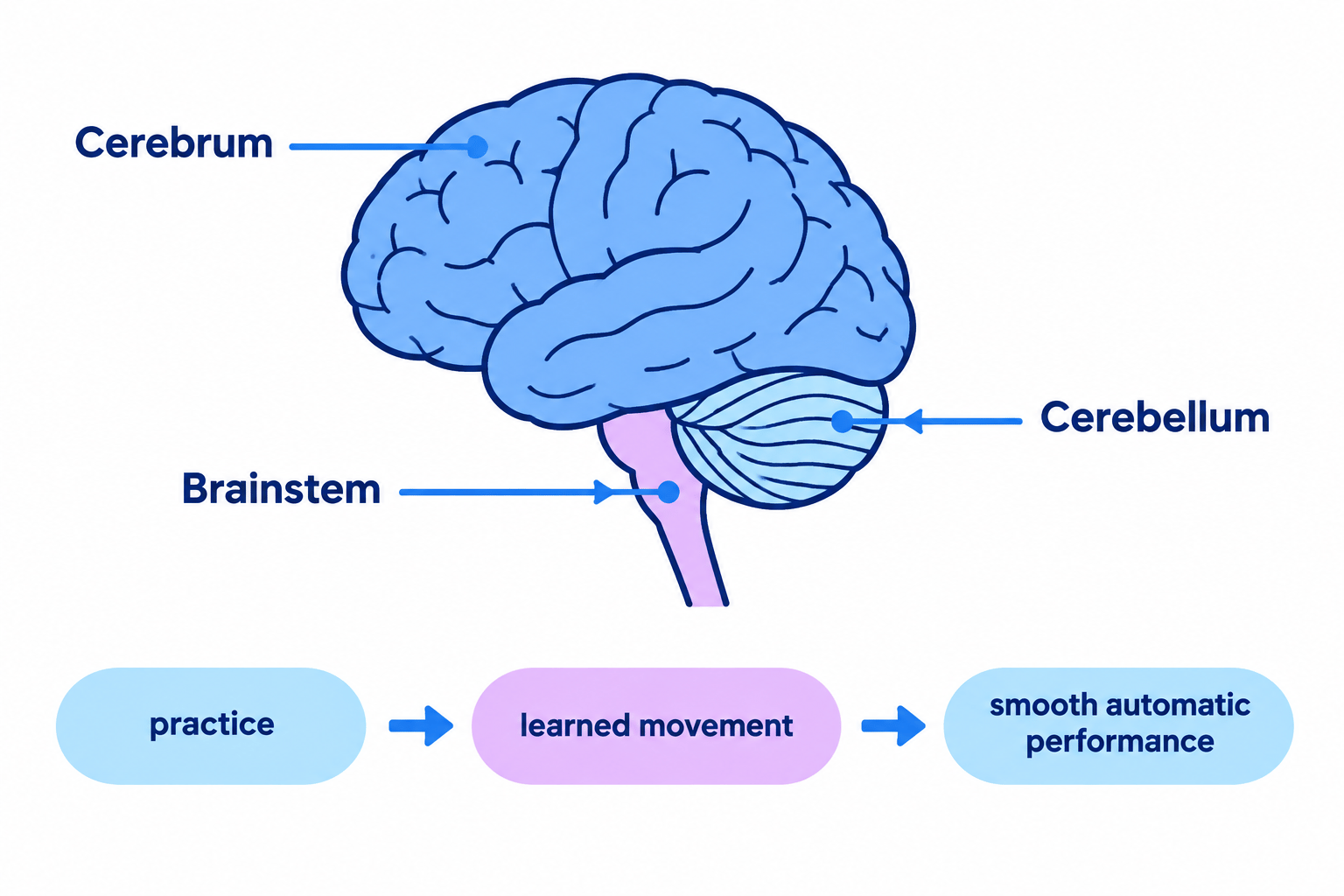
The Cerebellum
Definition
Cerebellum
A structure at the back of the brain, part of the hindbrain, involved in balance, posture and the coordination of movement.
- The cerebellum sits at the back of the brain, below the larger cerebrum.
- It is best known for balance and smooth, coordinated movement.
- It also stores procedural memory, the memory for how to do things.
Key Idea
- The cerebellum is linked to skills and habits, not to facts.
- Facts and events rely on other areas, such as the hippocampus.
Its Role in Procedural Memory
- Procedural memory is the memory for actions you can carry out.
- The cerebellum helps store these learned movements as you practise them.
- Once stored, a well-practised skill can be performed smoothly without conscious thought.
Example
- Think of riding a bike along a canal towpath, or buttering toast without looking.
- You do not talk yourself through each step, because the cerebellum runs the skill automatically.
Skills, Not Facts
- The cerebellum handles how to do things, not what you know.
- So if it is damaged, learned skills turn clumsy while memory for facts and events stays intact.
Common Mistake
- The cerebellum deals with skills, not facts, so do not tie it to memory for information.
- Keep the cerebellum separate from the cerebrum, the large outer part of the brain.
Using the Idea in the Exam
- Link the cerebellum to procedural, skill-based memory and to balance and coordination, not to memory for facts.
- In a scenario, name the exact skill the person can still perform while memory for facts fails, since that procedural-versus-declarative contrast is the mark and quoting the skill is a separate application mark.
Self review
- What kind of memory is the cerebellum linked to?
- Give two examples of procedural memories.
- Besides memory, what movement functions is the cerebellum involved in?
- Why might memory for facts be unaffected by cerebellum damage?