Memory as Three Stores in a One-Way Flow
Definition
Multi-store model
An early model of memory that describes three separate stores, the sensory register, short-term memory and long-term memory, with information passing between them through attention and rehearsal.
- Memory is not a single box, because information flows through three separate stores one after another.
- The three stores are the sensory register, short-term memory and long-term memory.
- Atkinson and Shiffrin set this model out, with information passing along in one direction.
Key Idea
- Information moves one way: from the senses, to short-term memory, to long-term memory.
- It only moves on if you act on it, by paying attention and then rehearsing it.
The Three Stores
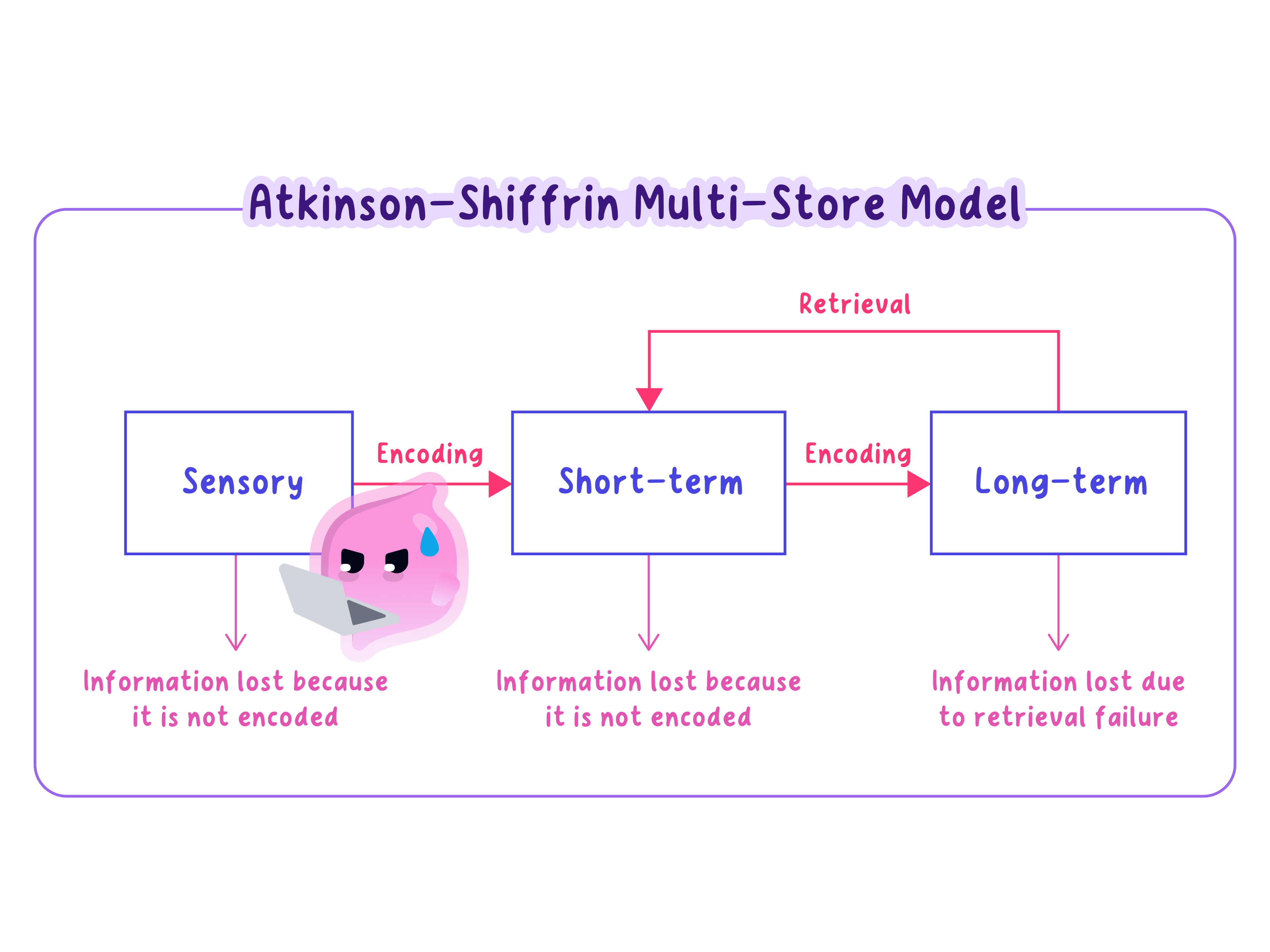
- Sensory register: a split-second snapshot of everything your senses take in, gone almost at once.
- Short-term memory: the handful of things you are holding in mind right now, your mental workspace.
- Long-term memory: the huge, lasting store, your archive of everything you have saved.
Example
- A friend reads out their number in the corridor, and you hold it just long enough to tap it into your phone.
- It reached short-term memory, but because you never rehearsed it, it never made it into long-term memory.
Moving Information On
Definition
Rehearsal
Repeating or actively thinking about information so that it passes from short-term memory into long-term memory.
- Paying attention pulls a snapshot from the sensory register into short-term memory.
- Rehearsing it, by repeating it or thinking it over, moves it into long-term memory.
- Do neither, and it simply drops out at the next stage.
- Your phone works the same way: the camera briefly sees everything, the screen shows what you are using now, and only what you save is kept.
Common Mistake
- Do not assume everything you see or hear gets remembered, because almost all of it fades from the sensory register in an instant.
- Nothing reaches long-term memory on its own, so if you do not rehearse it, it will not stick.
Drawing and Explaining the Model
- For a "describe the multi-store model" item, name all three stores in order: sensory register, short-term, long-term.
- Name each transfer as its own point: attention moves information from the sensory register to short-term memory, and rehearsal moves it from short-term to long-term memory.
- Add that ignored information is lost, to show the flow is not automatic, but keep to the what, since a describe item gives nothing for evaluation it did not ask for.
Self review
- What are the three stores of the multi-store model, in order?
- What moves information from the sensory register into short-term memory?
- What moves information from short-term into long-term memory?
- Why does most of what your senses take in never get remembered?
