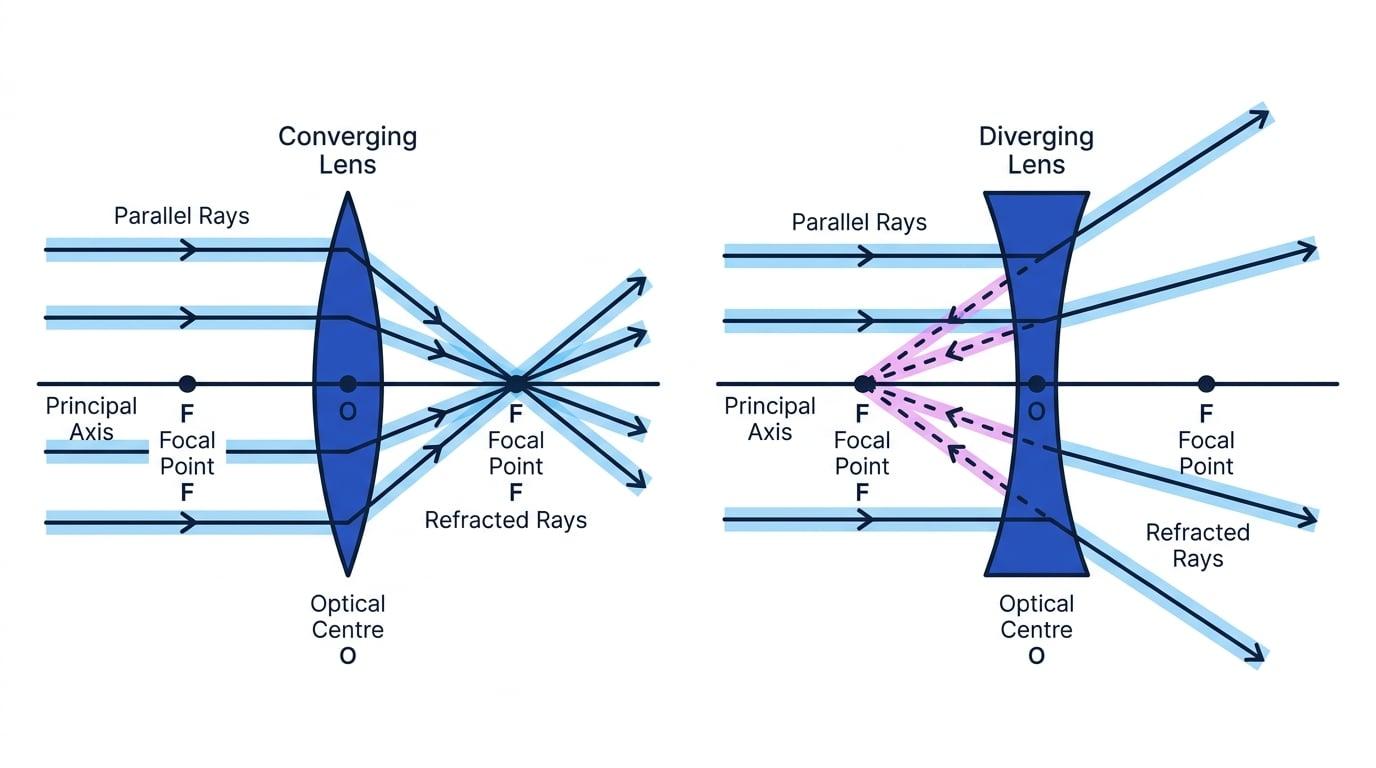
A lens bends light by refracting it at each of its two surfaces
Definition
Principal axis
The straight line that passes through the centre of a lens at right angles to both of its surfaces.
- A lens is a shaped piece of glass or clear plastic with at least one curved surface.
- Light is refracted as it crosses the boundary from air into the glass and refracted again as it leaves, so a lens steers light by refraction and not by reflection.
- In a thin lens the glass is so much thinner than the distances the rays travel that you can treat all of the bending as happening at one line drawn straight down the middle of the lens.
- The middle of that line is the centre of the lens, and every distance you quote for a lens is measured from it.
- Rays described as parallel to the principal axis run alongside that line and stay parallel to one another until they reach the glass.
- A ray travelling exactly along the principal axis strikes both surfaces head on, so it passes straight through without changing direction.
A converging lens brings a parallel beam together at a single point
Definition
Converging lens
A lens that is thicker at its centre than at its edges and refracts a parallel beam of light so that the rays come together at a point.
- A converging lens is fatter in the middle than at its rim, which is why it is also called a convex lens.
- Every ray of a beam that is parallel to the principal axis is refracted towards the axis as it passes through the lens.
- A ray entering near the rim meets a steeply sloping surface and is bent through a large angle, a ray entering close to the axis meets an almost flat surface and is barely bent at all, and the amounts are graded so that all of the rays cross the axis in the same place.
- That place is the principal focus, and real light energy arrives there, so the spot is genuinely bright and can be caught on a screen.
- Hold a hand lens in bright sunlight and you see this as a tiny dazzling dot on a sheet of paper, hot enough to scorch it.
A diverging lens spreads a parallel beam out, so nothing meets on the far side
Definition
Diverging lens
A lens that is thinner at its centre than at its edges and refracts a parallel beam of light so that the rays spread apart.
- A diverging lens is thinner in the middle than at its rim and is also called a concave lens.
- Each ray of a beam parallel to the principal axis is refracted away from the axis, so the beam leaves the lens wider than it arrived.
- The outgoing rays are diverging, so they never cross, and there is nowhere behind the lens where a screen picks up a bright dot.
- Extend the outgoing rays backwards as straight dashed lines and they all meet at one point, on the same side of the lens as the incoming beam.
- That point is the principal focus of a diverging lens, and it is called virtual because no light actually passes through it and the rays only appear to diverge from it.
- Fit a diverging lens in front of a torch and its beam is spread over a wider area instead of being concentrated.
The principal focus belongs to the lens and always sits on the principal axis
Definition
Principal focus
The point on the principal axis at which rays parallel to that axis converge after passing through a converging lens, or from which they appear to diverge after passing through a diverging lens.
- The principal focus is also called the focal point, and on diagrams it is labelled FFF.
- For a converging lens, FFF lies on the far side of the lens from the incoming parallel beam, and the light really does travel through it.
- For a diverging lens, FFF lies on the same side as the incoming beam, because only the backward extensions of the rays reach it.
- The position of FFF is fixed by the shape and the material of the lens, so it does not shift when you move a lamp or an object about in front of the lens.
- Nothing has to be placed at the principal focus for it to exist, since it is defined purely by what the lens does to a parallel beam.
A fatter lens bends light more, so its focal length is shorter
Definition
Focal length
The distance from the centre of a lens to its principal focus, measured along the principal axis.
- Focal length is given the symbol fff, and because it is a distance you quote it in units such as cm\text{cm}cm or m\text{m}m.
- Start the measurement at the centre of the lens, not at the front or back face of the glass, and finish it at the principal focus.
- A strongly curved, fat lens refracts each ray through a large angle, so the rays cross close to the lens and fff is short.
- A gently curved, nearly flat lens changes each ray's direction only slightly, so the rays run a long way before they cross and fff is long.
- A chunky hand lens may have a focal length of about 5 cm5\ \text{cm}5 cm, while a nearly flat lens of the same width may have one of 50 cm50\ \text{cm}50 cm or more.
- A diverging lens has a focal length in exactly the same way, measured from the centre of the lens to its virtual principal focus, and one with more steeply curved surfaces again has a shorter fff.
Light from a distant object arrives almost parallel and focuses on the focal plane
- Light spreads out from every point of an object, but by the time it has crossed several metres to reach a small lens the rays that get there are very nearly parallel.
- A converging lens therefore brings light from a distant window or streetlamp to a sharp focus almost exactly one focal length behind it.
- Light from a distant object off to one side arrives as a parallel beam that is tilted to the principal axis, and it focuses the same distance from the lens but above or below the axis.
- All of those focus points lie on one flat surface through the principal focus, at right angles to the principal axis, called the focal plane.
- A camera aimed at a distant view has its sensor sitting on the focal plane.
- This is how a focal length is usually found in practice: hold the lens so that it throws a sharp patch of light from a far-off window onto a wall, then measure from the centre of the lens to the wall with a metre rule.
- The object has to be genuinely far away, because light from something close by is still spreading out noticeably when it reaches the lens and comes to a focus beyond the focal plane.
Common Mistake
- Never measure a focal length from the front face of the glass, because the distance you want starts at the centre of the lens.
- Do not claim that a diverging lens has no focal length, since it has a perfectly definite one, measured to the point the outgoing rays appear to come from.
- Do not treat the principal focus as the place an object has to be put, because it is a property of the lens alone.
- Never draw the rays leaving a diverging lens meeting at a point on the far side, and never write that a lens reflects the light.
Exam technique
- Use the word refracted when you describe what the lens does, because "bent" on its own often scores nothing.
- For a diverging lens the mark hangs on appear to come from the principal focus, so do not write that the rays meet there.
- A definition of focal length needs both ends of the measurement named, the centre of the lens and the principal focus, and the principal axis as the line along which it is taken.
- On a diagram, put FFF on the principal axis, show fff as an arrow from the centre of the lens to FFF, and put arrowheads on the rays to show which way the light travels.
- Draw the construction lines behind a diverging lens dashed, never solid, and give every focal length a unit such as 12 cm12\ \text{cm}12 cm.
Self review
- Which process changes the direction of light inside a lens, and at how many surfaces does it act?
- What happens to a beam parallel to the principal axis after it passes through a thin diverging lens?
- Why is the principal focus of a diverging lens described as virtual?
- Where exactly does a focal length measurement start and where does it end?
- Two lenses are made of the same glass and one is much fatter in the middle, so which has the shorter focal length and why?