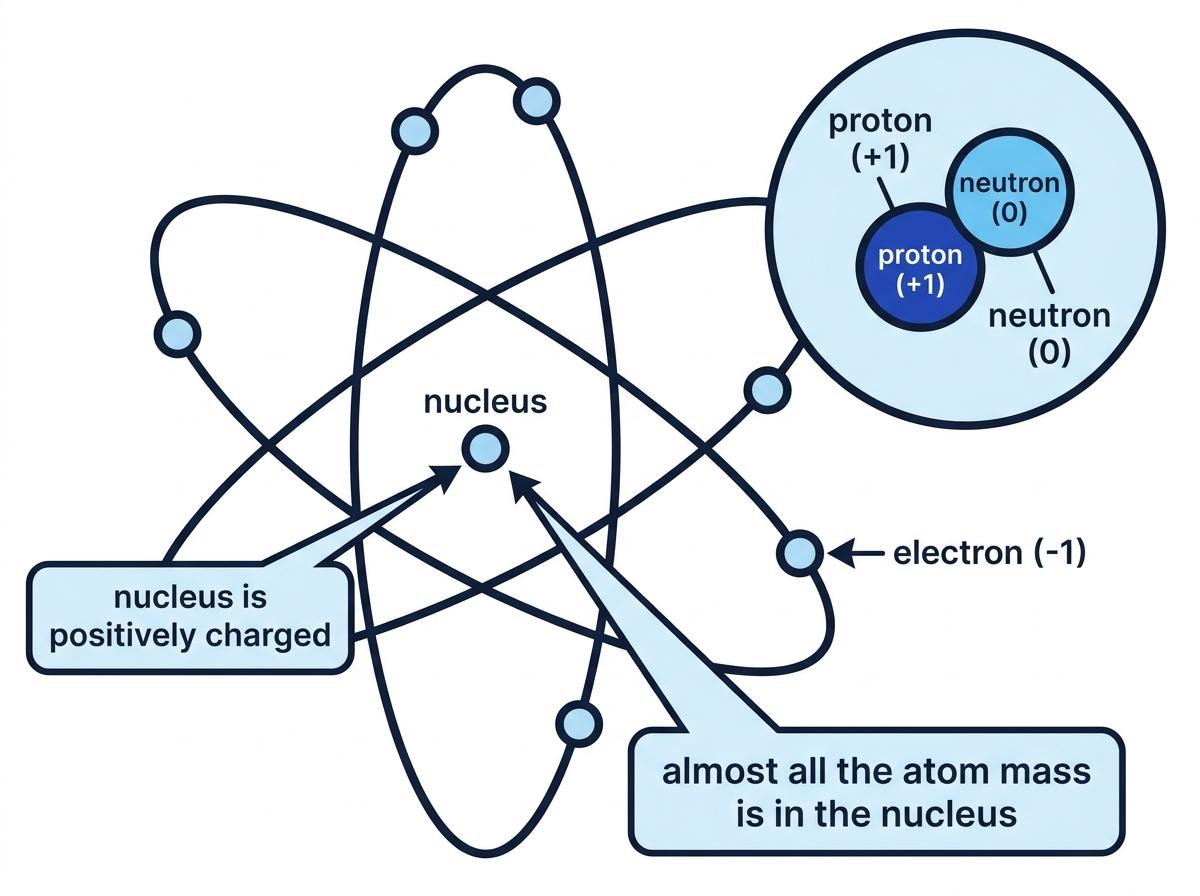
Inside the nucleus: protons and neutrons packed together
Definition
Nucleon
Any particle found in the nucleus, meaning a proton or a neutron.
- The nucleus is not a single lump of positive charge; it is built from two kinds of particle, protons and neutrons, held tightly together at the centre of the atom.
- A proton carries a positive charge, and a neutron carries no charge at all, which is where its name comes from.
- The three particles that make up an atom are compared using relative charge, which measures charge in units of the charge on a proton.
- A proton has a relative charge of +1+1+1.
- A neutron has a relative charge of 000.
- An electron has a relative charge of −1-1−1.
- Because the electron's charge is exactly equal and opposite to the proton's, one proton is cancelled by one electron, which is why a neutral atom has equal numbers of each.
- Protons and neutrons have almost exactly the same mass as each other, and each is roughly 200020002000 times heavier than an electron.
- That mass difference is the reason the nucleus holds almost all of the atom's mass while taking up almost none of its volume.
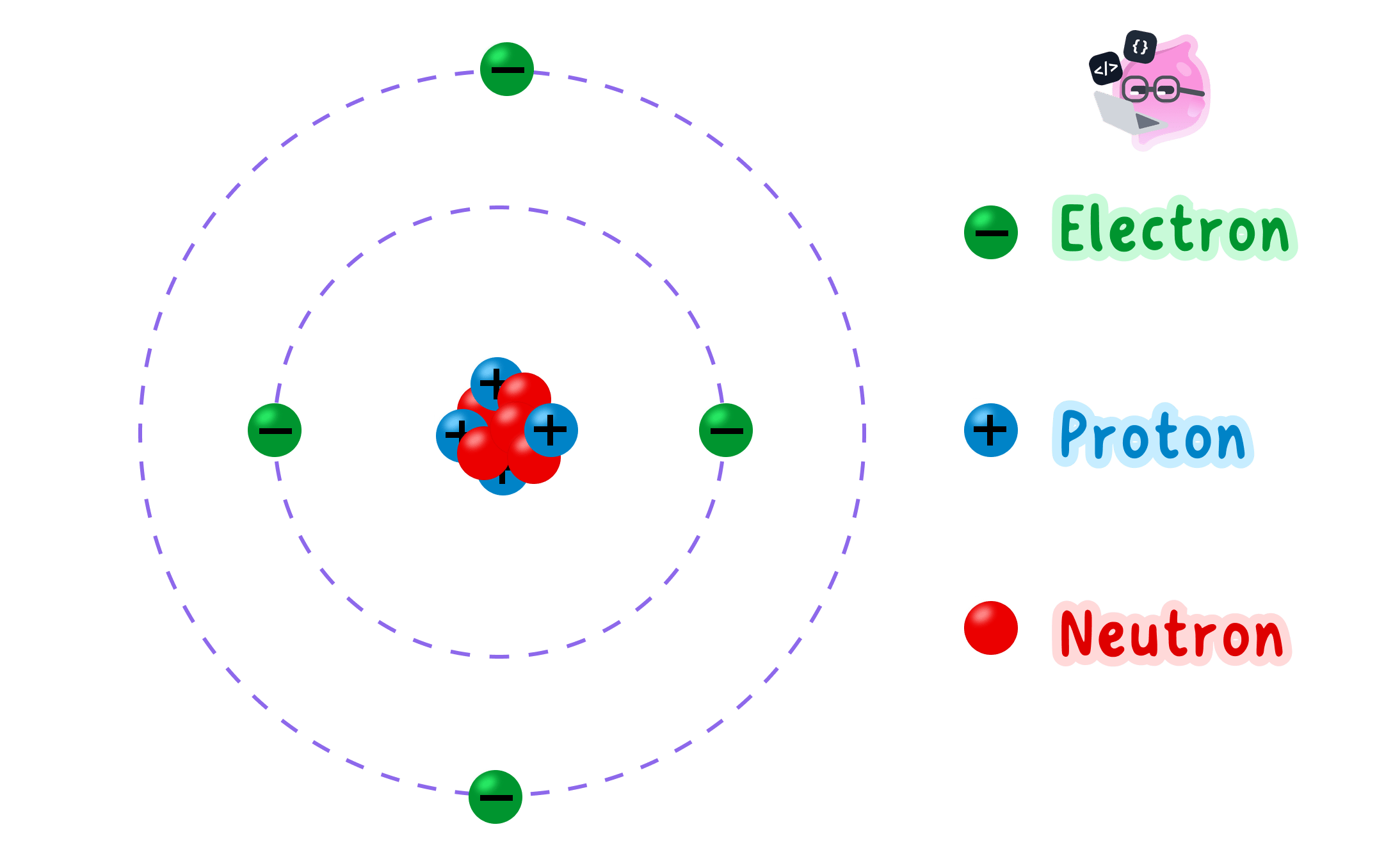
The proton count fixes which element an atom is
- Every atom of a given element has the same number of protons in its nucleus, and no two elements share that number.
- Every carbon nucleus has 666 protons, every oxygen nucleus has 888, and changing the number of protons would turn the atom into a different element altogether.
- The number of neutrons is not fixed in the same way, and this is the freedom that gives rise to isotopes.
Isotopes: same element, different number of neutrons
Definition
Isotope
An atom of the same element with the same number of protons but a different number of neutrons in its nucleus.
- Most elements exist as more than one isotope, so a sample of an element is usually a mixture of nuclei with different neutron numbers.
- Carbon shows this clearly: carbon-12 has 666 protons and 666 neutrons, carbon-13 has 666 protons and 777 neutrons, and carbon-14 has 666 protons and 888 neutrons.
- Hydrogen is the other standard example, with one isotope having no neutrons at all, one having a single neutron and one having two.
- Isotopes of an element are chemically identical, because chemistry depends on the electrons, and the number of electrons follows the unchanged number of protons.
- They differ in two ways that do matter.
- Extra neutrons make the nucleus heavier, so a carbon-14 atom has more mass than a carbon-12 atom.
- Some isotopes are unstable and decay, which is why carbon-14 is radioactive while carbon-12 sits in your body unchanged.
Common Mistake
- Do not define an isotope as "an atom with a different mass"; you must say same protons, different neutrons.
- Do not treat every isotope as radioactive; carbon-12 and carbon-13 are both perfectly stable.
- Do not give a neutron a small charge; its relative charge is exactly 000.
- Do not confuse changing the electron count, which makes an ion, with changing the neutron count, which makes an isotope.
Exam technique
- "Explain what is meant by an isotope" carries two marks, one for same number of protons and one for different number of neutrons, so write both halves even if the question looks short.
- Give the relative charges as the numbers +1+1+1, 000 and −1-1−1 rather than the words "positive, none, negative", which are worth less on a table-completion question.
- If a question asks why two isotopes behave the same chemically, the answer is about the same number of electrons, not about the neutrons.
Self review
- Describe the composition of a nucleus.
- State the relative charges of a proton, a neutron and an electron.
- Which particle count decides which element an atom is?
- Explain what is meant by an isotope.
- A nucleus has 888 protons and 101010 neutrons. How many nucleons does it contain, and what is its relative charge?