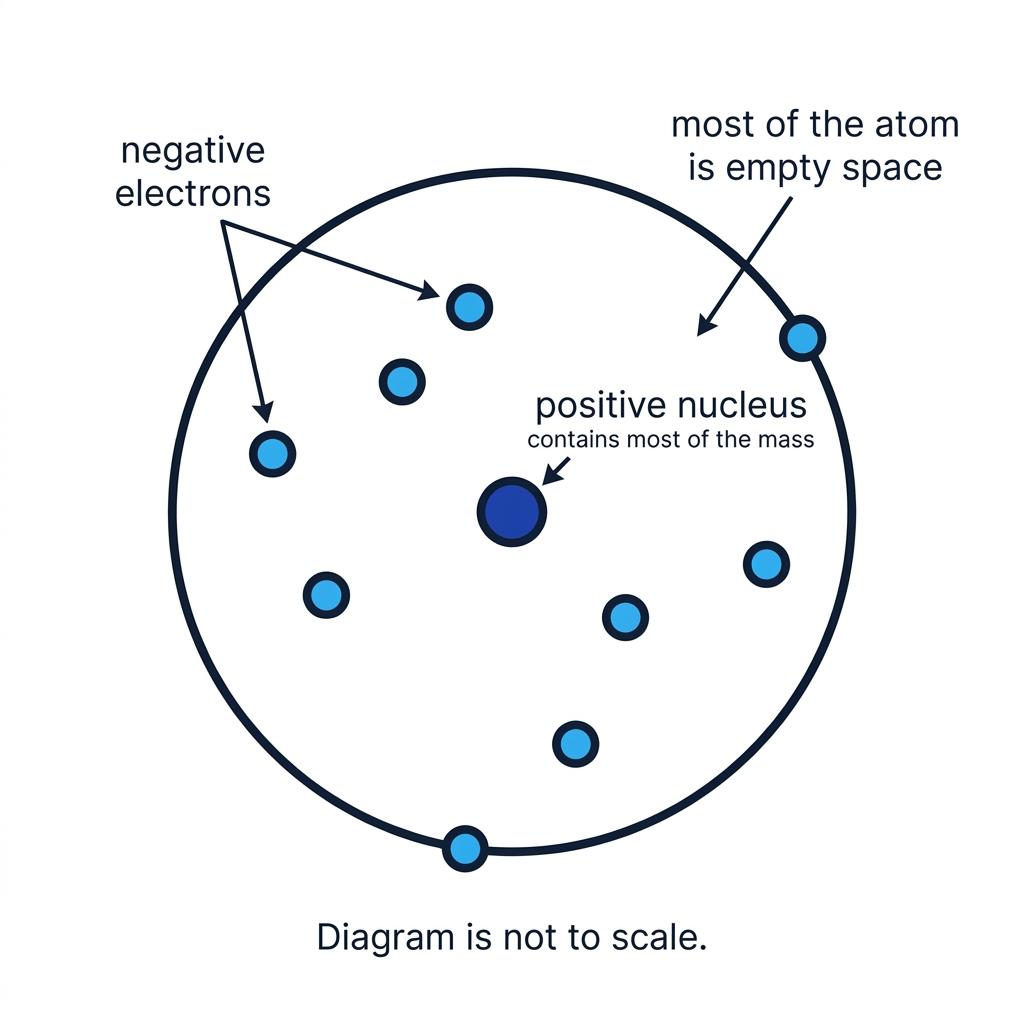
The atom: a tiny positive nucleus with electrons in orbit around it
Definition
Nucleus
The small, positively charged centre of an atom, which contains almost all of the atom's mass.
- An atom is built from two parts: a central nucleus and a set of electrons that orbit around it.
- The nucleus sits at the centre, carries a positive charge, and holds almost all of the atom's mass.
- The electrons move around the nucleus in orbits, often drawn as circular shells, and each one carries a negative charge.
- An electron has so little mass compared with the nucleus that the mass of the electrons can be ignored when you talk about the mass of the atom.
- What keeps the electrons in orbit is the electrostatic attraction between their negative charge and the positive charge of the nucleus, because opposite charges attract.
- Almost all of an atom is empty space: an atom is roughly 10−10 m10^{-10}\ \text{m}10−10 m across while its nucleus is roughly 10−15 m10^{-15}\ \text{m}10−15 m across.
- That makes the atom about 100 000100\,000100000 times wider than its nucleus, so if the nucleus were a 1 cm1\ \text{cm}1 cm marble, the nearest electrons would orbit about 1 km1\ \text{km}1 km away.
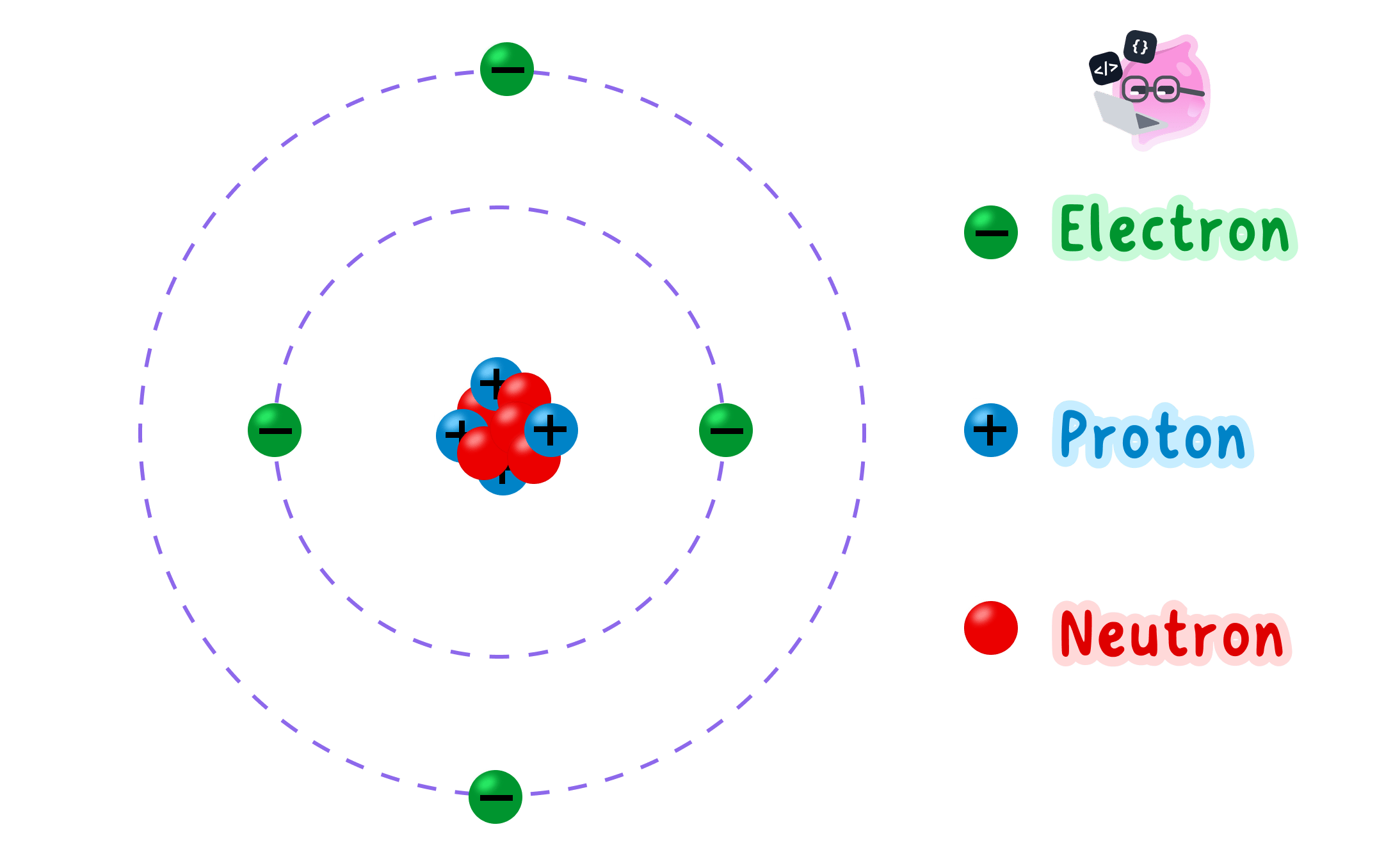
A neutral atom carries as much negative charge as positive charge
- Every electron carries the same size of negative charge, and the nucleus carries a positive charge that is a whole number of those same units.
- In an uncharged atom the number of orbiting electrons exactly matches the number of positive charges in the nucleus, so the two cancel and the atom has no overall charge.
- A neutral atom is not an atom with no charge in it: it holds a lot of positive and negative charge, balanced so that the total comes to zero.
- Because the electrons sit on the outside, they are the only part of the atom that can easily be removed or added; the nucleus is buried at the centre and is far harder to disturb.
Ions: what an atom becomes when it loses or gains electrons
Definition
Ion
An atom, or a group of atoms, with an overall electrical charge, because electrons have been lost or gained.
- Take an electron away and the balance is broken: the nucleus now has one more unit of positive charge than the electrons can cancel, so the particle left behind is a positive ion.
- Add an extra electron and the balance tips the other way, giving one more unit of negative charge than the nucleus can cancel, so the particle becomes a negative ion.
- The nucleus is unchanged when an ion forms, so the particle is still an atom of the same element; only its electron count has changed.
- A sodium atom that loses one electron becomes the ion Na+\text{Na}^{+}Na+, and a chlorine atom that gains one electron becomes the ion Cl−\text{Cl}^{-}Cl−.
- The size of the charge counts the electrons that moved: a charge of 2+2+2+ means two electrons were lost, and a charge of 1−1-1− means one electron was gained.
- This is why radiation from unstable nuclei is called ionising radiation: it carries enough energy to knock electrons off the atoms it passes, turning them into ions.
Common Mistake
- Do not say an atom becomes positive by gaining positive charge; it becomes positive by losing electrons.
- Do not draw or describe electrons as sitting inside the nucleus; they orbit outside it.
- Do not treat "neutral" as "has no charge": the positive and negative charges are equal in size and cancel.
- Do not claim that forming an ion changes the element; the nucleus is untouched, so the element stays the same.
Exam technique
- "Describe the structure of an atom" is point-marked, so name both parts and both charges: a positively charged nucleus with negatively charged electrons in orbit around it.
- Add that the nucleus holds almost all the mass and that the atom is mostly empty space whenever sizes are mentioned in the question.
- The mark most often dropped on ion questions is the direction of movement, so write how many electrons moved and whether they were lost or gained before giving the sign.
- Use the phrase electrostatic attraction for what holds the electrons in orbit, rather than a vague "the nucleus pulls them in".
Self review
- Describe the structure of an atom, naming the charge on each part.
- Which part of an atom holds almost all of its mass?
- Why does a neutral atom have no overall charge?
- How does an atom form a positive ion, and how does it form a negative ion?
- An atom gains two electrons. What is the charge on the ion, and has the element changed?