3.4.1 Production and nature of sound waves
Sound starts when something vibrates and pushes on the medium around it
- Every source of sound is something that is vibrating, moving repeatedly back and forth about one average position.
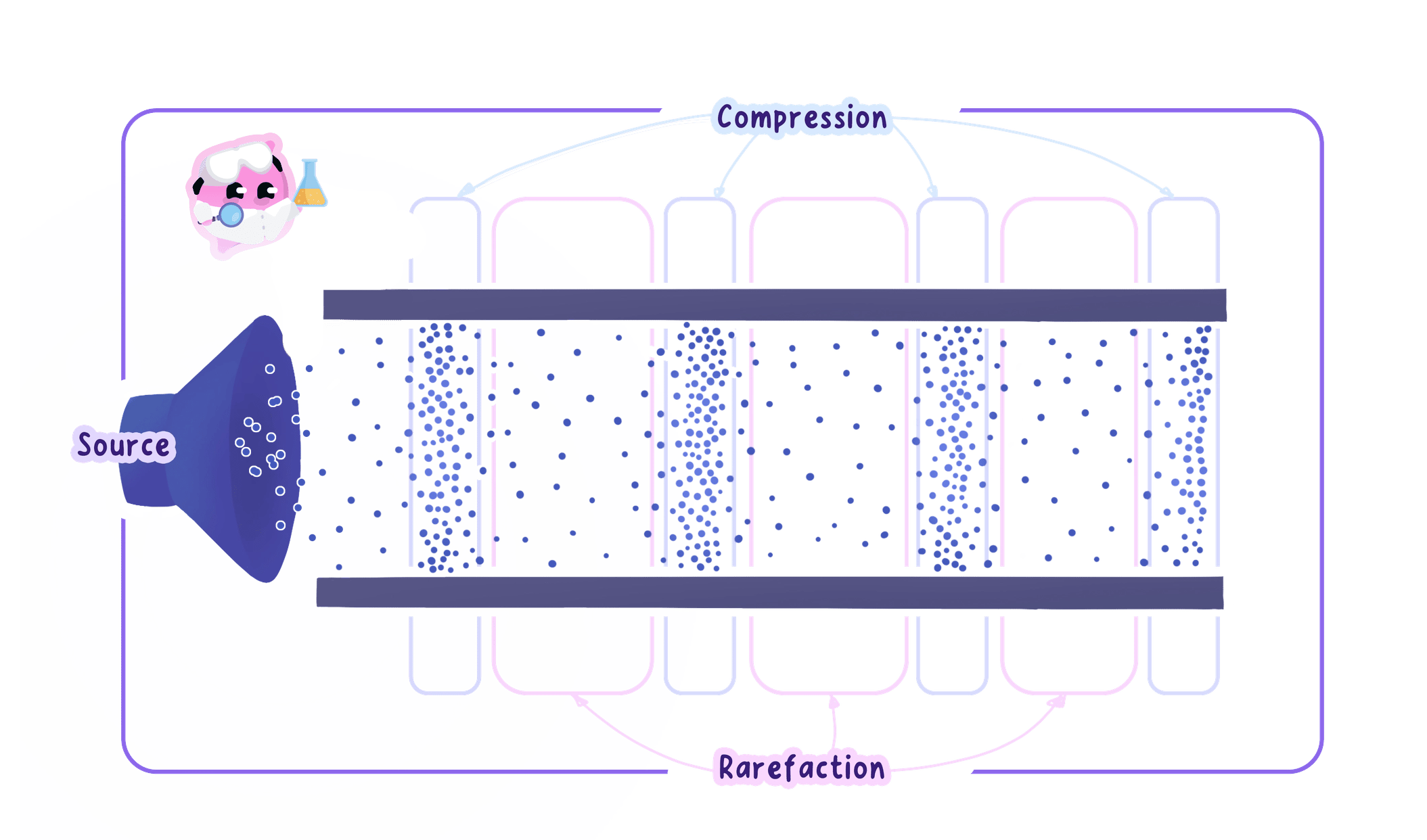
- As the surface of the source moves outwards it collides with the particles of the medium in front of it and pushes them closer to their neighbours.
- As the surface moves back inwards it pulls away from those particles and leaves them more room to spread out again.
- Those particles are now vibrating, so they push and pull on the particles beyond them, and the vibration is handed on from one layer of the medium to the next.
- Each particle keeps vibrating about the same average position, so the vibration is carried outwards while the air stays where it is.
- That handing on of the vibration is what transfers energy from the source to your ear, and it stops as soon as the source stops vibrating.
In every sound source you can name the part that is vibrating
- In a loudspeaker the vibrating part is the cone, which is driven in and out many times each second and pushes on the air in front of it.
- Rest your fingertips lightly on the front of a large loudspeaker while it is playing and you can feel the cone moving: the movement is small but fast.
- On a guitar the plucked string is the vibrating source.
- A string is thin, so on its own it shifts very little air; it shakes the bridge and the wooden body, and the broad body and the air inside it then vibrate and push on far more air.
- On a drum the stretched skin goes on vibrating after the stick has struck it, and grains of sand sprinkled on the skin jump about while it does.
- When you speak or sing, the vocal folds in your throat are blown apart and pulled back together by the air you breathe out, so they vibrate and set the air in your mouth vibrating.
- When a tuning fork is struck, its two prongs swing in and out together.
- Dip the tip of a sounding tuning fork into a beaker of water and the water sprays out, which is direct evidence that the prong is moving.
The particles vibrate along the same line as the energy travels
Longitudinal wave
A wave in which the particles of the medium vibrate parallel to the direction in which the wave transfers energy.
- Sound is a longitudinal wave in every medium it passes through, because the source works by pushing and pulling along the line it faces.
- If a loudspeaker on your left sends sound towards your right ear, the air particles vibrate left and right, along the very same line the energy is travelling.
- In a transverse wave the vibration is instead at right angles to the direction of energy transfer, and that single difference in direction is what separates the two families of wave.
- Each air particle shifts only a very short distance forwards and then back, and finishes where it began, so no particle travels from the loudspeaker to your ear.
- A long spring given a sharp push along its length behaves the same way: the coils move backwards and forwards along the spring while the pulse itself runs the whole length of it.
The forward push of the source crowds the particles into a compression
Compression
A region of a longitudinal wave in which the particles are closer together than normal, so the pressure there is higher than normal.
- Each time the vibrating surface moves outwards, the layer of air just in front of it is squeezed into a smaller space.
- The particles in that layer are packed closer together, so they strike any surface there more often and the pressure is raised above its normal value.
- That squeezed layer pushes on the layer beyond it, which is squeezed in turn, so the compression moves steadily away from the source.
- The compression travels but the particles do not travel with it: each layer is squeezed, then springs apart again as the compression moves on to the next layer.
- The pressure change is small, and a compression in ordinary speech sits only a tiny fraction above the pressure of the still air around it.
The backward movement of the source leaves a rarefaction behind it
Rarefaction
A region of a longitudinal wave in which the particles are further apart than normal, so the pressure there is lower than normal.
- When the vibrating surface moves back inwards it leaves extra room for the nearest particles, and they spread out into it.
- Those particles are further apart than normal, so the pressure in that thinned-out region drops below its normal value, and the region travels outwards just as the compression did.
- The source repeats the same cycle, out and back, so it sends out a compression, then a rarefaction, then another compression, for as long as it goes on vibrating.
- A sound wave is therefore a train of alternating compressions and rarefactions spreading out through the medium.
- One wavelength of a sound wave is the distance from the centre of one compression to the centre of the next.
- Measuring from one rarefaction to the next gives the same distance, because every wavelength holds one compression and one rarefaction.
- The spacing of the compressions is tied to how fast the source vibrates by the wave equation.
- v=fλv = f\lambdav=fλ
- At a fixed wave speed vvv, a source that vibrates more times each second gives a larger frequency fff and so packs its compressions closer together.
Your ear responds only to a limited band of frequencies
-
A source can vibrate at any rate at all, but your ear detects only part of that range.
-
The approximate range of frequencies audible to humans is:
20 Hz to 20 000 Hz 20\ \text{Hz}\text{ to }20\,000\ \text{Hz} 20 Hz to 20000 Hz -
A source vibrating more slowly than about 20 Hz20\ \text{Hz}20 Hz, or faster than about 20 000 Hz20\,000\ \text{Hz}20000 Hz, still sends compressions and rarefactions through the air; your ear simply does not respond to them.
-
Both limits are approximate: they differ from person to person, and the upper one drops as you get older.
Sound is a pressure wave, so it cannot cross a vacuum
- Everything a sound wave does depends on particles being there to be squeezed together and pulled apart, which is why sound is described as a pressure wave and why it needs a medium.
- A vacuum holds no particles, so there is nothing to compress and nothing to thin out, and no way for the vibration to be handed on.
- Sound therefore cannot travel through a vacuum, so an explosion out in space, however violent, reaches you in silence.
- Do not write that the air travels from the source to your ear; each particle vibrates about a fixed position and hands the vibration on to the next particle.
- Never say a compression is a region where the air is hot; it is a region where the particles are closer together and the pressure is higher than normal.
- If you sketch a sound wave as a smooth curve, that curve is a graph of pressure against distance, so do not go on to claim that the particles move up and down across the direction of travel.
- Do not allow sound to cross space in an answer: with no particles there is no wave at all, not merely a fainter one.
- Asked how a sound is produced, give three things: the part that vibrates, the fact that it sets the air particles vibrating, and the fact that the vibration is passed from particle to particle.
- The word that earns the longitudinal mark is parallel, used about the direction of vibration compared with the direction of energy transfer.
- Contrasting a compression with a rarefaction is worth two separate comparisons, particle spacing and pressure, each written as higher or lower than normal.
- Write that particles vibrate rather than that they move, because "move" leaves open the idea that they travel along with the wave.
- Quote the audible range as 20 Hz20\ \text{Hz}20 Hz to 20 000 Hz20\,000\ \text{Hz}20000 Hz and call it approximate.
- Name the part that vibrates in a loudspeaker, in a guitar and in a tuning fork.
- What two directions does the word "parallel" compare when you describe sound as longitudinal?
- How do the particle spacing and the pressure differ between a compression and a rarefaction?
- Between which two points on a sound wave would you measure one wavelength?
- Why does a vacuum stop a sound wave completely?
3.4.2 Transmission of sound and the speed of sound
Sound reaches you only if there are particles to hand it along
Vacuum
A region that contains no particles of matter, so there is nothing inside it to carry a mechanical wave such as sound.
- A vibrating source sets up a longitudinal disturbance in whatever material is touching it.
- Each particle that is pushed forward presses on the particles next to it, those particles press on their own neighbours, and in this way the compression is passed along the material.
- The particles only shuffle to and fro about their own positions, so what travels from the source to your ear is energy, not matter.
- The material that does this passing on is called the medium, and it can be a solid, a liquid or a gas.
- Sound cannot travel through a vacuum, because there are no particles there to be squeezed together and none to press on a neighbour.
- Take the particles away and the chain of pushes has nothing to run along, so the wave is never carried at all.
- Two astronauts standing on the surface of the Moon cannot hear each other shout, because there is almost no gas around them, so they speak by radio instead.
- Light and radio waves are electromagnetic waves, which need no medium, and that is why you can see the Sun across empty space but never hear it.
In the bell jar demonstration the ringing fades as the air is pumped out
- An electric bell is hung on threads inside a thick glass bell jar that is sealed onto a base plate, with its wires taken out through the seal to a supply so that it keeps ringing throughout.
- While there is air in the jar the bell is clearly heard: the vibrating gong pushes on the air inside, that air passes the vibration to the glass, and the glass passes it to the air outside and on to your ear.
- A vacuum pump joined to the base plate then slowly draws the air out of the jar.
- As the number of air particles inside falls there are fewer and fewer particles to hand the vibration on, so the ringing grows steadily quieter and fades away to nothing.
- Through the glass you can still see the hammer striking the gong, so the bell has not been switched off and is not broken; what has been removed is the path for the sound.
- Letting the air back in brings the ringing back at once, which shows that the gas was doing the carrying.
- The bell is hung on threads or stands on a soft pad so that its vibrations cannot leak out through the base plate as a solid path, which would still let sound reach you after the jar had been emptied.
Sound travels through air at roughly 340 m/s340\ \text{m/s}340 m/s
Speed of sound
The distance a sound wave travels through a given material in one second, which depends on the material and, in a gas, on its temperature.
- In air the value is approximately 330 m/s330\ \text{m/s}330 m/s to 350 m/s350\ \text{m/s}350 m/s, and 340 m/s340\ \text{m/s}340 m/s is the figure normally used in calculations.
- A speed of 340 m/s340\ \text{m/s}340 m/s means the wave has moved 340 m340\ \text{m}340 m away from the source after 1 s1\ \text{s}1 s.
- A range is quoted rather than one number because the speed rises with the temperature of the air.
- Particles in warmer air are already moving faster, so each one reaches its neighbour sooner and the disturbance is handed on more quickly: nearer 350 m/s350\ \text{m/s}350 m/s on a hot afternoon, nearer 330 m/s330\ \text{m/s}330 m/s on a cold night.
- Light travels at 3.0×10⁸ m/s3.0 \times 10^8\ \text{m/s}3.0×108 m/s, close to a million times faster than sound in air.
- That gap is why a distant lightning flash arrives at your eyes with no delay you could notice, while its thunder needs about 3 s3\ \text{s}3 s for every kilometre it has to cross.
- For the same reason a firework seen from far off flashes silently and bangs a second or two later, even though the flash and the bang began together.
Closer particles with stronger forces between them pass the disturbance on faster
- The speed of a sound wave is set by how quickly one particle can make the next particle move.
- The closer together the particles are, and the stronger the forces between them, the sooner a neighbour feels the push and the faster the wave advances.
- In a gas the particles are far apart and only affect each other when they collide, so a particle travels a long way before it passes anything on, and sound in air manages only about 340 m/s340\ \text{m/s}340 m/s.
- In a liquid the particles are already touching, with moderately strong forces between them, and sound in water reaches about 1500 m/s1500\ \text{m/s}1500 m/s, over four times the speed in air.
- In a solid the particles are packed close and held by strong bonds, so a vibration is handed on almost immediately, and sound in steel reaches around 5000 m/s5000\ \text{m/s}5000 m/s.
- In general, then, sound travels faster in solids than in liquids, and faster in liquids than in gases.
- The claim is a general one because the exact speed belongs to the particular material, so 1500 m/s1500\ \text{m/s}1500 m/s in water and 5000 m/s5000\ \text{m/s}5000 m/s in steel are indicative values rather than fixed constants for all liquids and all solids.
- Press your ear to a long metal railing while a friend taps the far end, and the tap arrives through the metal a moment before the same tap reaches you through the air.
Crossing into a new material changes the speed and the wavelength but not the frequency
-
Wave speed, frequency and wavelength are tied together by the wave equation.
v=fλ v = f\lambda v=fλ -
The frequency is fixed by the source, because every particle along the path is driven to and fro once for each vibration the source makes, so the number of vibrations per second cannot change part way along.
-
When a sound crosses from air into water the speed rises from about 340 m/s340\ \text{m/s}340 m/s to about 1500 m/s1500\ \text{m/s}1500 m/s, so with fff unchanged the wavelength must rise in the same proportion.
- A 500 Hz500\ \text{Hz}500 Hz note has a wavelength of 340500=0.68 m\dfrac{340}{500} = 0.68\ \text{m}500340=0.68 m in air and 1500500=3.0 m\dfrac{1500}{500} = 3.0\ \text{m}5001500=3.0 m in water, while its frequency stays at 500 Hz500\ \text{Hz}500 Hz in both.
-
The same argument runs the other way, so a sound passing into a slower material has its wavelength squeezed shorter while its frequency holds steady.
- Do not argue that sound is fastest in air because air is thin and easy to push through, since those widely spaced particles are exactly what makes a gas the slowest carrier.
- Never say that a vacuum stops sound because it is cold or dark; the only thing that matters is that it has no particles to pass the vibration on.
- Do not write that the frequency changes when a sound enters water: the speed and the wavelength change, the frequency is set by the source.
- Do not quote 3.0×10⁸ m/s3.0 \times 10^8\ \text{m/s}3.0×108 m/s for sound, because that is the speed of light and sound in air is about a million times slower.
- In the bell jar the bell keeps ringing the whole time, so do not explain the silence by saying that the bell stopped working.
- An answer on why sound fails to cross a vacuum needs two separate statements to score: there are no particles, and so there is nothing to pass the vibrations on.
- Write the unit every time, because a bare 340340340 with no m/s\text{m/s}m/s after it throws away the mark you had earned.
- If a question supplies its own value for the speed of sound, use that value and not your remembered 340 m/s340\ \text{m/s}340 m/s.
- A comparison question wants the whole order, solids then liquids then gases, together with the reason in terms of particle spacing and the forces between particles.
- Describing the bell jar earns most of its marks for the two observations together: the sound fading as the air leaves, and the hammer still seen to strike.
- Why can a sound cross a room full of air but not the empty space between the Earth and the Moon?
- In the bell jar demonstration, what can you see that proves the bell is still working after the sound has faded?
- What speed would you quote for sound in air, and why is it given as a range instead of a single number?
- Sound moves at about 1500 m/s1500\ \text{m/s}1500 m/s in water and about 5000 m/s5000\ \text{m/s}5000 m/s in steel: what is it about the particles that produces this order?
- A 500 Hz500\ \text{Hz}500 Hz note passes from air into water: which of the speed, the frequency and the wavelength change, and which does not?
3.4.3 Measuring the speed of sound in air and echoes
Measuring the speed of sound means measuring one distance and one time
- Sound travels at a finite speed, so if you can measure how far it goes and how long it takes to get there, the speed follows.
- Every way of finding the speed of sound in air reduces to those two measurements, a distance in metres and a time in seconds.
- v=dtv = \frac{d}{t}v=td
- vvv is the speed in m/s\text{m/s}m/s, ddd is the distance the sound travels in m\text{m}m, and ttt is the time taken in s\text{s}s.
- Measure the distance with a metre ruler or a tape measure, along the straight path the sound actually follows from the source to the detector.
- The timing is the awkward part, because sound gets through roughly 340 m340\ \text{m}340 m of air every second.
- Across a 3 m3\ \text{m}3 m bench the sound arrives after about 0.009 s0.009\ \text{s}0.009 s, far too quick for anybody to catch with a hand-held stopwatch.
- Either stretch the distance out to tens or hundreds of metres so the time grows into something a person can time, or hand the timing to an electronic timer that starts and stops itself.
- A timer that reads in milliseconds gives values such as 8.8 ms8.8\ \text{ms}8.8 ms, which has to be written as 0.0088 s0.0088\ \text{s}0.0088 s before it goes anywhere near the equation.
- Take every reading more than once and use the mean, because one timing on its own carries random error you cannot see.
Investigation: the speed of sound in air
- Aim: to measure the speed of sound in air.
- Apparatus: an electronic timer reading in milliseconds, two microphones acting as start and stop, a hammer and metal plate, and a metre ruler.
- Method:
- Lay the two microphones out in a straight line on the bench or floor and set them a measured distance apart, using the metre ruler to fix the separation, starting at about 1.00 m1.00\ \text{m}1.00 m.
- Plug the nearer microphone into the start input of the electronic timer and the far one into the stop input, then reset the display to zero.
- Hold the metal plate right beside the start microphone and strike it once with the hammer to make one sharp sound.
- The sound reaching the first microphone starts the timer, and the same sound arriving at the second microphone stops it.
- Read the time in milliseconds from the display, record it, reset the timer and repeat the strike at the same separation.
- Slide the second microphone further away, measure the new separation and repeat the strikes, so that you end up with several separations spread out to a few metres.
- Measure and plot:
- Tabulate the distance between the microphones against the time on the timer, converting each time from ms\text{ms}ms into s\text{s}s.
- Plot distance against time and draw the best straight line through the points.
- Take the gradient of that line as the speed of sound, or work out v=dtv = \dfrac{d}{t}v=td for each row instead.
- Result: a straight line through the origin, with a gradient of about 330330330 to 340 m/s340\ \text{m/s}340 m/s.
- Watch out:
- The electronic timer is what makes this work, since it removes the reaction-time error you would get by pressing a stopwatch yourself.
- Work well away from other groups, because their hammer blows will trigger your microphones.
- Quote the speed from the gradient of the graph rather than from a single reading, as the line uses all your data at once.
- Safety: take care with the hammer.
A hard flat surface sends the sound straight back to you
Echo
The sound heard when a sound wave is reflected from a surface and travels back to the listener.
- When a sound wave meets a wall, some of its energy is reflected back into the air instead of passing into the wall.
- The reflected wave carries on at the same speed as the original, so it reaches your ear a short time after the sound you made.
- Shout across a valley and the rock face on the far side hands your voice back to you a second or so later.
- Clap towards the flat end wall of a sports hall, or towards a large wall across a playground, and the clap comes back as one sharp repeat.
- You notice the reflection as a separate sound only when the surface is far enough away, because two sounds that arrive within about 0.1 s0.1\ \text{s}0.1 s of each other are heard as one.
- At 340 m/s340\ \text{m/s}340 m/s the wave covers 34 m34\ \text{m}34 m in that 0.1 s0.1\ \text{s}0.1 s, so the wall needs to be more than roughly 17 m17\ \text{m}17 m away before you hear the delay.
- Nearer than that, the reflection merges into the original sound and only makes the space sound hard and ringing.
- A large, hard, flat surface such as a cliff, a brick wall or a tiled corridor gives the clearest return, because it sends nearly all the sound energy back in one direction.
- A soft surface such as a curtain, a carpet or a bank of long grass absorbs the sound energy into its fibres, so the reflection that returns is weak or missing altogether.
- A broken-up surface such as a hedge, a line of trees or a pile of rubble scatters the reflection in all directions, so what gets back to you is too spread out in time and too quiet to pick out.
The sound in an echo covers twice the distance to the surface
- Stand a measured distance ddd from a wall and make one sharp sound, and the wave has two journeys to finish before you hear it again.
- It travels the distance ddd out to the wall, then the same distance ddd back to where you are standing.
- The distance that belongs in the equation is that whole path, 2d2d2d, and not the gap between you and the wall.
- v=2dtv = \frac{2d}{t}v=t2d
- Here ttt is the time from making the sound to hearing the reflection, so it is the time for the whole out-and-back trip.
- One way to make the timing manageable by hand is to clap in a steady rhythm so that each clap lands exactly on the reflection of the clap before it.
- Time 202020 claps, divide the total by 202020, and you have a value of ttt in which your reaction time has been shared out and largely cancelled.
- The same there and back reasoning turns up wherever a pulse is sent out and its reflection is timed.
Turning the equation round gives a distance from a known speed
- When the speed of sound is already known and the distance is what you are after, rearrange the same relationship.
- d=vt2d = \frac{vt}{2}d=2vt
- Multiplying the speed by the echo time gives the whole path the sound covered, and halving it gives the one-way distance to the reflecting surface.
- A walker shouts towards a cliff and hears the reply 1.2 s1.2\ \text{s}1.2 s later, on a day when the speed of sound in air is 340 m/s340\ \text{m/s}340 m/s.
- d=340×1.22d = \frac{340 \times 1.2}{2}d=2340×1.2
- d=204 md = 204\ \text{m}d=204 m
- The cliff stands 204 m204\ \text{m}204 m away, and the sound itself covered 408 m408\ \text{m}408 m.
- You can halve the time first instead, putting the one-way time of 0.6 s0.6\ \text{s}0.6 s into d=vtd = vtd=vt, which gives the same 204 m204\ \text{m}204 m.
- Pick one of those two routes and stay in it, because halving the time and doubling the distance in the same calculation corrects for the return journey twice.
- You stand 85 m85\ \text{m}85 m from the flat brick wall of a sports hall, clap your hands once, and hear the clap come back 0.50 s0.50\ \text{s}0.50 s later.
- Start from the speed equation:
- The sound went to the wall and back, so the distance it travelled is twice 85 m85\ \text{m}85 m:
- The measured 0.50 s0.50\ \text{s}0.50 s is the time for that full journey, so substitute both values:
- The speed of sound in the air that day was 340 m/s340\ \text{m/s}340 m/s, which sits where you would expect it to.
- Do not drop the distance to the wall straight into v=dtv = \dfrac{d}{t}v=td, because by the time you hear the reflection the sound has covered that distance twice.
- Never halve the time and double the distance in the same working, since that gives half the true speed.
- Say which route you have taken, the full path 2d2d2d with the full echo time, or the one-way distance ddd with half the echo time.
- Do not trust a stopwatch you start and stop yourself on a single clap, because a reaction time of about 0.2 s0.2\ \text{s}0.2 s is larger than the interval you are trying to measure.
- Do not describe the returning sound as a fresh sound made by the wall; it is your own wave reflected back.
- A question that asks for a method wants three separate things: what distance you measure and with what, what time you measure and with what, and the calculation v=dtv = \dfrac{d}{t}v=td that joins them.
- Get the words to the wall and back onto the page in any echo answer, because that phrase is what shows the factor of two was deliberate.
- Write the doubled distance on its own line before substituting, so the method still scores if the arithmetic slips.
- Convert any time given in ms\text{ms}ms into s\text{s}s first, and put m/s\text{m/s}m/s on the final speed.
- Check your answer against the value you expect for air, since a result ten times too big or too small usually means an undoubled distance or a time left in milliseconds.
- If asked how to improve a measurement, name a longer distance, repeat readings with a mean, and an electronic timer in place of a stopwatch.
- Which two quantities must you measure to find the speed of sound in air, and what equation combines them?
- Why is the distance used in an echo calculation twice the distance to the wall?
- A clap returns from a wall 60 m60\ \text{m}60 m away after 0.35 s0.35\ \text{s}0.35 s, so what speed of sound does that give?
- Why does a thick hedge give almost no returning sound while a brick wall of the same size gives a clear one?
- In the two-microphone experiment, what does the gradient of the distance against time graph tell you, and why is it better than one reading?
3.4.4 Loudness and pitch
A larger amplitude makes a sound louder
Loudness
How loud or quiet a sound seems to a listener, set by the amplitude of the sound wave: a larger amplitude gives a louder sound.
- The amplitude of a sound wave is the maximum distance the particles of the air are pushed from their undisturbed positions as the wave passes.
- A larger amplitude gives a louder sound, and a smaller amplitude gives a quieter sound.
- A source with a larger amplitude vibrates further on every swing, so it drives the air in front of it harder.
- Its compressions are squeezed more tightly and its rarefactions are stretched more thinly, so the wave carries more energy each second.
- Your eardrum is then pushed and pulled through a greater distance as each wave arrives, and you register that as a louder sound.
- Turning up the volume on a loudspeaker makes its cone travel further backwards and forwards, while the number of times it moves each second stays the same.
- Clapping harder gives a louder clap because your hands set the air moving through a greater distance, not because the clap happens any more often.
A higher frequency is heard as a higher pitch
Pitch
How high or low a note sounds to a listener, set by the frequency of the sound wave: a higher frequency gives a higher pitch.
- The frequency of a sound wave is the number of complete waves that pass a point each second, measured in hertz, Hz\text{Hz}Hz.
- A higher frequency gives a higher pitch, and a lower frequency gives a lower pitch.
- A source vibrating at a higher frequency sends out more compressions every second, so more of them arrive at your ear in each second.
- Your ear reports that faster stream of arrivals as a higher note.
- The A string of a violin tuned to 440 Hz440\ \text{Hz}440 Hz sends 440440440 compressions into your ear each second, and the note one octave above it, at 880 Hz880\ \text{Hz}880 Hz, sends twice as many.
- A human ear responds to frequencies from about 20 Hz20\ \text{Hz}20 Hz to 20 000 Hz20\,000\ \text{Hz}20000 Hz, and a vibration outside that range gives no sensation of sound however strong it is.
- The upper limit falls with age, so an adult may hear nothing above about 12 000 Hz12\,000\ \text{Hz}12000 Hz while a child in the same room hears it easily.
- Pitch and frequency are two views of one thing: frequency is the measured number of waves per second, pitch is how your ear reports that number.
Amplitude and frequency can be changed one at a time
- Changing the amplitude changes the loudness and leaves the pitch exactly where it was.
- Changing the frequency changes the pitch and leaves the loudness exactly where it was.
- Two sounds with the same frequency but different amplitudes are the same note, one louder than the other, like a piano key struck gently and then struck hard.
- Two sounds with the same amplitude but different frequencies are equally loud but different notes, like two guitar strings plucked with the same force.
- Frequency also has no effect on how fast the sound travels, so a high note and a low note leaving an instrument together reach you together.
An oscilloscope shows amplitude as height and frequency as spacing
- A microphone turns the pressure variations of a sound wave into a varying p.d., and an oscilloscope draws that p.d. against time as a trace on its screen.
- The height of the trace above the centre line shows the amplitude, so a taller wave means a louder sound.
- The number of complete waves across the screen shows the frequency, so more waves in the same screen width means a higher pitch.
- Each wave takes up less width when the frequency is higher, because one complete vibration then takes less time.
- A comparison of two traces only means anything if the settings are identical for both of them.
- The time base, which sets how much time one horizontal division stands for, must be left untouched, or a low note can be made to look like a high one.
- The gain, the vertical sensitivity that sets how many volts one vertical division stands for, must also be left untouched, or a quiet sound can be made to look loud.
- The microphone should stay the same distance from the source, because a sound that has spread further arrives with a smaller amplitude.
Investigation: pitch and loudness on an oscilloscope
- Aim: to use a cathode-ray oscilloscope to display sound waves of different pitch and loudness.
- Apparatus: a cathode-ray oscilloscope, a microphone, tuning forks of different frequency, and a signal generator with a loudspeaker.
- Method:
- Your teacher sets up the oscilloscope so a steady trace runs across the middle of the screen, and connects the microphone to the Y-input.
- A tuning fork is struck and held by the microphone, and the time base is adjusted until two or three complete waves show on the screen, and you sketch that trace.
- With no setting changed, a fork of a different pitch is sounded, and you sketch the new trace next to the first.
- Still with no setting changed, a louder sound is made at the same pitch, either by striking the fork harder or by turning up the signal generator feeding the loudspeaker, and you sketch that trace as well.
- Measure and plot:
- Compare the spacing of the waves across your three sketches, which is what tells you about pitch.
- Compare the height of the waves across the same sketches, which is what tells you about loudness.
- Result:
- The higher-pitched fork has the higher frequency and fits more waves onto the screen.
- The louder sound has the larger amplitude and gives a taller wave.
- Making the sound louder leaves the frequency unchanged, and changing the pitch leaves the amplitude unchanged.
- Watch out:
- The time base and the gain must stay fixed between traces, or the comparison is invalid.
- A tuning fork is used as the source because it gives a clean single-frequency wave that is easy to read.
- Safety: keep the signal generator below about 20 kHz20\ \text{kHz}20 kHz.
Instruments set their pitch by how fast the source vibrates
- Pressing a guitar string against a fret shortens the vibrating length, so the string vibrates more times each second and the pitch rises.
- Tightening the string with its tuning peg also raises the pitch, because a tighter string springs back faster and so vibrates at a higher frequency.
- Slackening the string, or letting a longer length of it vibrate, lowers the frequency and drops the pitch.
- Plucking that same string harder moves no fret and changes no tension, so the note stays put and only the loudness rises.
- A bass drum has a wide, slack skin that vibrates slowly, giving frequencies of only a few tens of hertz, near the bottom of the audible range.
- A cymbal is a thin metal disc that vibrates rapidly, giving frequencies of several thousand hertz, near the top of the range.
- Either one can be played softly or deafeningly, which shows that where an instrument sits in the frequency range says nothing about how loud it can be.
- A signal generator is set to 256 Hz256\ \text{Hz}256 Hz and its trace shows two complete waves across the screen, each reaching two divisions above the centre line.
- The frequency dial is turned to 512 Hz512\ \text{Hz}512 Hz with the output level and every oscilloscope setting left alone, and four complete waves now fit across the same screen, still two divisions tall.
- You hear the note jump an octave with no change in loudness, which is what the trace reports: the same height, twice as many waves.
- Back at 256 Hz256\ \text{Hz}256 Hz, turning the output level up instead gives two waves again but four divisions tall, and the same note now sounds louder.
- Do not say a louder sound has a higher pitch, because turning the volume up raises the amplitude and leaves the frequency, and so the note, untouched.
- Never write that a high-pitched sound travels faster than a low-pitched one, since both travel at the same speed through the same air.
- Do not compare two oscilloscope traces taken at different time base settings, because the number of waves on the screen then tells you nothing about which sound had the higher frequency.
- Do not call amplitude the height of the wave without saying where it is measured from: it runs from the undisturbed centre line to a crest, which is half the crest-to-trough height.
- Do not treat pitch and frequency as separate properties, because frequency is the number of waves per second and pitch is your ear's response to that number.
- Answer a comparison of two sounds with two separate linked statements, one naming amplitude and loudness, the other naming frequency and pitch.
- Make the link with the word because, as in “the second sound is louder because its amplitude is larger”.
- Name the quantity rather than describing the picture: write larger amplitude instead of “bigger wave”, and higher frequency instead of “more squashed together”.
- If a question tells you the loudness is unchanged, say in your answer that the amplitude is therefore the same, rather than writing about the pitch alone.
- Give the audible range with its units as 20 Hz20\ \text{Hz}20 Hz to 20 000 Hz20\,000\ \text{Hz}20000 Hz, since a bare pair of numbers is not a frequency.
- A sound is made louder without any change of note: which property of the wave has changed, and which has stayed the same?
- Why does a source that vibrates at a higher frequency sound higher in pitch?
- What is the approximate range of frequencies a human ear can hear, and what happens to the upper limit as you age?
- Two oscilloscope traces are being compared: which two settings must have been left untouched, and why?
- Fretting a guitar string and plucking it harder: which one changes the pitch, and which one changes the loudness?
3.4.5 Ultrasound and its uses
Ultrasound is sound too high in frequency for human ears to detect
Ultrasound
Sound with a frequency higher than 20 kHz20\ \text{kHz}20 kHz, which is above the upper limit of human hearing.
- The boundary is set at 20 kHz20\ \text{kHz}20 kHz, which is the same frequency as 20 000 Hz20\,000\ \text{Hz}20000 Hz, and any sound above it counts as ultrasound.
- That value is the top of what a healthy human ear can pick up, so the number describes your hearing rather than anything that changes in the wave as the frequency creeps past it.
- Ultrasound is an ordinary sound wave made by a source vibrating very fast, so it needs a medium and travels at the speed of sound in whatever material it is passing through.
- It is not electromagnetic radiation, it has no place in the electromagnetic spectrum, and it is not ionising.
- A dog whistle sounding at roughly 30 kHz30\ \text{kHz}30 kHz is silent to you and perfectly clear to a dog, and a hunting bat finds moths in the dark using ultrasound pulses.
- In a workshop or a hospital, ultrasound is produced by a transducer, a crystal that an alternating voltage drives into rapid vibration and that also picks up waves arriving back at it.
A pulse of ultrasound is reflected wherever the material it travels through changes
- All three uses in this article rest on the same measurement, sending a short pulse of ultrasound into a material and timing the reflected pulse that comes back.
- Each pulse lasts a tiny fraction of a second, so the transducer has time to fall silent and listen for the return before it fires again.
- At a boundary between two materials that transmit sound differently, part of the pulse is reflected straight back towards the source and the rest carries on deeper.
- The greater the mismatch between the two materials, the stronger the reflected pulse, so an air-filled gap inside solid metal sends back a very strong reflection indeed.
- An electronic timer measures the interval between the outgoing pulse and the returning one, and that time is the only quantity the instrument really reads.
Non-destructive testing finds a crack inside a component without cutting it open
Non-destructive testing
A check for internal flaws that leaves the component undamaged and still fit for use, carried out by sending pulses into it and studying the reflections.
- A steel casting or a weld can hide a crack or a gas-filled void that nothing on the outside reveals and that would let the part snap under load.
- The transducer is pressed onto the surface with a smear of gel or oil, which squeezes out the film of air that would reflect the pulse before it ever entered the metal.
- In a sound component the pulse crosses the whole thickness, reflects from the far surface and comes back, giving a single late echo.
- If a crack or void sits part way through, it reflects some of the pulse and produces an extra echo that arrives early, ahead of the far-surface echo.
- The depth of the flaw below the surface follows from the time of that early echo and the speed of sound in the metal, halved because the pulse went down to the flaw and back.
- An early echo that returns in half the time of the far-surface echo puts the flaw halfway through the thickness.
- Sliding the transducer across the surface and noting where the early echo appears and vanishes maps how far the flaw spreads sideways.
- Railway rails, pipeline welds and aircraft parts are all tested this way where they sit, and a component that passes goes straight back into service.
Medical scanning builds an image from echoes off the boundaries between tissues
- Pulses of ultrasound are sent into the body from a probe held against the skin with gel spread underneath it.
- The gel shuts out the air, because a skin-to-air boundary would reflect almost the whole pulse before it got inside.
- Different soft tissues such as muscle, fat, blood and fluid transmit sound differently, so part of the pulse is reflected at every boundary between two tissues.
- Every boundary along the path returns its own echo, and the return time of that echo fixes how deep the boundary lies below the probe.
- As the probe is swept across the skin, the pattern of return times and echo strengths is assembled into a cross-sectional image on a screen.
- A developing fetus is scanned with ultrasound rather than X-rays because ultrasound is not ionising, so it avoids any risk of damage to cells that are dividing rapidly.
- X-rays are also poor at this job because they pass through soft tissue with little absorption, so a boundary between two soft tissues barely shows on the image, while ultrasound reflects from it strongly.
- One scan can show where the fetus is lying and measure its length, from which its age is estimated.
Sonar turns the return time of a pulse into the depth of the water
- A ship carries a transducer in its hull that fires a pulse of ultrasound straight down into the sea.
- The pulse reflects from the sea bed, or from a shoal of fish or a wreck part way down, and returns to a detector on the hull.
- The speed of sound in water is about 1500 m/s1500\ \text{m/s}1500 m/s, and it is that value, never the speed in air, that a sonar calculation uses.
- Putting the measured return time and that speed into the echo calculation gives the depth of water below the ship.
- A shoal of fish sends its echo back sooner than the sea bed does, so a fishing boat sees the fish and the bottom as two separate marks on one trace.
The pulse travels there and back, so halve the distance you calculate
-
The time an ultrasound instrument records is the time for the whole journey, out to the reflecting surface and back to the detector.
-
Multiplying the wave speed by that time therefore gives the total path length, which is twice the depth or distance you are asked for.
distance=v×t2 \text{distance} = \frac{v \times t}{2} distance=2v×t -
In this equation vvv is the speed of sound in the material the pulse passes through, in m/s\text{m/s}m/s, and ttt is the total time from sending the pulse to receiving the echo, in s\text{s}s.
- A survey ship fires a pulse of ultrasound down towards the sea bed and its detector picks up the echo 0.24 s0.24\ \text{s}0.24 s later, in water where sound travels at 1500 m/s1500\ \text{m/s}1500 m/s.
- Start with speed, distance and time for the complete there-and-back journey.
- Substitute the speed in water and the measured time.
- The pulse went down to the sea bed and back again, so halve that path length.
- The sea bed is 180 m180\ \text{m}180 m below the ship.
- Do not offer v×tv \times tv×t as the depth, because that is the there-and-back path and the answer wanted is half of it.
- Never use the speed of sound in air for a pulse crossing water or body tissue, since sound moves several times faster there and an air value makes your depth far too small.
- Do not call ultrasound a kind of radiation or slot it into the electromagnetic spectrum, as it is a mechanical sound wave that cannot cross a vacuum.
- Do not write that ultrasound cannot travel through a solid, given that flaw detection depends on a pulse crossing a steel casting twice.
- Do not treat 20 kHz20\ \text{kHz}20 kHz as a limit on the wave, because it is a limit on human hearing.
- A definition mark needs both halves, the figure 20 kHz20\ \text{kHz}20 kHz and the phrase above the upper limit of human hearing, since "high frequency sound" on its own earns nothing.
- Describing a use costs marks when the answer says the ultrasound "shows" or "finds" the flaw, so spell out the chain of pulse sent in, reflected at the crack, echo detected, time used to work out the depth.
- For a scan, the reflection must be placed at a boundary between two different tissues, not vaguely "off the organ".
- Show the division by 222 as a written step rather than doing it in your head, so that the halving is visible even if the arithmetic slips.
- Convert a time given in milliseconds into s\text{s}s before substituting, and put the unit on the final depth, which is where easy marks disappear.
- What frequency marks the start of ultrasound, and what is it about people rather than about waves that fixes it there?
- How does the arrival time of an echo tell an engineer how deep a crack lies inside a casting, and why does the crack echo arrive first?
- Why does an ultrasound scan reveal the boundary between two soft tissues when an X-ray image does not?
- An echo returns from the sea bed 0.10 s0.10\ \text{s}0.10 s after the pulse leaves the ship, in water where sound travels at 1500 m/s1500\ \text{m/s}1500 m/s, so how deep is the water?
- Which speed belongs in the calculation for a pulse travelling through body tissue, and which value must you avoid?