4.1.1 Magnetic poles, forces and magnetic materials
Every magnet has two poles, and that is where the pull is strongest
Magnetic pole
A region at the end of a magnet where the magnetic force is strongest, and which sets in a definite direction when the magnet is free to turn.
- Roll a bar magnet through iron filings and they cling in thick tufts at the two ends and almost nowhere along the middle, which shows the force is concentrated at the poles.
- Hang the same magnet from a thread so it can swing freely and it always settles with the same end pointing towards the Earth's geographic north.
- That end is the north-seeking pole, written N pole, and the opposite end is the south-seeking pole, written S pole.
- Poles always come in pairs, so snapping a bar magnet in half does not give you a lone N pole: you get two shorter magnets, each with its own N pole and S pole.
- A bar that behaves like this is magnetised, while an identical-looking bar with no poles and no preferred direction is unmagnetised.
Like poles repel, unlike poles attract
- Bring the N pole of one magnet up to the N pole of a second magnet hanging on a thread and the hanging magnet swings away, which is repulsion.
- Two S poles do exactly the same, so the rule is that like poles repel.
- Bring an N pole up to an S pole and the hanging magnet swings towards it, so unlike poles attract.
- Both are non-contact forces: they act across an air gap, with no need for the magnets to touch.
- The force grows rapidly as the gap closes, which is why two strong magnets snap together over the last few millimetres.
- The two magnets always push or pull on each other equally and in opposite directions, so a large magnet does not feel a smaller force than the small one it is pulling.
Repulsion is the only proof that a bar is magnetised
- An unmagnetised magnetic material, such as an iron nail, is attracted by either pole of a magnet, because the magnet first turns the nail into a magnet and then pulls on it.
- A magnetised bar is attracted by one pole of a test magnet and repelled by the other.
- Attraction therefore cannot separate the two cases, because both a magnet and a plain iron nail get pulled in.
- Repulsion can only happen between two magnets, so a push is decisive evidence.
- To test an unlabelled steel bar, bring each of its ends near a known N pole in turn: if either end is pushed away, the bar is a magnet.
- Do not offer attraction as your evidence that a bar is magnetised, because an unmagnetised iron nail is attracted just as strongly.
- State repulsion as the test when a question asks how you would check, and say which pole you brought near.
Magnetic materials are a short list of metals, not metals in general
Magnetic material
A material that is attracted by a magnet and that can itself be magnetised. The examples you need are iron, steel, cobalt and nickel.
- Steel is mostly iron, so anything made of steel is magnetic: paper clips, food tins, screws and the body panels of a car.
- Non-magnetic materials are not attracted at all and cannot be magnetised, and they include copper, aluminium, brass, gold, plastic, wood, glass and rubber.
- Copper and aluminium are excellent electrical conductors yet a magnet ignores them completely, so being a metal and being magnetic are separate properties.
- You can test this with loose change: a magnet picks up a 1p and a 5p because both are steel underneath their plating, but leaves a 20p behind because it is cupronickel.
- Recycling plants use the same difference: a large magnet lifts the steel cans off the conveyor belt and leaves the aluminium ones behind.
- Name the poles as N pole and S pole, never as positive and negative, because charge language is marked wrong here.
- When you describe a force, say which pole is near which and then whether the result is attraction or repulsion.
- "Magnetic" means attracted by a magnet, so do not argue that copper is magnetic because it is a metal or because it conducts.
- If asked for magnetic materials, give named substances such as iron, steel, cobalt and nickel rather than the word "metals".
- What is the difference between a magnetised and an unmagnetised iron bar?
- State what happens when the N pole of one magnet is brought near the S pole of another.
- Which single observation proves that a steel bar is a magnet, and why is attraction not enough?
- Name four magnetic materials and three non-magnetic ones.
- Why is a copper wire not attracted by a magnet even though copper is a metal?
4.1.2 Induced magnetism, temporary and permanent magnets
A magnetic material turns into a magnet just by sitting in a field
Induced magnetism
The magnetism produced in an unmagnetised magnetic material when it is placed in a magnetic field, for example by bringing a permanent magnet close to it.
- Hold the N pole of a magnet just above a steel paper clip and the clip jumps up, but before it can be pulled it has to become a magnet itself.
- The field of the permanent magnet magnetises the clip so that the end nearest the magnet becomes an S pole, which is why the two facing ends always attract.
- The far end of the clip is then an N pole, so a second clip hangs off the bottom of the first and a third off the bottom of that.
- Each clip down the chain is a weaker magnet than the one above it, because the field weakens with distance, so the chain runs out after three or four clips.
- Lift the permanent magnet away and the chain drops apart, because the induced magnetism in the clips almost entirely disappears.
- Induction also explains why a magnet never repels an unmagnetised magnetic material: the material always ends up with the opposite pole facing the magnet.
Soft iron makes a temporary magnet that switches off
Temporary magnet
A magnet made from a magnetically soft material such as soft iron, which magnetises easily and loses nearly all of its magnetism as soon as the magnetising field is removed.
- "Soft" here describes the magnetism, not the metal: soft iron is a hard, heavy metal that would hurt if you dropped it on your foot.
- Placed in a magnetic field, soft iron magnetises strongly and almost instantly.
- Take the field away and it keeps almost none of that magnetism, so it goes back to being an ordinary lump of iron.
- That behaviour is exactly what an electromagnet core needs: wind a coil round a soft-iron core, switch the current on and the core boosts the field enormously, switch it off and the load drops.
- A scrapyard crane lifts a car body with a soft-iron electromagnet and releases it over the crusher by breaking the circuit, which a permanent magnet could never do.
Steel makes a permanent magnet that keeps its magnetism
Permanent magnet
A magnet made from a magnetically hard material such as steel, which is difficult to magnetise but then keeps its magnetism when the magnetising field is removed.
- Steel is iron with a small amount of carbon in it, and that small change makes its magnetism hard to alter in either direction.
- Magnetising a steel bar needs a stronger field, or repeated stroking with a magnet, where soft iron would have magnetised at once.
- Once it is magnetised, steel holds its poles for years with no power supply, which is why compass needles, fridge magnets and loudspeaker magnets are made from magnetically hard materials.
- Heating a steel magnet strongly, hammering it, or dropping it repeatedly will knock the magnetism out, because these jolt the internal arrangement out of line.
Pick the material by asking whether the magnetism has to switch off
- The two materials differ on three properties, and questions usually want them as matched pairs.
- How easily they magnetise: soft iron magnetises easily and quickly, steel resists and needs a stronger field.
- How much they keep: soft iron retains almost none once the field is removed, steel retains nearly all of it.
- What they are used for: soft iron for the cores of electromagnets, relays and transformers, steel for permanent magnets such as compass needles and fridge magnets.
- If a device needs magnetism you can turn on and off, choose soft iron; if it needs magnetism that stays without any electricity, choose steel.
- Do not read "magnetically soft" as physically soft, since soft iron is a hard metal and the word only describes how easily its magnetism changes.
- Induced magnetism always gives the near end the opposite pole to the pole causing it, so a permanent magnet cannot repel an unmagnetised nail.
- A temporary magnet is not a weak one while it is switched on: a soft-iron electromagnet can be far stronger than a permanent magnet of the same size.
- A question asking for "differences" wants paired statements, so write "soft iron is easy to magnetise whereas steel is hard to magnetise" rather than a property on its own.
- Give the material and its use together, as in "soft iron for the core of an electromagnet" and "steel for a compass needle".
- If asked why an electromagnet has a soft-iron core, the mark is for it losing its magnetism when the current is switched off, not simply for it being magnetic.
- To explain why a magnet attracts a nail, name induced magnetism and say which pole is induced nearest the magnet.
- What is meant by induced magnetism?
- A magnet's N pole is held above an iron nail. Which pole is induced at the top of the nail, and why?
- State two differences between the properties of soft iron and steel.
- Why is soft iron, rather than steel, used for the core of an electromagnet?
- Give one everyday use of a permanent magnet and one of an electromagnet.
4.1.3 Magnetic fields and magnetic field lines
A magnetic field is the region where a magnetic pole would feel a force
Magnetic field
A region in which a magnetic pole experiences a force.
- The field itself is invisible, so it is mapped by what it does: put a small magnetic pole anywhere in the region and it is pushed or pulled.
- The field around a bar magnet fills the space in every direction, is strongest close to the poles and gets weaker as you move away.
- Anything magnetic inside that region feels the force, which is why a paper clip is dragged towards a magnet across a gap of air.
- The field has no sharp edge; it simply becomes too weak to detect, so "outside the field" really means far enough away that nothing measurable happens.
Field lines leave the N pole and enter the S pole
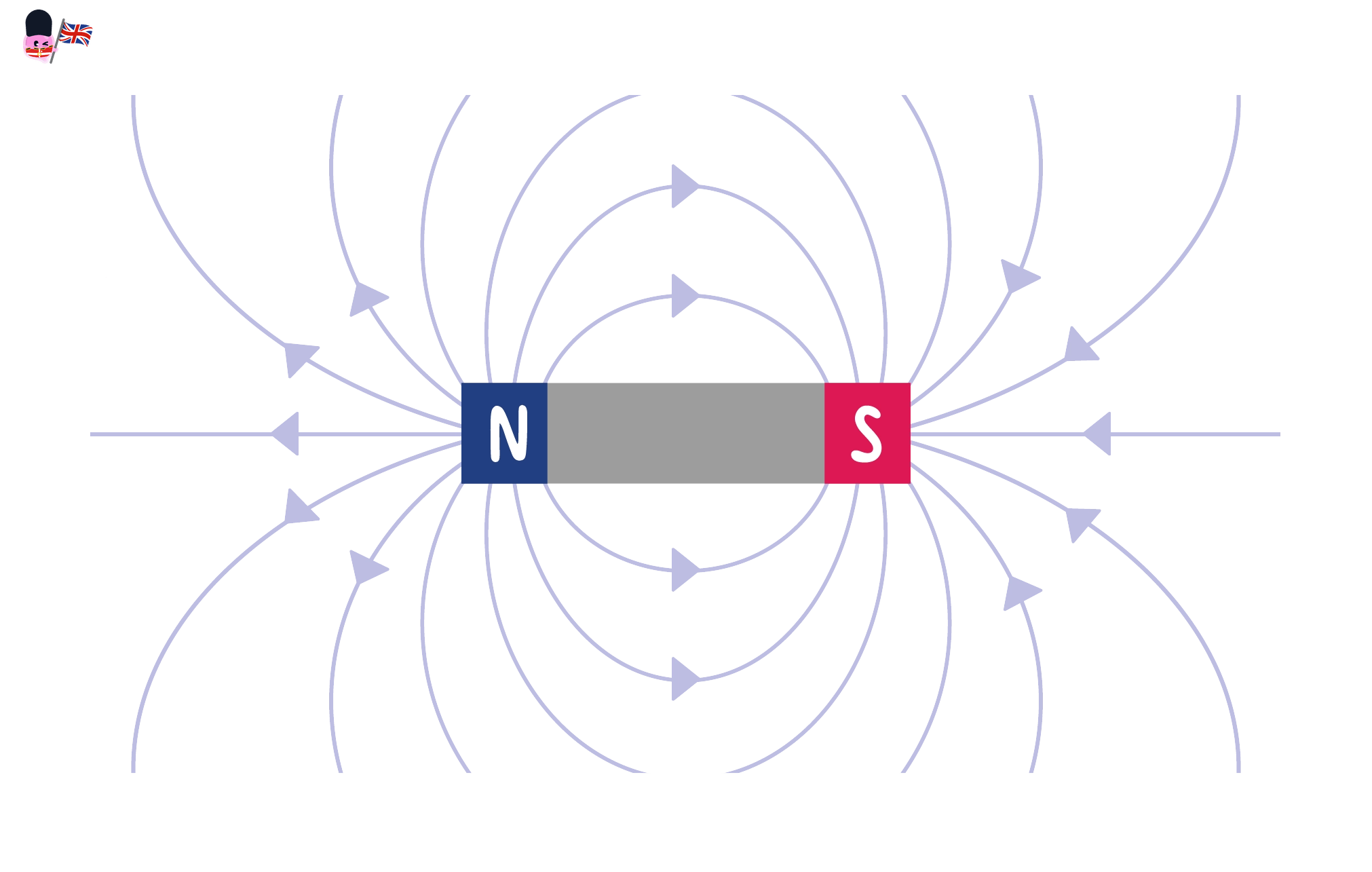
- A magnetic field line is drawn so that it shows the shape of the field and, through its arrowhead, the direction of the field at every point along it.
- Outside the magnet the lines come out of the N pole and go into the S pole, and every line carries an arrowhead pointing that way.
- The lines are complete loops, continuing inside the magnet from S back round to N, although a sketch usually shows only the part outside.
- They are packed tightly at the poles and spread widely at the sides, because the field is strongest at the poles.
- Field lines never cross, because a single point cannot have the field pointing in two directions at once.
- Draw them as smooth curves that start on one pole and finish on the other, rather than as straight spokes or as lines that stop in mid-air.
Field direction is defined by the force on an N pole
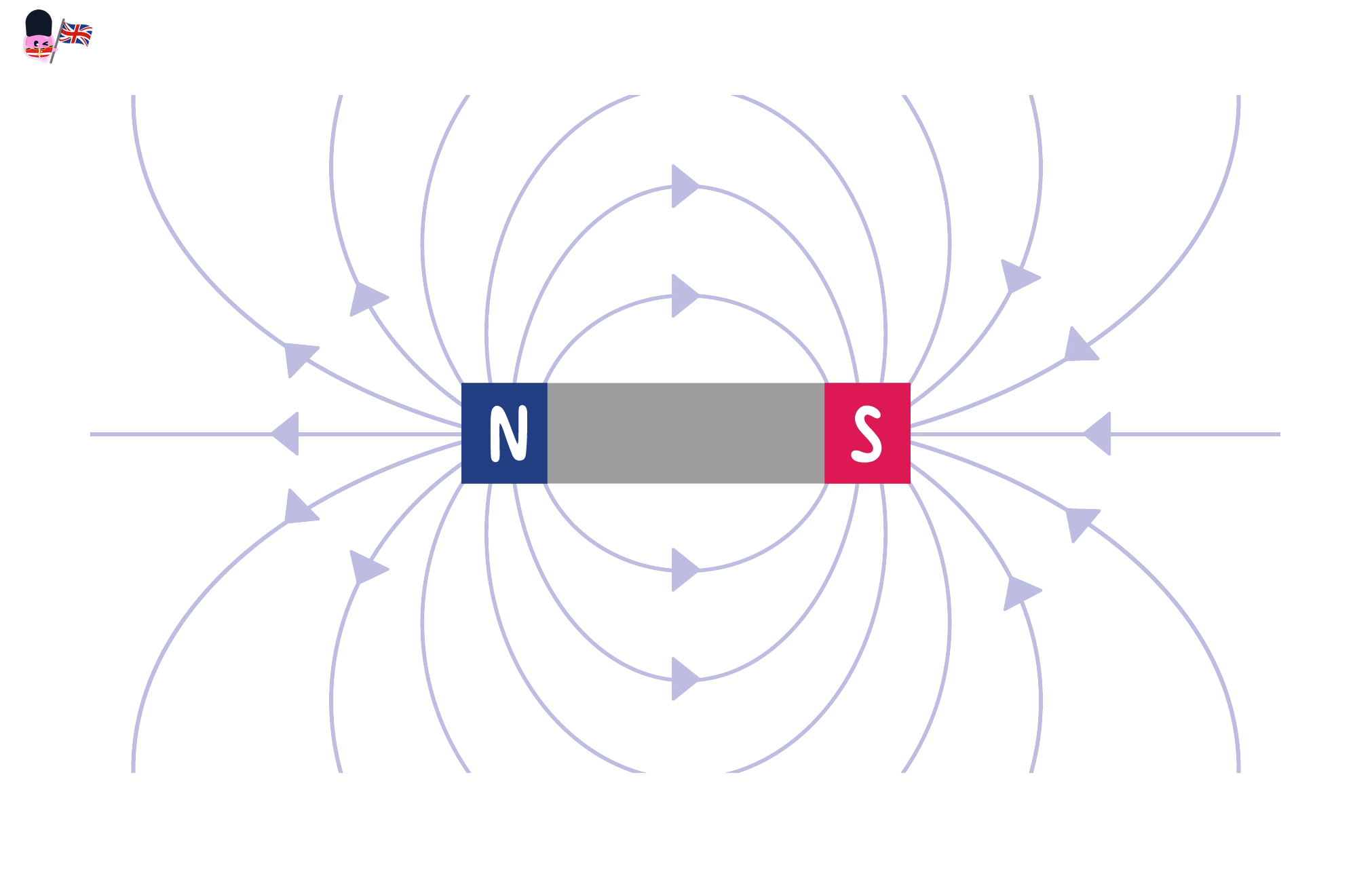
- The direction of a magnetic field at a point is the direction of the force on the N pole of a magnet placed at that point.
- A plotting compass is a tiny bar magnet on a low-friction pivot, so its N-seeking end swings until it lies along the field line and points the way the field points.
- Set several compasses round a bar magnet and the needles fan out from the N pole and converge on the S pole, matching the arrows on the field lines exactly.
- The Earth produces its own magnetic field, and that is what makes a compass needle settle pointing roughly north wherever you stand.
Magnetic forces come from two fields interacting
- Two magnets never touch, so the force between them is carried by their magnetic fields.
- Each magnet sits inside the field of the other, and the force it feels comes from that field.
- Between unlike poles the two fields point the same way, so the lines join into continuous lines running straight from one magnet to the other and the magnets are pulled together.
- Between like poles the two fields point against each other, so the lines are pushed apart and bulge outwards, and the magnets are pushed apart.
- Midway between two like poles the two fields cancel exactly, giving a neutral point where the resultant field is zero and a plotting compass has no direction to settle in.
Closely spaced lines mean a strong field
- The spacing of the lines carries information as well as their shape: the closer the lines, the stronger the field.
- Near the poles of a bar magnet the lines are bunched together, so the field there is strong.
- Level with the middle of the magnet the lines are far apart, so the field there is weak.
- That gives you a quick check on any sketch: evenly spaced lines all over the diagram cannot be right for a bar magnet.
- Field lines must never cross, so redraw any sketch in which two lines meet.
- Arrows run from N to S outside the magnet, and an arrow the other way throws away the direction mark.
- A magnetic field is a region, not a line, so define it as a region in which a magnetic pole experiences a force.
- A neutral point is a point of zero resultant field, not a point where the two magnets happen to be equally strong.
- A "draw the field pattern" question is marked on three things: smoothly curved lines, arrows in the right direction, and lines that are closer together at the poles.
- Draw at least four or five lines, starting each one on the N pole and finishing it on the S pole, rather than leaving lines hanging in space.
- Check the pole labels before you draw when two magnets are shown, because like and unlike poles give completely different patterns.
- If asked to compare the field strength at two points, quote the line spacing at each point as your reason.
- Define a magnetic field.
- In which direction do field lines point outside a bar magnet?
- How is the direction of a magnetic field at a point defined?
- What does the spacing of the field lines tell you?
- Two N poles face each other. Describe what happens to the field lines between them, and what is found at the midpoint.
4.1.4 Plotting magnetic fields and uses of magnets
A plotting compass traces a field line one short step at a time
- A plotting compass is a small pivoted magnet, so it always settles along the field line passing through it.
- The needle only reveals the direction at the one point where it sits, so a whole line has to be built up by moving the compass in short steps.
- Marking pencil dots at the two ends of the needle, then moving the compass so that it starts where the last dot was, keeps each step short enough for the curve to come out accurate.
- Working on plain paper on a wooden bench matters, because iron and steel nearby become induced magnets and bend the field you are trying to record.
Investigation: plotting the magnetic field around a bar magnet
- Aim: to plot the field lines around a bar magnet, and around two magnets facing pole to pole, and to mark the direction of the field.
- Apparatus: eye protection, one or two bar magnets, a plotting compass, a shaker of iron filings, plain paper, a sharp pencil and a sheet of thin card.
- Method:
- Lay the paper on a wooden bench well away from other magnets and from the steel frame of the bench, put the bar magnet in the middle and draw round it, labelling which end is N.
- Place the plotting compass just off the N pole and mark a pencil dot at each end of the needle.
- Move the compass along so that its tail sits exactly on the dot the head made, then mark a new dot at the head.
- Keep stepping the compass along in this way until you reach the S pole or the edge of the paper.
- Join the dots into one smooth curve and add an arrowhead pointing away from the N pole.
- Start again from a different point around the magnet and repeat until six to eight lines cover the pattern on both sides.
- For the iron-filings version, cover the magnet with the card, sprinkle filings thinly over the card and tap it gently so they settle into the pattern.
- Repeat both methods with two magnets a few centimetres apart, once with N facing N and once with N facing S.
- Measure and plot: no numerical readings are taken, so the record is a set of sketched patterns with arrows: one bar magnet, two like poles, and two unlike poles.
- Result: the lines run from N to S outside the magnet and are closest together at the poles; unlike poles give lines that link the two magnets, while like poles give lines pushed apart with a neutral point midway where the compass will not settle.
- Watch out:
- Iron filings show the shape only, because a filing has no arrowhead, so use the compass to add the directions.
- Sprinkle the filings thinly, since a heavy dose clumps together and blurs the pattern.
- Keep other magnets, iron objects and the steel bench frame away, because they distort the field you are trying to map.
- Re-plot any line that comes out kinked, and repeat each line to check that it lands in the same place.
- Safety: wear eye protection while handling iron filings, and sprinkle them onto the card rather than straight onto the magnet, because filings are almost impossible to clean off a magnet.
Iron filings show the shape fast, a compass gives the direction
- Each iron filing becomes an induced magnet in the field, so the filings line up end to end and reveal the whole pattern in one go.
- The trade-off is that a filing has two identical ends: it lies along the line but cannot show which way the field points.
- A compass is slower because it maps one point at a time, but its N-seeking end gives the direction of the field directly.
- The usual approach is to use filings for the shape and then place a compass on the pattern to add the arrowheads.
- The filings also make the field strength visible, because they crowd together near the poles where the field is strongest.
Permanent magnets are chosen when the magnetism must stay on
- A fridge magnet and a magnetic cupboard catch hold on with no power supply at all.
- A compass needle is a light steel magnet on a low-friction pivot, free to turn to the Earth's field.
- Loudspeakers and headphones hold a permanent magnet next to a coil, and the changing current in the coil pushes against that fixed field to drive the cone in and out.
- Small d.c. motors, such as the one in a cordless drill, use permanent magnets to provide the field that the current-carrying coil turns in.
- Magnetic door seals on a fridge and the catch that holds a laptop lid shut work the same way, quietly and with no wiring.
Electromagnets are chosen when the magnetism must be switched
- An electromagnet is a coil of insulated wire wound on a soft-iron core, and it is magnetic only while a current flows.
- A scrapyard crane picks up a car body and drops it into the crusher simply by breaking the circuit.
- A relay uses a small current through an electromagnet to close a switch carrying a much larger current, which is how turning a car ignition key operates the heavy starter motor safely.
- A circuit breaker in a consumer unit contains an electromagnet that snaps the switch open the instant the current becomes too large.
- Electric bells, magnetic locks on secure doors, and the separators that pull steel cans out of a recycling stream all depend on being able to switch the field off.
- The strength of an electromagnet can also be changed by altering the current or the number of turns on the coil, which is impossible with a permanent magnet.
- Iron filings on their own do not give the direction of the field, so a plot made with filings alone cannot earn the direction mark.
- Do not draw the field lines as straight spokes radiating from the magnet, because outside a bar magnet they curve round from N to S.
- An electromagnet is not simply a stronger magnet: the property being used is that its magnetism switches off with the current.
- When describing the compass method, give the sequence in order: draw round the magnet, mark both ends of the needle, move the compass to the last dot, repeat, then join the dots and add an arrow.
- Say that the plotting is done away from other magnets and iron objects, because that precaution is usually worth a mark on its own.
- For a "uses" question, pair each use with its reason, as in "a scrapyard crane, because the magnetism can be switched off to release the load".
- Watch the wording: a question about an electromagnet wants a soft-iron core and a current, while one about a permanent magnet wants steel and no power supply.
- Describe how a plotting compass is used to plot one magnetic field line.
- Why do iron filings show the shape of a field but not its direction?
- Why should the plotting be done away from other magnets and iron objects?
- Give two uses of a permanent magnet and two of an electromagnet.
- State two ways of making an electromagnet stronger.