Refractive index compares the speed of light in two regions
Refractive index
The ratio of the speed of a wave in one region to its speed in another. Symbol nnn, and it has no unit because it is a ratio of two speeds.
n=v1v2 n = \frac{v_1}{v_2} n=v2v1where v1v_1v1 is the speed in the first region and v2v_2v2 is the speed in the second.
- For a material quoted on its own, the comparison is always with air, so the faster speed goes on top and nnn comes out greater than 111.
- Light travels at about 3.0×10⁸ m/s3.0 \times 10^8\ \text{m/s}3.0×108 m/s in air and at roughly 2.0×10⁸ m/s2.0 \times 10^8\ \text{m/s}2.0×108 m/s in glass, which is where the familiar value n≈1.5n \approx 1.5n≈1.5 comes from.
- A larger refractive index means light is slowed more, so it is bent more sharply at the boundary.
- Typical values are about 1.331.331.33 for water, 1.51.51.5 for glass and 2.42.42.4 for diamond, and nnn is exactly 111 for a vacuum.
- Because it is a ratio of two quantities with the same unit, nnn never carries a unit of its own.
The same number can be found from the angles instead of the speeds
-
Measuring the speed of light inside a glass block is far beyond a school laboratory, but the angles are easy to measure with a protractor.
-
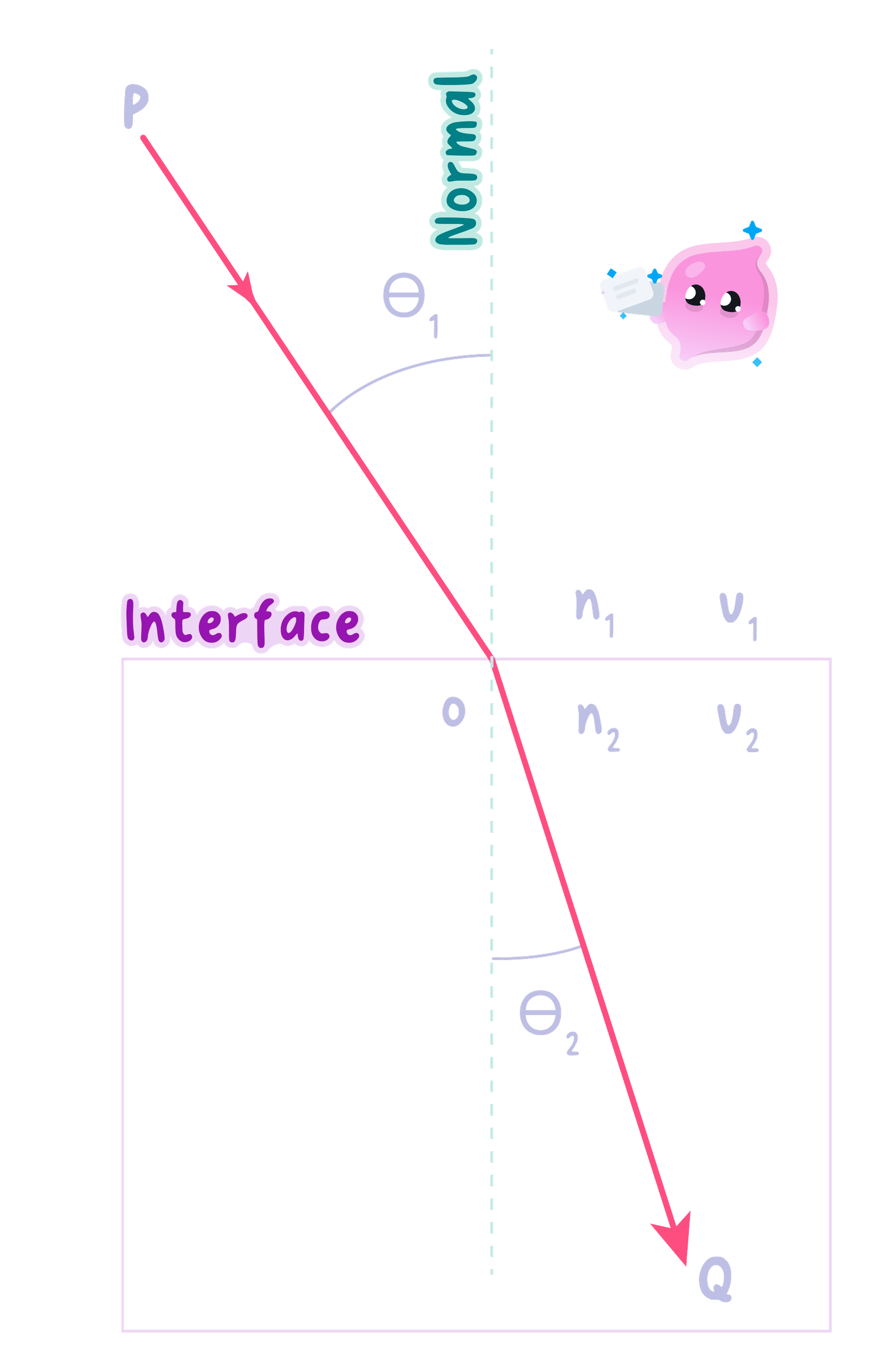
For light passing from air into a material, the refractive index is found from the sines of the two angles.
n=sinisinr n = \frac{\sin i}{\sin r} n=sinrsini -
Here iii is the angle in the air and rrr is the angle in the material, and both are measured from the normal.
-
Since rrr is smaller than iii on the way in, sini\sin isini is bigger than sinr\sin rsinr and nnn automatically comes out greater than 111.
-
The equation rearranges to sini=nsinr\sin i = n \sin rsini=nsinr and to sinr=sinin\sin r = \dfrac{\sin i}{n}sinr=nsini, so any one of the three quantities can be found from the other two.
-
If the light is going the other way, out of the material into air, turn the fraction upside down and use the angle in the material on the bottom.
Refractive index and critical angle are the same fact in two forms
-
At the critical angle the light inside the material is at angle ccc to the normal and the refracted ray grazes the surface at 90∘90^\circ90∘.
-
Putting those angles into the sine relationship, with sin90∘=1\sin 90^\circ = 1sin90∘=1, collapses it to a single tidy equation.
n=1sinc n = \frac{1}{\sin c} n=sinc1 -
Rearranged to find the critical angle itself, it becomes sinc=1n\sin c = \dfrac{1}{n}sinc=n1, so c=sin−1(1n)c = \sin^{-1}\left(\dfrac{1}{n}\right)c=sin−1(n1).
-
The two quantities move in opposite directions: a bigger refractive index gives a smaller critical angle, so light is trapped more easily.
-
This is why diamond, with n=2.4n = 2.4n=2.4, has a critical angle of only about 24∘24^\circ24∘, while water, with n=1.33n = 1.33n=1.33, needs about 49∘49^\circ49∘.
- Do not calculate sin(ir)\sin\left(\dfrac{i}{r}\right)sin(ri); take the sine of each angle first and then divide.
- Do not put the angle inside the glass on top when light is going from air into glass, or your nnn comes out less than 111.
- Do not give the refractive index a unit, because it is a ratio.
- Do not stop at sinc\sin csinc when the question asks for the critical angle; take the inverse sine to finish the job.
- Do not put the slower speed on top in n=v1v2n = \dfrac{v_1}{v_2}n=v2v1 when comparing a material with air, since that inverts the answer.
- Choosing which of the three equations to use:
- Two speeds in the question means n=v1v2n = \dfrac{v_1}{v_2}n=v2v1.
- Two angles at a boundary means n=sinisinrn = \dfrac{\sin i}{\sin r}n=sinrsini.
- The words "critical angle", or one angle with a refracted ray along the surface, means n=1sincn = \dfrac{1}{\sin c}n=sinc1.
- Set your calculator to degrees before you start, since a calculator left in radians turns every one of these into a wrong answer.
- You have to recall all three equations, so write the one you are using down before substituting; it often carries a mark of its own.
- Show the values of sini\sin isini and sinr\sin rsinr as a middle line, because that is where an error-carried-forward mark can rescue a slip.
- Sanity-check every refractive index against 111: anything below it means you have the fraction upside down.
- Give refractive indices to two significant figures unless the data justifies more, and give angles to the nearest degree.
- When a question mixes the two ideas, calculate the critical angle first and then compare it with the angle you were given.
- Define refractive index in terms of speeds, and say why it has no unit.
- Write the equation linking nnn to the angles of incidence and refraction, saying which angle is in which material.
- Light enters a liquid at 45∘45^\circ45∘ and refracts at 32∘32^\circ32∘. Calculate the refractive index.
- A material has a critical angle of 42∘42^\circ42∘. Calculate its refractive index.
- Explain why a material with a higher refractive index has a smaller critical angle.
