Light bends at a boundary because its speed changes there
Refraction
The change in direction of light as it passes from one transparent material into another, caused by a change in its speed at the boundary.
- Light travels fastest in a vacuum and in air, and more slowly in water, Perspex and glass.
- When a ray reaches the boundary at an angle, one side of the beam crosses into the glass and slows while the other side is still moving fast in the air.
- That lagging side pivots the whole beam round, in the same way a trolley slews sideways when one wheel hits gravel before the other.
- Entering a slower material the ray bends towards the normal, and leaving into a faster one it bends away from the normal.
- The frequency of the light is set by its source and never changes at a boundary, so the colour stays the same; the speed and the wavelength change together.
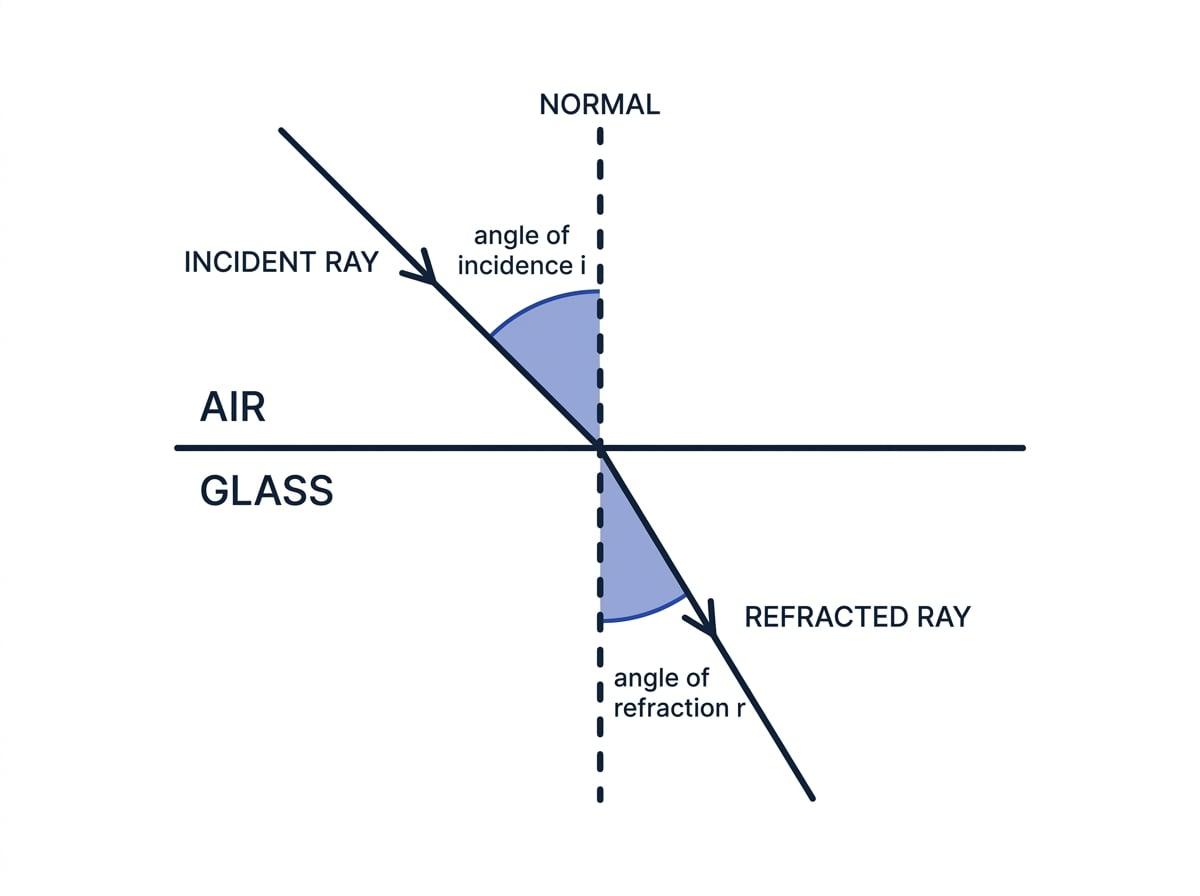
Both angles are measured from the normal, never from the surface
Normal
A construction line drawn at right angles (90∘90^\circ90∘) to a boundary, at the exact point where a ray meets it.
Angle of refraction
The angle between the refracted ray and the normal, measured inside the second material. Symbol rrr.
- The angle of incidence, iii, is the angle between the incident ray and the normal on the air side of the boundary.
- The normal is drawn as a dashed line so that it is never mistaken for a ray of light.
- Going from air into glass the ray bends towards the normal, so rrr is smaller than iii.
- A ray arriving along the normal has i=0∘i = 0^\circi=0∘, so it slows down but carries straight on with no bending at all.
- Increasing iii increases rrr, but not in proportion, so doubling one does not double the other.
Through a rectangular block the light emerges parallel but shifted
- A rectangular block has two parallel faces, so the light crosses two boundaries and is refracted twice.
- At the first face it slows and bends towards the normal.
- Inside the glass it travels in a straight line, because nothing changes along the way.
- At the second face it speeds up and bends away from the normal by the same amount.
- The two bends are equal and opposite, so the emergent ray is parallel to the incident ray but displaced sideways, which is called lateral displacement.
- The shift grows with a thicker block and with a larger angle of incidence, which is why a pencil viewed through thick glass appears jumped to one side.
- Blocks of other shapes behave differently because their faces are not parallel.
- A triangular prism bends the light twice the same way, so the ray leaves in a genuinely new direction.
- A semicircular block aimed at the centre of its flat face lets the ray enter along a radius, which is the normal to the curved surface, so it refracts only once.
Investigation: tracing rays through a transparent block
- Aim: to trace the path of light through transparent blocks of different shapes, measure the angles, and find the refractive index of the glass.
- Apparatus: a ray box or lamp with a single narrow slit, a rectangular glass or Perspex block, a triangular prism and a semicircular block, a protractor, a 30 cm30\ \text{cm}30 cm ruler, a sharp pencil and plain paper.
- Method:
- Stand the rectangular block on the paper and draw carefully round it, so it can be replaced in exactly the same position.
- Mark a point O\text{O}O near the middle of one long face and draw the normal there as a dashed line at 90∘90^\circ90∘ to that face.
- Darken the room and shine the ray at O\text{O}O so the angle of incidence is about 20∘20^\circ20∘.
- Mark two crosses far apart on the incident ray and two more on the ray emerging from the far face, without letting the block move.
- Lift the block away, join each pair of crosses, then join the entry point to the exit point to reveal the path inside the glass.
- Repeat for angles of incidence of about 30∘30^\circ30∘, 40∘40^\circ40∘, 50∘50^\circ50∘ and 60∘60^\circ60∘.
- Swap in the prism and then the semicircular block and trace the ray through each in the same way to compare the paths.
- Measure and plot: measure iii and rrr from the normal at the first face, tabulate them under i / degrees and r / degrees, then calculate sini\sin isini and sinr\sin rsinr and work out n=sini/sinrn = \sin i / \sin rn=sini/sinr for each pair before averaging.
- Result: rrr is always smaller than iii on entering the block, a ray sent along the normal passes straight through, the emergent ray from the rectangular block is parallel to the incident ray but laterally displaced, and nnn comes out at about 1.51.51.5 for glass.
- Watch out:
- The block must not shift between marking the entry and exit rays, so draw round it first and hold it still.
- At small angles the bend is tiny and a 1∘1^\circ1∘ marking error matters a lot, so take readings up to about 60∘60^\circ60∘ to keep the percentage uncertainty down.
- Mark the centre of the bright band with a sharp pencil and place the two crosses as far apart as the paper allows.
- Safety: the ray box lamp gets hot, so let it cool before moving it, and never look straight into the beam.
Refractive index puts a number on how much a material slows light
Refractive index
The ratio of the speed of a wave in one region to its speed in another. Symbol nnn, with no unit because it is a ratio of two speeds.
n=v1v2 n = \frac{v_1}{v_2} n=v2v1-
For a material quoted on its own the comparison is with air, so the faster speed goes on top and nnn comes out greater than 111.
-
Typical values are about 1.331.331.33 for water, 1.51.51.5 for glass and 2.42.42.4 for diamond, and a larger nnn means light is slowed more and bent more sharply.
-
Measuring the speed inside glass is beyond a school laboratory, but the angles are easy to measure, so the same number is found from their sines.
n=sinisinr n = \frac{\sin i}{\sin r} n=sinrsini -
Here iii is the angle in the air and rrr is the angle in the material, both measured from the normal.
-
The equation rearranges to sini=nsinr\sin i = n \sin rsini=nsinr and sinr=sinin\sin r = \dfrac{\sin i}{n}sinr=nsini, so any one of the three can be found from the other two.
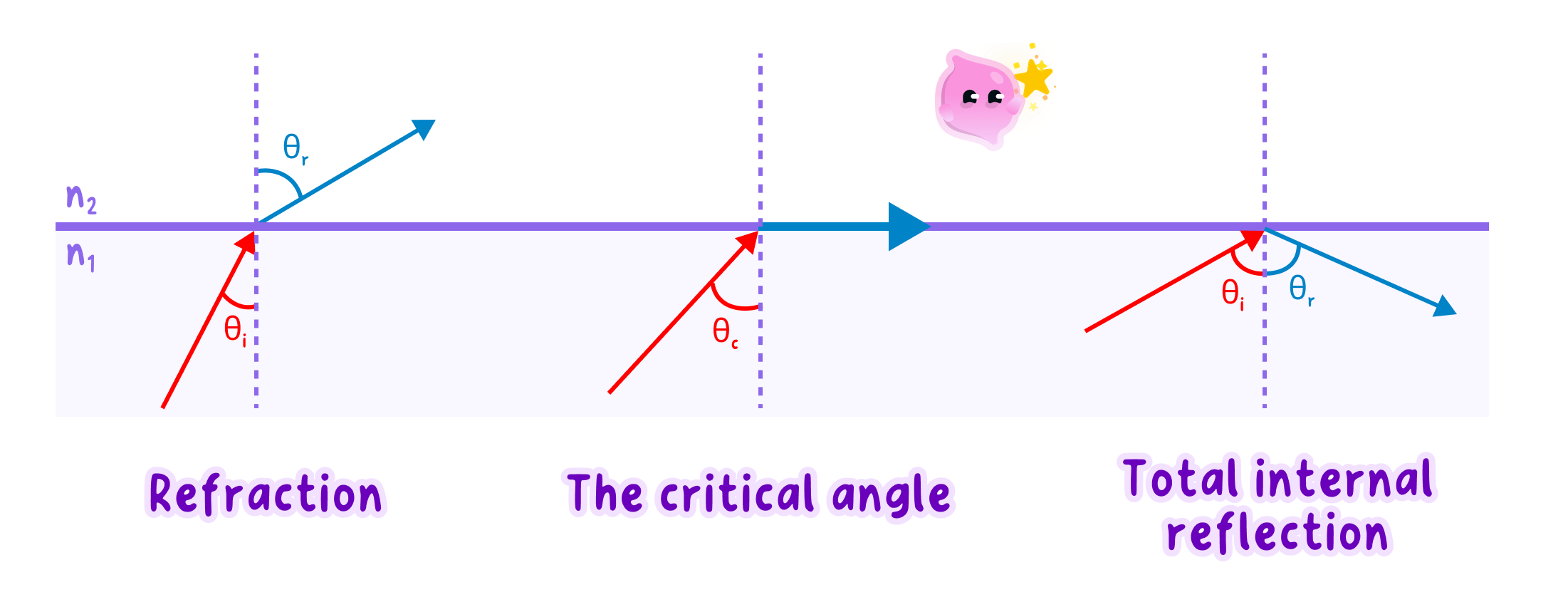
The critical angle is where the escaping ray grazes the surface
Critical angle
The angle of incidence inside the denser material for which the angle of refraction in the less dense material is exactly 90∘90^\circ90∘. Symbol ccc.
-
When light inside glass reaches the boundary with air it usually splits: a bright refracted ray escapes, bending away from the normal, and a faint internally reflected ray stays inside obeying i=ri = ri=r.
-
As the angle inside the glass grows, the escaping ray swings further round and dims, while the internally reflected ray brightens.
-
At the critical angle the escaping ray lies flat along the surface, grazing the boundary at 90∘90^\circ90∘ to the normal, and it is barely visible.
-
Putting i=ci = ci=c and r=90∘r = 90^\circr=90∘ into the sine relationship, with sin90∘=1\sin 90^\circ = 1sin90∘=1, collapses it to a single equation.
n=1sinc n = \frac{1}{\sin c} n=sinc1 -
Rearranged to find the angle itself this gives sinc=1n\sin c = \dfrac{1}{n}sinc=n1, so c=sin−1(1n)c = \sin^{-1}\left(\dfrac{1}{n}\right)c=sin−1(n1).
-
The two quantities move in opposite directions: glass with n=1.5n = 1.5n=1.5 has a critical angle of about 42∘42^\circ42∘, water about 49∘49^\circ49∘, and diamond with n=2.4n = 2.4n=2.4 only about 24∘24^\circ24∘.
Past the critical angle every bit of the light is reflected back
Total internal reflection
What happens when light strikes a boundary with a less dense material at an angle of incidence greater than the critical angle: no light is refracted out and all of it is reflected back inside.
- There is no angle larger than 90∘90^\circ90∘ available on the far side of the boundary, so past the critical angle a refracted ray simply cannot exist.
- Two conditions must both hold, and an answer giving only one of them is incomplete.
- The light must be travelling from a denser material towards a less dense one.
- The angle of incidence must be greater than the critical angle.
- The word total does real work: 100%100\%100% of the light is reflected, making it a better reflector than any silvered mirror, since a mirror always absorbs a little.
- You can watch all three stages in a semicircular block by aiming the ray at the centre of its flat face and slowly swinging the ray box round the curved edge.
- Everyday examples are all around: right-angled prisms in periscopes and binoculars turn light through 90∘90^\circ90∘ at a 45∘45^\circ45∘ face, bicycle reflectors throw a headlight beam straight back, and a diamond sparkles because light bounces round inside it many times before escaping.
Optical fibres put total internal reflection to work
Optical fibre
A thin, flexible strand of very pure glass or plastic that carries light along its length by repeated total internal reflection.
- A fibre is built as an inner core wrapped in cladding of lower refractive index, so light in the core always meets a less dense material at the wall.
- The core is thinner than a human hair, so light can only strike the sides at a glancing angle, which is larger than the critical angle measured from the normal to the wall.
- The ray therefore zig-zags along the fibre, bouncing thousands of times a metre with almost no loss, and it follows gentle bends round corners.
- In telecommunications a laser or light-emitting diode turns the electrical signal into rapid on-and-off pulses of light, and a detector at the far end turns them back.
- Fibres carry far more information per second than copper, fade much less over distance, are immune to electrical interference, and are thinner, lighter and more secure.
- The same physics is used in an endoscope, where one bundle of fibres carries light into the body and a second carries the image back out.
- Do not say light bends because the glass is denser; the mark is for the change in speed.
- Do not draw the ray bending inside the block; it travels straight between the faces and bends only at the boundaries.
- Do not calculate sin(ir)\sin\left(\dfrac{i}{r}\right)sin(ri); take the sine of each angle first, then divide.
- Do not give the refractive index a unit, because it is a ratio, and check it is greater than 111 or your fraction is upside down.
- Do not give only one condition for total internal reflection, and do not expect it at all when light passes from air into glass.
- Do not stop at sinc\sin csinc when the question asks for the critical angle; take the inverse sine to finish.
- Draw the normal as a dashed line at each face before you draw a single ray, since every angle depends on it.
- You have to recall all three equations here, so write the one you are using before substituting; it often carries a mark on its own.
- Show sini\sin isini and sinr\sin rsinr as a middle line, because that is where an error-carried-forward mark can rescue a slip, and set the calculator to degrees first.
- In a total internal reflection diagram show no ray at all leaving the surface, since a faint escaping ray contradicts the word "total".
- Describing the block experiment is point-marked, so name the ray box, the outline drawn round the block, the marked crosses and the protractor.
- When a question mixes the ideas, calculate the critical angle first and then compare it with the angle you were given.
- What causes light to change direction when it enters a glass block, and which way does it bend?
- Describe the path of a ray through a rectangular glass block, including how the emergent ray compares with the incident ray.
- Light enters a liquid at 45∘45^\circ45∘ and refracts at 32∘32^\circ32∘. Calculate the refractive index.
- State what is meant by the critical angle, and calculate it for a material of refractive index 1.51.51.5.
- Give the two conditions needed for total internal reflection.
- Explain how an optical fibre keeps light inside it, and give two advantages of fibres over copper cables.