Redshift: light from a receding source arrives stretched
Definition
Redshift
An increase in the observed wavelength of electromagnetic radiation emitted from receding stars and galaxies.
- A source that is receding is one moving away from the observer, and that motion changes what the observer measures.
- Each time the source emits the next wave crest it has already moved further away, so successive crests are spread further apart by the time they arrive.
- Crests further apart means a longer observed wavelength, and since the speed of the wave has not changed, a longer wavelength also means a lower observed frequency.
- You hear the same effect with sound when an ambulance passes: the siren drops in pitch the instant the vehicle changes from approaching to receding.
- The word red is used because red is the longest-wavelength end of the visible spectrum, so stretching visible light shifts it towards the red end.
- The effect applies to all electromagnetic radiation, not only to visible light, so radiation that was never red in the first place is still described as redshifted.
- A source moving towards an observer produces the opposite effect, squashing the waves to a shorter wavelength, which is called blueshift.
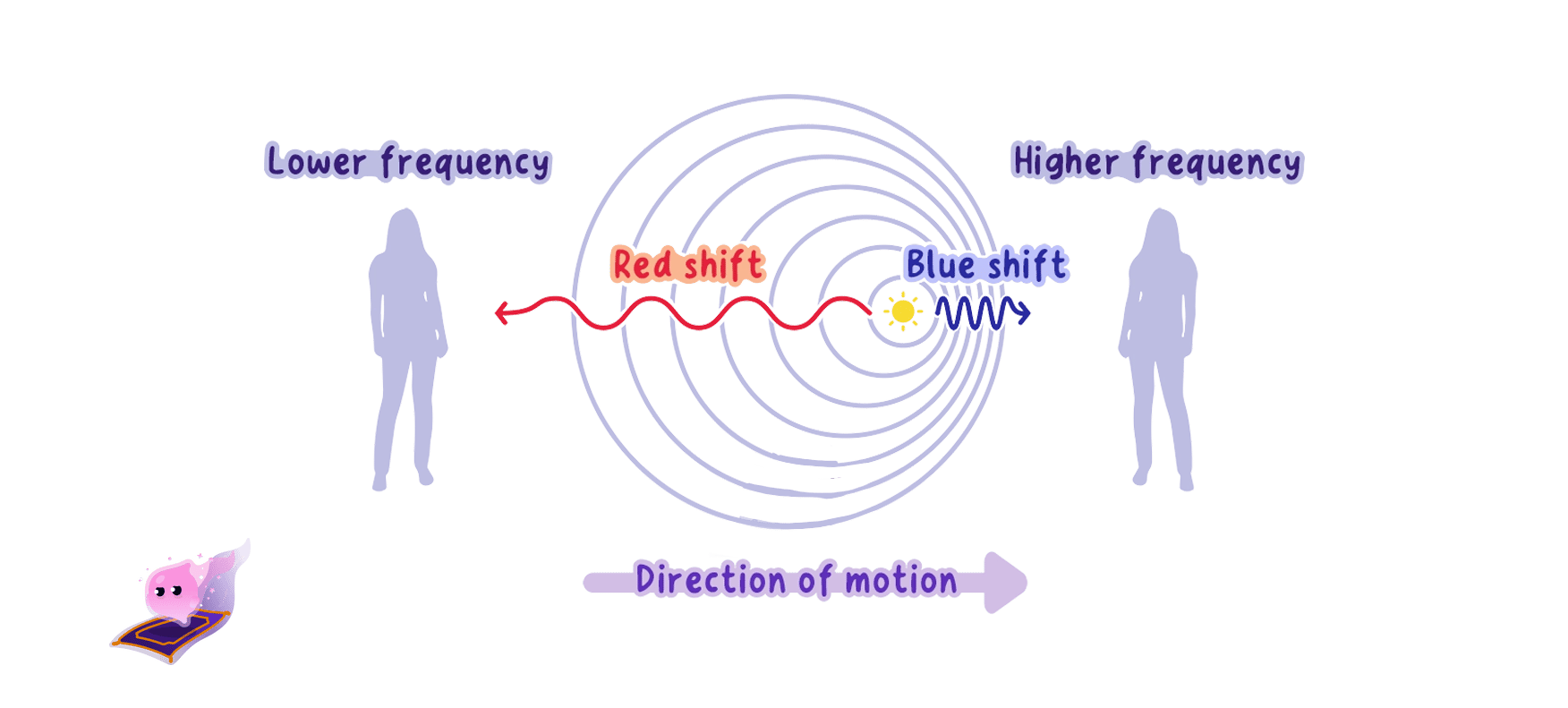
Key Idea
Redshift is about the wavelength the observer measures, not about the light changing colour on its journey; the source emitted it perfectly normally.
How we know: comparing starlight with the same element on Earth
Definition
Spectral line
A line at one particular wavelength in the spectrum of an element, always found at the same wavelength for that element.
- Each element produces its own fixed set of spectral lines, a pattern as recognisable as a barcode.
- That pattern can be produced and measured in a laboratory on the Earth, giving a known set of wavelengths to compare against.
- When the same pattern is picked out in light from a distant galaxy, the whole set of lines is found shifted towards longer wavelengths.
- So the light emitted from distant galaxies appears redshifted in comparison with light emitted on the Earth.
- The pattern being shifted as a whole, with the spacings kept in proportion, is what proves this is motion rather than a different element.
- A larger shift means the galaxy is receding faster, so the size of the shift carries information as well as its direction.
- What this observation tells us about the Universe as a whole is taken up in the next article; here the point is the measurement itself.
Common Mistake
- Do not say the light turns red, because redshift means the wavelength increases, and it applies to radiation outside the visible range too.
- Do not write that the speed of the light changes, since light from a receding galaxy still travels at 3.0×10⁸ m/s3.0 \times 10^{8}\ \text{m/s}3.0×108 m/s and only the wavelength and frequency shift.
- Do not mix up the directions: receding gives a longer wavelength, approaching gives a shorter one.
Exam technique
- Use the exact phrase increase in observed wavelength when defining redshift, since "the light stretches" is the version that usually falls short.
- Say what the comparison is against, namely light from the same element emitted on the Earth, because the comparison is where the mark sits.
- Where a spectrum diagram is given, check which end is which before deciding on redshift or blueshift, since the axis is not always drawn the way you expect.
- The word receding is the one to use for a source moving away, and it is worth writing rather than "going backwards".
Self review
- Describe what is meant by redshift.
- Explain why waves from a receding source arrive with a longer wavelength.
- What happens to the observed frequency when a source recedes, and why?
- What is light from a distant galaxy compared with in order to detect redshift?
- A spectral line appears at a shorter wavelength than in the laboratory. What does that tell you about the source?
