Sound starts when something vibrates and pushes on the medium around it
- Every source of sound is something that is vibrating, moving repeatedly back and forth about one average position.
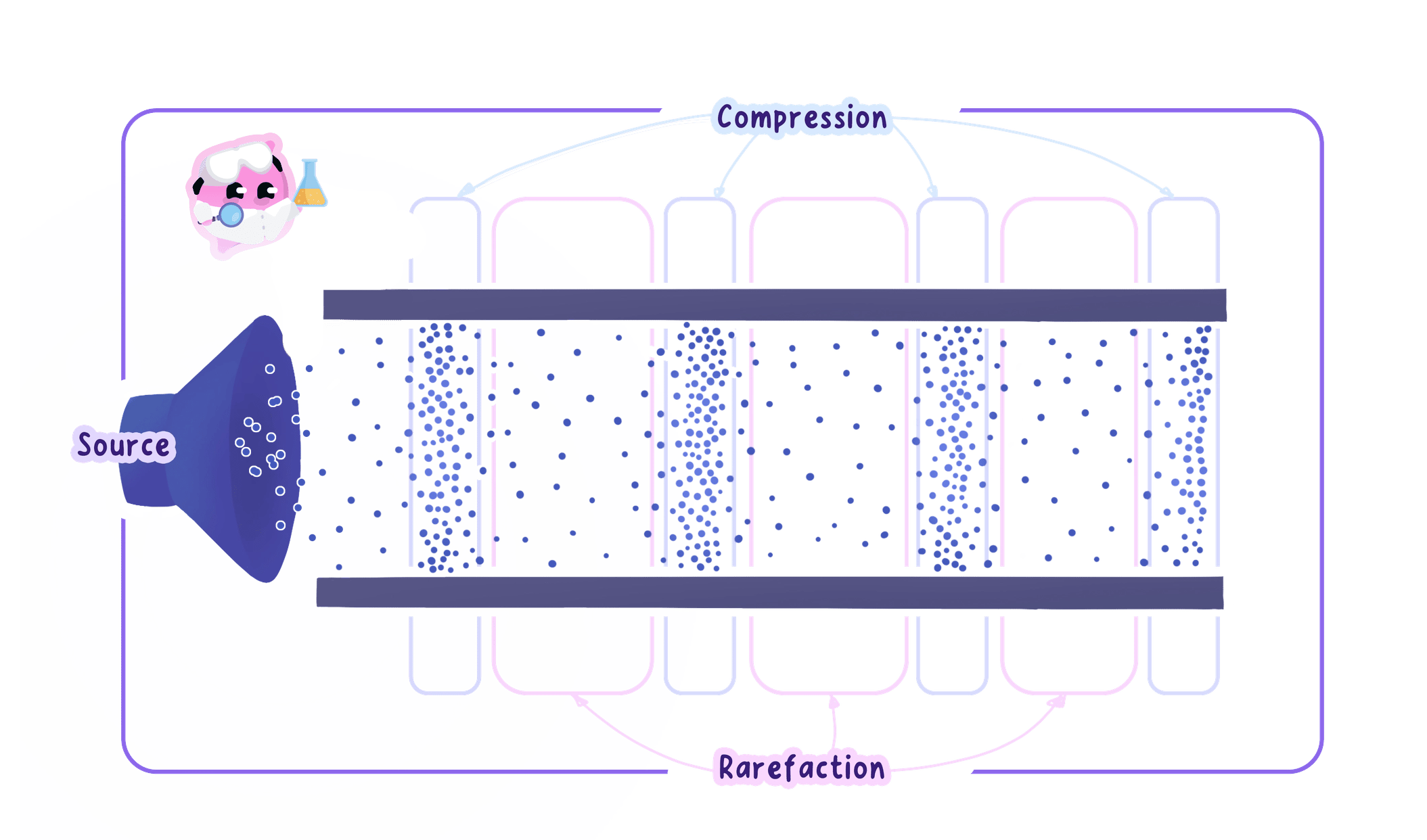
- As the surface of the source moves outwards it collides with the particles of the medium in front of it and pushes them closer to their neighbours.
- As the surface moves back inwards it pulls away from those particles and leaves them more room to spread out again.
- Those particles are now vibrating, so they push and pull on the particles beyond them, and the vibration is handed on from one layer of the medium to the next.
- Each particle keeps vibrating about the same average position, so the vibration is carried outwards while the air stays where it is.
- That handing on of the vibration is what transfers energy from the source to your ear, and it stops as soon as the source stops vibrating.
In every sound source you can name the part that is vibrating
- In a loudspeaker the vibrating part is the cone, which is driven in and out many times each second and pushes on the air in front of it.
- Rest your fingertips lightly on the front of a large loudspeaker while it is playing and you can feel the cone moving: the movement is small but fast.
- On a guitar the plucked string is the vibrating source.
- A string is thin, so on its own it shifts very little air; it shakes the bridge and the wooden body, and the broad body and the air inside it then vibrate and push on far more air.
- On a drum the stretched skin goes on vibrating after the stick has struck it, and grains of sand sprinkled on the skin jump about while it does.
- When you speak or sing, the vocal folds in your throat are blown apart and pulled back together by the air you breathe out, so they vibrate and set the air in your mouth vibrating.
- When a tuning fork is struck, its two prongs swing in and out together.
- Dip the tip of a sounding tuning fork into a beaker of water and the water sprays out, which is direct evidence that the prong is moving.
The particles vibrate along the same line as the energy travels
Longitudinal wave
A wave in which the particles of the medium vibrate parallel to the direction in which the wave transfers energy.
- Sound is a longitudinal wave in every medium it passes through, because the source works by pushing and pulling along the line it faces.
- If a loudspeaker on your left sends sound towards your right ear, the air particles vibrate left and right, along the very same line the energy is travelling.
- In a transverse wave the vibration is instead at right angles to the direction of energy transfer, and that single difference in direction is what separates the two families of wave.
- Each air particle shifts only a very short distance forwards and then back, and finishes where it began, so no particle travels from the loudspeaker to your ear.
- A long spring given a sharp push along its length behaves the same way: the coils move backwards and forwards along the spring while the pulse itself runs the whole length of it.
The forward push of the source crowds the particles into a compression
Compression
A region of a longitudinal wave in which the particles are closer together than normal, so the pressure there is higher than normal.
- Each time the vibrating surface moves outwards, the layer of air just in front of it is squeezed into a smaller space.
- The particles in that layer are packed closer together, so they strike any surface there more often and the pressure is raised above its normal value.
- That squeezed layer pushes on the layer beyond it, which is squeezed in turn, so the compression moves steadily away from the source.
- The compression travels but the particles do not travel with it: each layer is squeezed, then springs apart again as the compression moves on to the next layer.
- The pressure change is small, and a compression in ordinary speech sits only a tiny fraction above the pressure of the still air around it.
The backward movement of the source leaves a rarefaction behind it
Rarefaction
A region of a longitudinal wave in which the particles are further apart than normal, so the pressure there is lower than normal.
- When the vibrating surface moves back inwards it leaves extra room for the nearest particles, and they spread out into it.
- Those particles are further apart than normal, so the pressure in that thinned-out region drops below its normal value, and the region travels outwards just as the compression did.
- The source repeats the same cycle, out and back, so it sends out a compression, then a rarefaction, then another compression, for as long as it goes on vibrating.
- A sound wave is therefore a train of alternating compressions and rarefactions spreading out through the medium.
- One wavelength of a sound wave is the distance from the centre of one compression to the centre of the next.
- Measuring from one rarefaction to the next gives the same distance, because every wavelength holds one compression and one rarefaction.
- The spacing of the compressions is tied to how fast the source vibrates by the wave equation.
- v=fλv = f\lambdav=fλ
- At a fixed wave speed vvv, a source that vibrates more times each second gives a larger frequency fff and so packs its compressions closer together.
Your ear responds only to a limited band of frequencies
-
A source can vibrate at any rate at all, but your ear detects only part of that range.
-
The approximate range of frequencies audible to humans is:
20 Hz to 20 000 Hz 20\ \text{Hz}\text{ to }20\,000\ \text{Hz} 20 Hz to 20000 Hz -
A source vibrating more slowly than about 20 Hz20\ \text{Hz}20 Hz, or faster than about 20 000 Hz20\,000\ \text{Hz}20000 Hz, still sends compressions and rarefactions through the air; your ear simply does not respond to them.
-
Both limits are approximate: they differ from person to person, and the upper one drops as you get older.
Sound is a pressure wave, so it cannot cross a vacuum
- Everything a sound wave does depends on particles being there to be squeezed together and pulled apart, which is why sound is described as a pressure wave and why it needs a medium.
- A vacuum holds no particles, so there is nothing to compress and nothing to thin out, and no way for the vibration to be handed on.
- Sound therefore cannot travel through a vacuum, so an explosion out in space, however violent, reaches you in silence.
- Do not write that the air travels from the source to your ear; each particle vibrates about a fixed position and hands the vibration on to the next particle.
- Never say a compression is a region where the air is hot; it is a region where the particles are closer together and the pressure is higher than normal.
- If you sketch a sound wave as a smooth curve, that curve is a graph of pressure against distance, so do not go on to claim that the particles move up and down across the direction of travel.
- Do not allow sound to cross space in an answer: with no particles there is no wave at all, not merely a fainter one.
- Asked how a sound is produced, give three things: the part that vibrates, the fact that it sets the air particles vibrating, and the fact that the vibration is passed from particle to particle.
- The word that earns the longitudinal mark is parallel, used about the direction of vibration compared with the direction of energy transfer.
- Contrasting a compression with a rarefaction is worth two separate comparisons, particle spacing and pressure, each written as higher or lower than normal.
- Write that particles vibrate rather than that they move, because "move" leaves open the idea that they travel along with the wave.
- Quote the audible range as 20 Hz20\ \text{Hz}20 Hz to 20 000 Hz20\,000\ \text{Hz}20000 Hz and call it approximate.
- Name the part that vibrates in a loudspeaker, in a guitar and in a tuning fork.
- What two directions does the word "parallel" compare when you describe sound as longitudinal?
- How do the particle spacing and the pressure differ between a compression and a rarefaction?
- Between which two points on a sound wave would you measure one wavelength?
- Why does a vacuum stop a sound wave completely?
