1.8.1 Pressure
Pressure is force spread over an area
Pressure
The force acting per unit area, at right angles to the surface.
p=FA p = \frac{F}{A} p=AFwhere ppp is pressure in Pa\text{Pa}Pa, FFF is the force in N\text{N}N and AAA is the area in m2\text{m}^2m2.
- The unit is the pascal, Pa\text{Pa}Pa. One pascal is one newton spread over one square metre, so 1 Pa=1 N/m21\ \text{Pa} = 1\ \text{N/m}^21 Pa=1 N/m2.
- Pressure is a scalar, even though the force that produces it is a vector. It has a size but no direction of its own.
- The force used in the equation must act perpendicular to the surface. A force sliding along a surface presses on nothing and produces no pressure.
- The whole idea is that the same force can produce wildly different pressures depending on how it is spread. Nothing about the force changes; only the area does.
- Because AAA is on the bottom of the fraction, shrinking the area increases the pressure, and enlarging the area decreases it.
- Areas are almost always given in cm2\text{cm}^2cm2 and must be converted, and the conversion is not the one people expect: 1 m2=10 000 cm21\ \text{m}^2 = 10\,000\ \text{cm}^21 m2=10000 cm2, so divide a value in cm2\text{cm}^2cm2 by 10 00010\,00010000.
Investigation: the pressure you exert on the ground
- Aim: to measure the pressure your own weight exerts on the floor, and to see how that pressure changes when the contact area changes.
- Apparatus: bathroom scales, a large sheet of squared graph paper, a sharp pencil and a calculator.
- Method:
- Stand on the bathroom scales and record your mass in kg\text{kg}kg.
- Lay the graph paper on the floor, stand with one foot on it and draw carefully round the sole, holding the pencil vertical so the outline is not oversized.
- Step off and count the squares inside the outline, counting a square only if half or more of it lies inside the line.
- Convert the count to an area in cm2\text{cm}^2cm2, then divide by 10 00010\,00010000 to get the area in m2\text{m}^2m2.
- Calculate your weight from F=mgF = mgF=mg, taking g=10 N/kgg = 10\ \text{N/kg}g=10 N/kg.
- Calculate p=F/Ap = F/Ap=F/A for one foot, then repeat using twice the area for standing on both feet.
- Measure and plot:
- Record mass, square count, contact area, weight and pressure in a table headed quantity / unit, such as area / m² and pressure / Pa.
- There is no graph here, because the outcome is a pair of calculated pressures rather than a varying quantity.
- Result: the pressure works out at a few tens of kilopascals, and standing on two feet roughly halves it because the same weight is spread over twice the area.
- Watch out:
- Counting squares only estimates the area, so apply the half-square rule consistently and use finer graph paper if it is available.
- A sloping pencil traces an outline larger than the real contact patch, so keep it upright.
- Draw round the foot more than once and take a mean area to reduce the random error.
- Safety: minimal risk, but check that the scales sit on a flat, firm floor before standing on them.
Why the same force feels so different
- A drawing pin has a broad head and a needle-sharp point. Your thumb pushes with a modest force on the large head, so the pressure on your thumb is low, but that identical force is concentrated onto the tiny tip area, so the pressure there is enormous and the pin sinks into the wood.
- A sharp knife cuts better than a blunt one for the same reason. Sharpening reduces the area of the cutting edge, so the same downward force produces a far greater pressure.
- Skis and snowshoes work the other way round. They spread your weight over a large area, so the pressure on the snow is small enough that you stay on the surface instead of sinking.
- A tracked vehicle or a tractor with wide tyres crosses soft ground that would trap a car, because the large contact area keeps the pressure below what the ground can support.
- Foundations under a building are wide for the same reason: the weight of the building is enormous, so the area beneath it must be large enough to keep the pressure on the soil low.
- Pressure is not force. Force is measured in newtons, pressure in pascals. Answers that quote a pressure in newtons score nothing.
- 1 m2=10 000 cm21\ \text{m}^2 = 10\,000\ \text{cm}^21 m2=10000 cm2, not 100100100. Dividing by the wrong factor is the single most common error in this topic.
- Use the weight in newtons, not the mass in kilograms. Convert with F=mgF = mgF=mg first.
- A larger area gives a smaller pressure. Getting that relationship backwards is easy under time pressure, so check your answer against the drawing pin.
- Write p=F/Ap = F/Ap=F/A down before substituting, then work out the area on its own line, then divide. Each stage carries its own mark.
- Convert every area to m2\text{m}^2m2 and every mass to a weight in N\text{N}N before you substitute.
- For "explain why" questions, name the quantity that stays the same and the quantity that changes: "the force is unchanged, but the area is much smaller, so the pressure is much greater".
- Expect very large or very small numbers here and use standard form rather than trailing zeros.
- Define pressure and write the equation, giving the unit of each quantity.
- Convert 250 cm2250\ \text{cm}^2250 cm2 into m2\text{m}^2m2.
- A force of 80 N80\ \text{N}80 N acts on an area of 0.020 m20.020\ \text{m}^20.020 m2. Calculate the pressure.
- Explain why a person wearing skis does not sink into soft snow.
- Explain why a sharp knife cuts more easily than a blunt one.
1.8.2 Pressure beneath the surface of a liquid
Pressure in a liquid grows with depth and with density
Pressure beneath a liquid surface
The pressure caused by the weight of the liquid above a point, which increases with the depth below the surface and with the density of the liquid.
- Picture a column of liquid standing above a point. The pressure at that point is produced by the weight of everything in the column.
- Go deeper and the column is taller, so it weighs more, so the pressure is greater. This is why a dam wall is built thick at the bottom and thin at the top.
- Use a denser liquid and every metre of that column weighs more, so the pressure is greater again at the same depth. Mercury produces far more pressure than water at the same depth.
- Pressure in a liquid acts equally in all directions at a given depth, not just downwards. That is why water squirts sideways out of a hole in the side of a container, and why the pressure on your eardrums when you dive is the same whichever way you turn your head.
- The pressure does not depend on the shape of the container or on how much liquid there is in total. Only the vertical depth below the surface counts.
- Liquids are effectively incompressible, so their density stays the same all the way down, which is why the pressure rises steadily and evenly with depth.
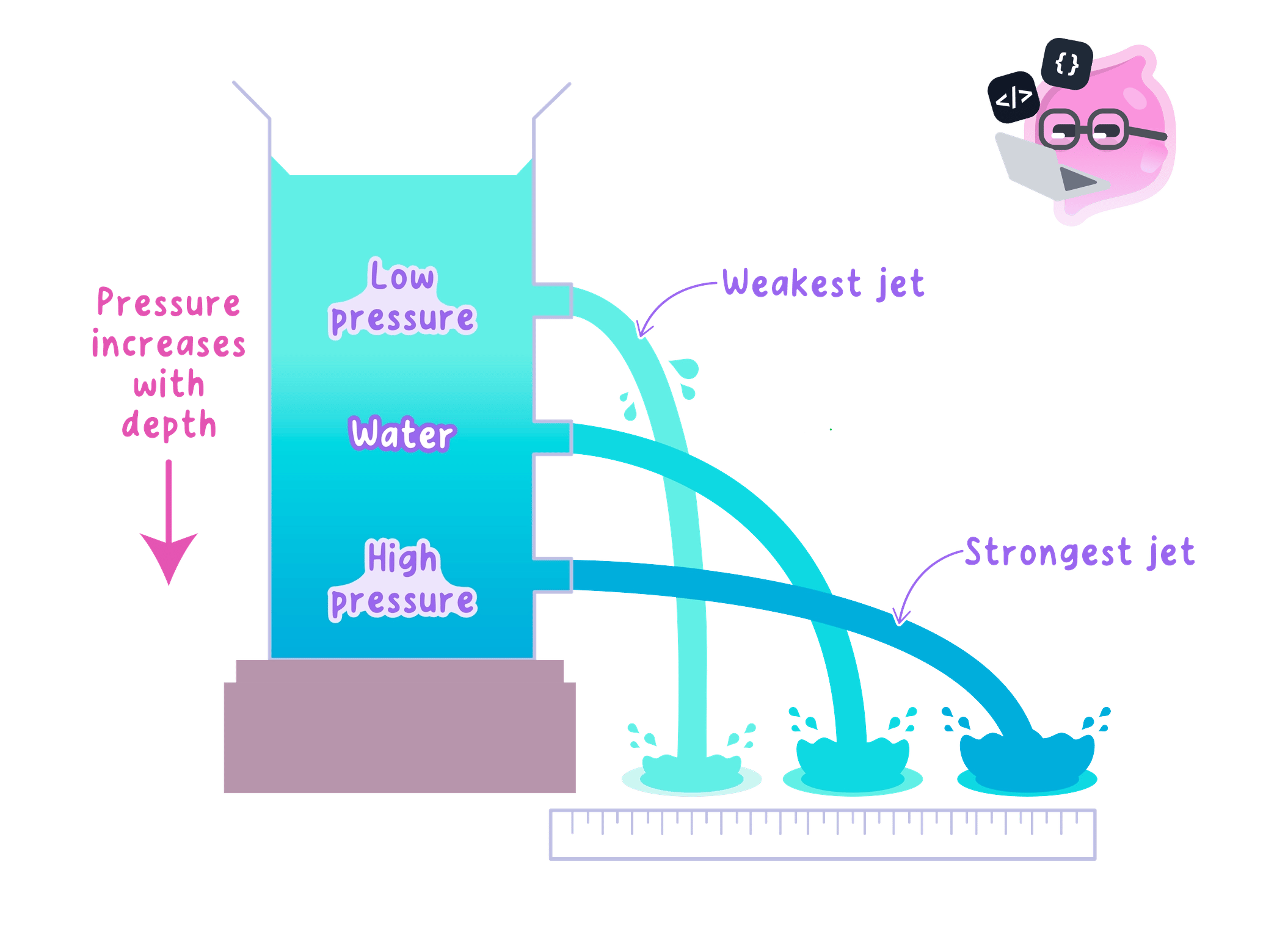
- A tall can of water is punctured with three holes at different heights, and water jets out of all three.
- The jet from the lowest hole travels furthest, because the water there is under the greatest pressure. The jet from the top hole barely dribbles out.
Calculating the change in pressure
Change in pressure with depth
The extra pressure produced by descending through a liquid, found from the density of the liquid, the gravitational field strength and the change in depth.
Δp=ρgΔh \Delta p = \rho g \Delta h Δp=ρgΔhwhere Δp\Delta pΔp is the change in pressure in Pa\text{Pa}Pa, ρ\rhoρ is the density of the liquid in kg/m3\text{kg}/\text{m}^3kg/m3, ggg is the gravitational field strength in N/kg\text{N/kg}N/kg and Δh\Delta hΔh is the change in depth in m\text{m}m.
- The equation confirms in symbols what the picture already showed: pressure rises in direct proportion to depth, and in direct proportion to density.
- It gives the pressure due to the liquid alone. To find the total pressure at that point you must add the atmospheric pressure pushing down on the surface, which is about 1.0×10⁵ Pa1.0 \times 10^{5}\ \text{Pa}1.0×10⁵ Pa.
- Density must be in kg/m3\text{kg}/\text{m}^3kg/m3. A density quoted in g/cm3\text{g}/\text{cm}^3g/cm3 is multiplied by 100010001000, so water at 1.0 g/cm31.0\ \text{g}/\text{cm}^31.0 g/cm3 becomes 1000 kg/m31000\ \text{kg}/\text{m}^31000 kg/m3.
- Δh\Delta hΔh is the vertical depth change. Following a sloping pipe downwards for 20 m20\ \text{m}20 m while dropping only 6 m6\ \text{m}6 m vertically counts as Δh=6 m\Delta h = 6\ \text{m}Δh=6 m.
- Notice that neither the area nor the volume of liquid appears anywhere in the equation, which is the algebraic reason the shape of the container makes no difference.
- Depth is measured from the surface downwards. A point 2 m2\ \text{m}2 m above the bottom of a 10 m10\ \text{m}10 m tank is at a depth of 8 m8\ \text{m}8 m, not 2 m2\ \text{m}2 m.
- Density must be in kg/m3\text{kg}/\text{m}^3kg/m3. Substituting 1.01.01.0 instead of 100010001000 for water makes the answer a thousand times too small.
- Δp=ρgΔh\Delta p = \rho g \Delta hΔp=ρgΔh gives the pressure due to the liquid only. Add atmospheric pressure when the question asks for the total.
- The width or shape of the container is irrelevant. A narrow tube and a wide tank of the same depth give the same pressure at the bottom.
- For qualitative questions, give a reason as well as a direction: "the pressure increases with depth because the weight of liquid above the point is greater".
- Check the units of every quantity before substituting, especially depths given in mm\text{mm}mm or cm\text{cm}cm and densities given in g/cm3\text{g}/\text{cm}^3g/cm3.
- Read carefully whether the question wants the pressure due to the liquid or the total pressure including the atmosphere. The word "total" is the signal.
- When comparing two liquids or two depths, state which quantity is being kept constant, then apply the direct proportionality.
- Describe how the pressure in a liquid changes as you go deeper, and explain why.
- Explain why a dam is thicker at its base than at its top.
- Write the equation for the change in pressure beneath the surface of a liquid.
- Calculate the pressure due to sea water of density 1030 kg/m31030\ \text{kg}/\text{m}^31030 kg/m3 at a depth of 30 m30\ \text{m}30 m, taking g=9.8 N/kgg = 9.8\ \text{N/kg}g=9.8 N/kg.
- Two containers of different width hold water to the same depth. Compare the pressure at the bottom of each.