1.2.1 Speed and velocity
Speed: the distance covered every second
Speed
The distance travelled per unit time.
v=st v = \frac{s}{t} v=tswhere vvv is the speed in m/s\text{m/s}m/s, sss is the distance in m\text{m}m and ttt is the time in s\text{s}s.
- A speed of 8 m/s8\ \text{m/s}8 m/s means 8 m8\ \text{m}8 m is covered in every second; "how fast it goes" describes speed but does not define it.
- Rearrange the same equation as the question needs: s=v×ts = v \times ts=v×t for a distance, t=s/vt = s/vt=s/v for a time.
- The SI unit is m/s\text{m/s}m/s, but km/h\text{km/h}km/h and cm/s\text{cm/s}cm/s are also used.
- Keep the units consistent: whatever units go in set the unit that comes out, so a distance in km\text{km}km with a time in h\text{h}h gives a speed in km/h\text{km/h}km/h.
- Convert with 1 km=1000 m1\ \text{km} = 1000\ \text{m}1 km=1000 m and 1 h=3600 s1\ \text{h} = 3600\ \text{s}1 h=3600 s, which together give 1 m/s=3.6 km/h1\ \text{m/s} = 3.6\ \text{km/h}1 m/s=3.6 km/h.
Velocity: speed with a direction attached
Velocity
Speed in a given direction.
- A velocity is only fully stated with a direction: 8.0 m/s8.0\ \text{m/s}8.0 m/s due north, or 12 m/s12\ \text{m/s}12 m/s downwards; a speed needs only a number and a unit.
- The same equation v=s/tv = s/tv=s/t gives the velocity when an object moves in a straight line in one fixed direction.
- An object can travel at constant speed while its velocity changes, because a change of direction alone changes the velocity.
- A car going round a roundabout at a steady 8.0 m/s8.0\ \text{m/s}8.0 m/s keeps its speed but has a continuously changing velocity, since the direction it heads in changes every instant.
Average speed: total distance over total time
Average speed
- Real journeys are not steady: a bus speeds up, slows down and stops.
- A single value of v=s/tv = s/tv=s/t across the whole trip is only the average speed, the steady speed that would cover the same distance in the same time.
- That is different from the instantaneous speed, the speed at one moment, which is what a speedometer shows.
- The marks live in the word total: the total time includes every part of the journey, including any time spent stationary at lights or in a queue.
- Constant speed does not mean constant velocity. An object turning a corner keeps its speed but changes its velocity, because its direction changes.
- Do not average the speeds. Adding two speeds and halving only works if the two stages take exactly the same time; always go back to total distance over total time.
- Do not drop stationary time from the total time; a stop still lasts, and it drags the average speed down.
- Do not mix units inside one substitution: convert km\text{km}km to m\text{m}m and hours or minutes to seconds before substituting if the answer is wanted in m/s\text{m/s}m/s.
- Write the equation from recall before substituting; marks are staged, so a correct equation and substitution still score even if the arithmetic slips, and the final answer needs its unit.
- Match the command word: "define speed" needs the wording distance travelled per unit time; "state the velocity" needs a number, a unit and a direction.
- The word average signals that the motion was not steady, so use total distance over total time, not one stage.
- If the data is in km\text{km}km and h\text{h}h but the answer is wanted in m/s\text{m/s}m/s, convert first and show the conversion.
- Define speed, and give the equation with its unit.
- What extra information does a velocity carry that a speed does not?
- How can an object have a constant speed but a changing velocity?
- How do you find the average speed for a journey that includes a stop?
- Convert 20 m/s20\ \text{m/s}20 m/s into km/h\text{km/h}km/h.
1.2.2 Distance–time and speed–time graphs
The two graphs are not the same graph
Distance-time graph
A graph with time on the horizontal axis and distance travelled on the vertical axis; the gradient of the line is the speed of the object.
Speed-time graph
A graph with time on the horizontal axis and speed on the vertical axis; the gradient of the line is the acceleration, and the area beneath the line is the distance travelled.
- Almost every mark lost here comes from treating one graph as though it were the other, so read the axis labels first, then read the shape.
- Speed is distance travelled per unit time, v=s/tv = s/tv=s/t, so a steeper distance-time line covers more distance in the same time and therefore means a greater speed.
- These are speed-time graphs, not velocity-time graphs.
Reading a distance-time graph
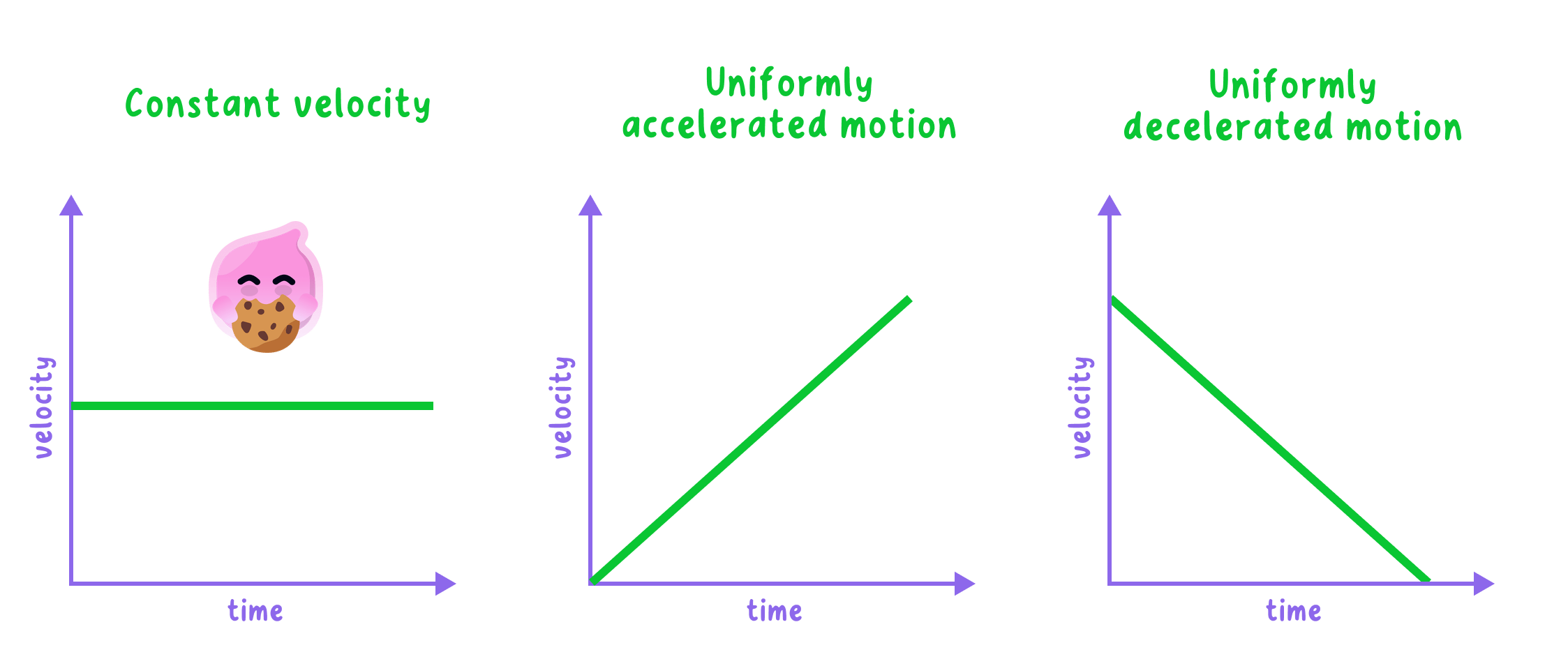
- Horizontal line: the distance is not changing, so the object is at rest.
- Straight sloping line (a positive gradient): equal distances in equal times, so constant speed; the steeper the line, the faster the object.
- Curve getting steeper: the speed is increasing, so the object is accelerating.
- Curve getting less steep: the speed is decreasing, so the object is decelerating.
- Line sloping downwards (a negative gradient): the object is moving back towards its starting point.
Reading a speed-time graph
- On the time axis (speed zero): the object is at rest.
- Horizontal line above the axis: the speed is not changing, so constant speed, the shape most often misread.
- Straight line sloping upwards (a positive gradient): the speed is increasing steadily, so the object is accelerating.
- Straight line sloping downwards (a negative gradient): the speed is decreasing, so the object is decelerating; where the line meets the time axis it has stopped.
- A curved line means the acceleration itself is changing.
- The commonest error is reading a distance-time graph as though it were a speed-time graph.
- A horizontal line means at rest on a distance-time graph, but constant speed on a speed-time graph.
- A straight sloping line means constant speed on a distance-time graph, but constant acceleration on a speed-time graph.
- A downward slope on a speed-time graph means slowing down, not moving backwards.
- However steep it is, a straight distance-time line never means acceleration; acceleration shows up there only as a curve.
- Check the axis labels before writing anything, questions deliberately mix the two graph types.
- Asked to describe the motion, work through the graph in order and account for every section, quoting the times: "from 0 to 8 s the car moves at constant speed, from 8 to 12 s it is at rest...".
- Use the precise words at rest, constant speed, accelerating, decelerating, not "steady" or "going up".
- Sketch means labelled axes and the right shape; plot means accurate crosses on the grid, joined with a ruler or one thin smooth curve. Label axes as quantity / unit, for example time / s.
- On a distance-time graph, what does the gradient of the line represent?
- On a speed-time graph, what do the gradient and the area under the line represent?
- What motion does a horizontal line show on each of the two graphs?
- On a distance-time graph, what shape of line shows that an object is accelerating?
- What is the difference between "sketch" and "plot" in a graph question?
1.2.3 Gradients and areas of motion graphs
Speed from the gradient of a distance-time graph
Gradient of a distance-time graph
Equal to the speed of the object, in m/s\text{m/s}m/s.
gradient=change in distancechange in time=ΔsΔt \text{gradient} = \frac{\text{change in distance}}{\text{change in time}} = \frac{\Delta s}{\Delta t} gradient=change in timechange in distance=ΔtΔs- This works because speed is distance travelled per unit time, so the gradient, a distance divided by a time, is a speed.
- A steeper gradient means a greater speed; a horizontal line has zero gradient, so the object is at rest.
- Take a gradient only from a straight section: on a curve the speed is changing, and a straight line drawn between two points on it gives only an average.
Distance from the area under a speed-time graph
Area under a speed-time graph
Equal to the distance travelled, in m\text{m}m.
- A height on the graph is a speed in m/s\text{m/s}m/s and a width is a time in s\text{s}s, so height ×\times× width gives m/s×s=m\text{m/s} \times \text{s} = \text{m}m/s×s=m, a distance.
- Constant speed is a horizontal line, so the area is a rectangle: distance=speed×time\text{distance} = \text{speed} \times \text{time}distance=speed×time.
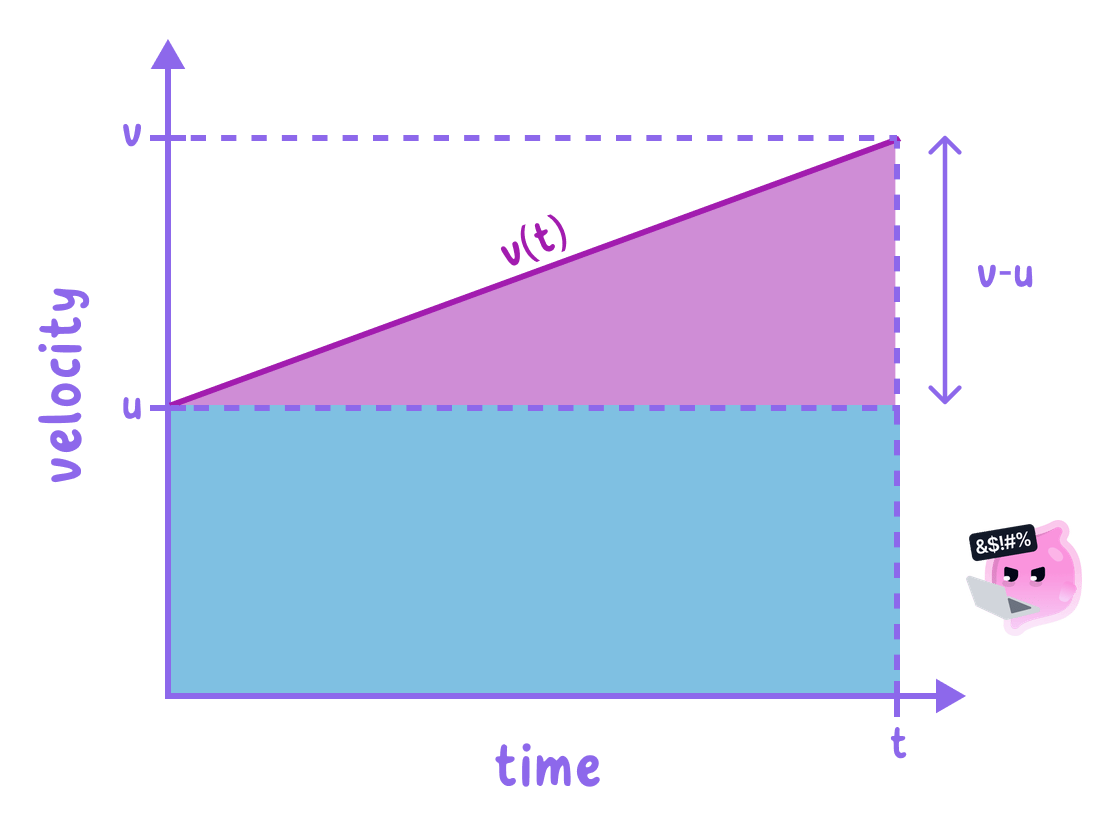
- Constant acceleration is a sloping straight line, so the area is a triangle, 12×base×height\tfrac{1}{2} \times \text{base} \times \text{height}21×base×height (a trapezium if the object does not start from rest).
- For a journey made of several straight sections, split the area into these simple shapes, work out each one, then add them.
Acceleration from the gradient of a speed-time graph
Gradient of a speed-time graph
Equal to the acceleration, in m/s2\text{m/s}^2m/s2.
a=ΔvΔt a = \frac{\Delta v}{\Delta t} a=ΔtΔv- Acceleration is the change in velocity per unit time, so once again the gradient, a speed divided by a time, is exactly the quantity you want.
- A steeper line means a larger acceleration; a horizontal line has zero gradient, so zero acceleration (constant speed).
- A line sloping downwards has a negative gradient, so the acceleration is negative and the object is slowing down.
- The most costly error is treating the two graphs as the same graph.
- On a distance-time graph the gradient is the speed, and the area underneath means nothing, never calculate it.
- On a speed-time graph the gradient is the acceleration and the area underneath is the distance.
- A horizontal line means stationary on a distance-time graph but constant speed on a speed-time graph, so "it has stopped" is only right when a flat speed-time line sits on the time axis.
- Check the axis labels before deciding whether to take a gradient or an area, the stem will not label the graph for you.
- Take a gradient with a large triangle, its hypotenuse covering at least half the straight section, reading the corners off gridlines; a small triangle magnifies the reading error.
- Show the equation and the substitution, not just the answer, so staged marks still score if the arithmetic slips.
- Always give the unit: m/s\text{m/s}m/s for a distance-time gradient, m\text{m}m for an area, m/s2\text{m/s}^2m/s2 for a speed-time gradient.
- How do you find the speed from a distance-time graph?
- How do you find the distance travelled from a speed-time graph?
- What does the gradient of a speed-time graph give, and in what unit?
- Why should you use a large triangle when taking a gradient?
- What area shape does constant acceleration from rest give on a speed-time graph?
1.2.4 Acceleration and deceleration
Acceleration: how quickly the velocity changes
Acceleration
The change in velocity per unit time.
a=ΔvΔt a = \frac{\Delta v}{\Delta t} a=ΔtΔvwhere Δv\Delta vΔv is the change in velocity in m/s\text{m/s}m/s and Δt\Delta tΔt is the time taken in s\text{s}s; the unit of acceleration is m/s2\text{m/s}^2m/s2.
- The symbol Δ\DeltaΔ means "change in", and a change is always final value minus initial value, so a=v−uta = \dfrac{v - u}{t}a=tv−u.
- The unit follows from the equation: a velocity in m/s\text{m/s}m/s divided by a time in s\text{s}s gives metres per second, per second, written m/s2\text{m/s}^2m/s2.
- An acceleration of 3 m/s23\ \text{m/s}^23 m/s2 means the velocity changes by 3 m/s3\ \text{m/s}3 m/s during every second.
Investigation: measuring speed and acceleration with a tickertape timer
- Aim: to use a tickertape timer to find the speed of a trolley and to identify and calculate its acceleration.
- Apparatus: tickertape timer and power supply, paper tape, trolley, a sloping runway, and a ruler.
- Method:
- Attach the tape to the trolley and thread it through the timer.
- Switch the timer on and release the trolley down the sloping runway.
- The timer prints 50 dots per second, so a ten-tick strip lasts 10×150=0.2 s10 \times \tfrac{1}{50} = 0.2\ \text{s}10×501=0.2 s; measure a strip's length to get the average speed over it from v=length/0.2 sv = \text{length} / 0.2\ \text{s}v=length/0.2 s.
- Compare successive ten-tick strips and find the acceleration from a=Δv/Δta = \Delta v / \Delta ta=Δv/Δt.
- Measure and plot:
- Measure the length of each ten-tick strip, which gives the speed over it.
- Build a tape chart of successive strips to show how the speed changes.
- Result: equal strip lengths mean constant speed; strips that lengthen evenly mean constant acceleration, with a=Δv/Δta = \Delta v / \Delta ta=Δv/Δt.
- Watch out:
- The dots bunch together at the crowded start, so ignore that region.
- Average over several ten-tick strips rather than trusting a single reading.
- Safety: stop the trolley before it runs off the end of the runway.
Constant and changing acceleration
- On a speed-time graph, how steeply the line rises shows how quickly the speed is changing.
- A horizontal line means the speed is not changing: zero acceleration (constant speed).
- A straight sloping line means the speed changes by the same amount every second: constant (uniform) acceleration; the steeper the line, the larger the acceleration.
- A curved line means changing (non-uniform) acceleration, a curve that steepens shows an increasing acceleration, one that flattens shows a decreasing acceleration.
- From data, compare the change in speed over equal time intervals: equal changes mean constant acceleration, unequal changes mean changing acceleration.
- Two vehicles have their speed recorded every 1.0 s1.0\ \text{s}1.0 s.
- Vehicle A: 0, 4, 8, 12, 16 m/s0,\ 4,\ 8,\ 12,\ 16\ \text{m/s}0, 4, 8, 12, 16 m/s. The speed rises by 4 m/s4\ \text{m/s}4 m/s every second, so the acceleration is constant at 4 m/s24\ \text{m/s}^24 m/s2 and the graph is a straight sloping line.
- Vehicle B: 0, 6, 10, 12, 13 m/s0,\ 6,\ 10,\ 12,\ 13\ \text{m/s}0, 6, 10, 12, 13 m/s. The rises are 666, 444, 222 and 1 m/s1\ \text{m/s}1 m/s, so the acceleration is changing, it is decreasing, and the graph is a curve that flattens out.
- Vehicle B is speeding up the whole time, even though its acceleration is falling.
Deceleration is a negative acceleration
Deceleration
A negative acceleration: the object is slowing down, so its final velocity is less than its initial velocity.
- There is no separate equation: use a=Δv/Δta = \Delta v / \Delta ta=Δv/Δt, take the direction of travel as positive, and because vvv is less than uuu, Δv\Delta vΔv comes out negative and so does aaa.
- Keep the minus sign in your working; it carries the physics.
- A negative acceleration does not mean moving backwards; it means slowing down while still travelling forwards.
- Do not write "a deceleration of −2 m/s2-2\ \text{m/s}^2−2 m/s2", which says it is speeding up. Either give the acceleration as −2 m/s2-2\ \text{m/s}^2−2 m/s2, or call it a deceleration of 2 m/s22\ \text{m/s}^22 m/s2.
- Constant acceleration is not constant speed: on a speed-time graph a straight slope is constant acceleration, a horizontal line is constant speed and zero acceleration.
- Do not read a speed-time graph as a distance-time graph: gradient of distance-time is speed, gradient of speed-time is acceleration, area under speed-time is distance.
- Write a=Δv/Δta = \Delta v / \Delta ta=Δv/Δt from recall before substituting, and show v−uv - uv−u as its own step, so staged marks still score if the arithmetic slips.
- Always give the unit m/s2\text{m/s}^2m/s2, and convert a time given in minutes to seconds first.
- When asked to judge "from the shape of the graph", name the shape and state the conclusion ("a straight slope, so constant acceleration"); no calculation is wanted.
- Define acceleration, and give its equation and unit.
- What does Δv\Delta vΔv stand for, and how do you work it out?
- On a speed-time graph, how do you tell constant acceleration from changing acceleration?
- Why does a deceleration come out as a negative acceleration?
- Does a negative acceleration mean the object is moving backwards?
1.2.5 Free fall and terminal velocity
The acceleration of free fall, g
Acceleration of free fall (g)
The acceleration of an object that is falling freely, acted on by gravity alone; near the surface of the Earth it is approximately constant and approximately 9.8 m/s29.8\ \text{m/s}^29.8 m/s2.
- Near the surface of the Earth: ggg gets smaller far from the planet, so the value only holds close to the ground.
- Approximately constant: over the heights used in exam questions the field is treated as uniform, so ggg does not change as the object falls.
- Some questions tell you to use 10 m/s210\ \text{m/s}^210 m/s2 instead; always use the value printed in the question.
- The same number is the gravitational field strength, 9.8 N/kg9.8\ \text{N/kg}9.8 N/kg: a field that pulls each kilogram with 9.8 N9.8\ \text{N}9.8 N gives each kilogram an acceleration of 9.8 m/s29.8\ \text{m/s}^29.8 m/s2.
- In free fall, all objects accelerate at the same rate whatever their mass: a larger mass is pulled by a larger weight, but is also harder to accelerate, and the two effects cancel exactly.
Released together on the airless Moon, a hammer and a feather hit the ground at the same instant: with no air resistance only gravity acts, and ggg is the same for both.
Falling with no resistance
- With no air or liquid resistance, the only force on the object is its weight.
- The weight is constant, so the resultant force is constant and downward, and the object falls with a constant acceleration of ggg.
- The speed increases by about 9.8 m/s9.8\ \text{m/s}9.8 m/s every second: 000, then 9.8 m/s9.8\ \text{m/s}9.8 m/s, then 19.6 m/s19.6\ \text{m/s}19.6 m/s, and so on.
- On a speed-time graph this is a straight line of constant gradient from the origin, and it never levels off: with no resistance there is no terminal velocity.
Falling with air or liquid resistance
Terminal velocity
The constant velocity a falling object reaches when the upward resistive force has grown equal to its weight, so the resultant force on it, and therefore its acceleration, is zero.
- Air resistance (drag) acts upwards on a falling object, and it increases as the object goes faster.
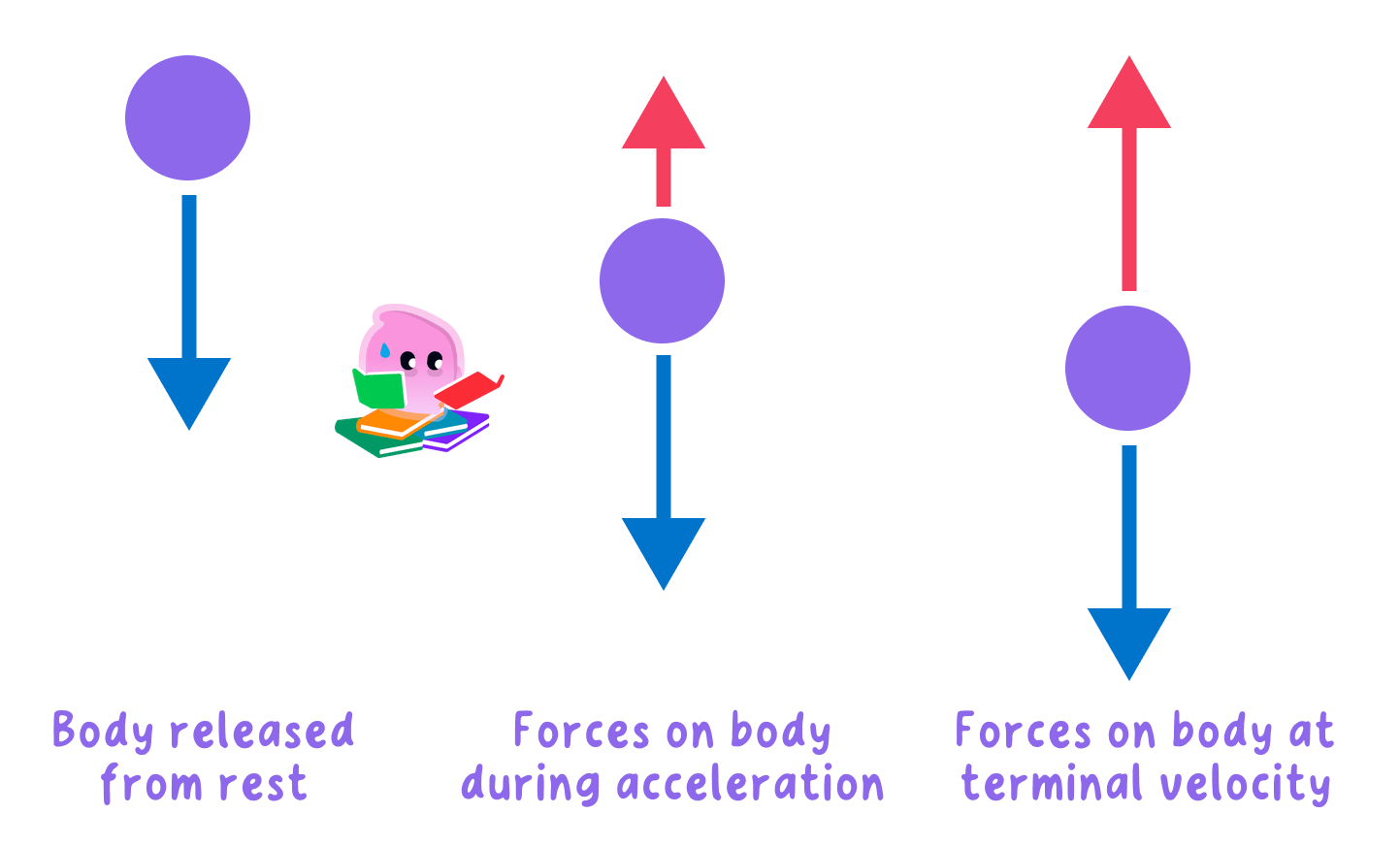
- At the moment of release the speed is zero, so the drag is zero; the resultant force is the full weight and the acceleration is at its maximum value, ggg.
- As the object speeds up, the drag increases, so the resultant force (weight minus drag) decreases and the acceleration decreases, but the object is still speeding up, just less quickly each second.
- When the drag has grown to equal the weight, the resultant force is zero, the acceleration is zero, and the object falls at a constant speed: its terminal velocity.
- On a speed-time graph this is a curve that starts steep, gets less steep, and levels off into a horizontal line at the terminal velocity.
- If a parachute opens, the surface area jumps and the drag becomes larger than the weight, so the resultant force acts upwards and the skydiver decelerates to a new, much lower terminal velocity that is safe for landing.
- The same reasoning applies in a liquid: a ball bearing dropped into a tall tube of oil meets a large resistance even at low speed, so it reaches a small terminal velocity quickly and then falls at constant speed.
- "Heavier objects fall faster." Without resistance they do not: mass makes no difference to ggg. A denser object reaches a higher terminal velocity, but that is the resistance, not gravity.
- "At terminal velocity there are no forces on it." There are two forces, weight and resistance; they are equal and opposite, so the resultant force is zero. Never write "no forces".
- "The acceleration decreases, so it slows down." A decreasing acceleration still means speeding up, just more gently; the object only slows once the resistive force becomes greater than the weight.
- "Describe the motion as it falls" is point-marked, so write separable points: name the forces, compare them, state the resultant, then say what happens to the acceleration and to the speed, linked with "because" and "so".
- Use the exact terms weight, air resistance (or drag), resultant force, acceleration and terminal velocity; contradicting yourself, such as "resultant force zero, still accelerating", cancels the mark.
- If a value of ggg is printed in the question, use that value.
- State the approximate value of ggg near the Earth's surface, with its unit.
- Why do all objects fall with the same acceleration when there is no air resistance?
- What happens to the acceleration of a falling object as air resistance builds up?
- Define terminal velocity.
- What happens to a skydiver's motion when the parachute opens?