A force towards the centre keeps an object moving in a circle
Definition
Centripetal force
The resultant force on an object moving in a circle, directed towards the centre of the circle and at right angles to the object's motion.
- An object going round a circle at steady speed is still accelerating, because its direction of motion (and so its velocity) is always changing.
- A changing velocity needs a resultant force, and here that force points towards the centre, perpendicular to the motion.
- Because the force is at right angles to the motion, it changes the direction of travel but not the speed.
- This inward force is provided by whatever is available: the tension in a string for a whirled ball, friction for a car turning a corner, or gravity for the Moon orbiting the Earth.
- Remove the inward force and the object carries straight on in a tangent, which is why mud flies off a spinning wheel.
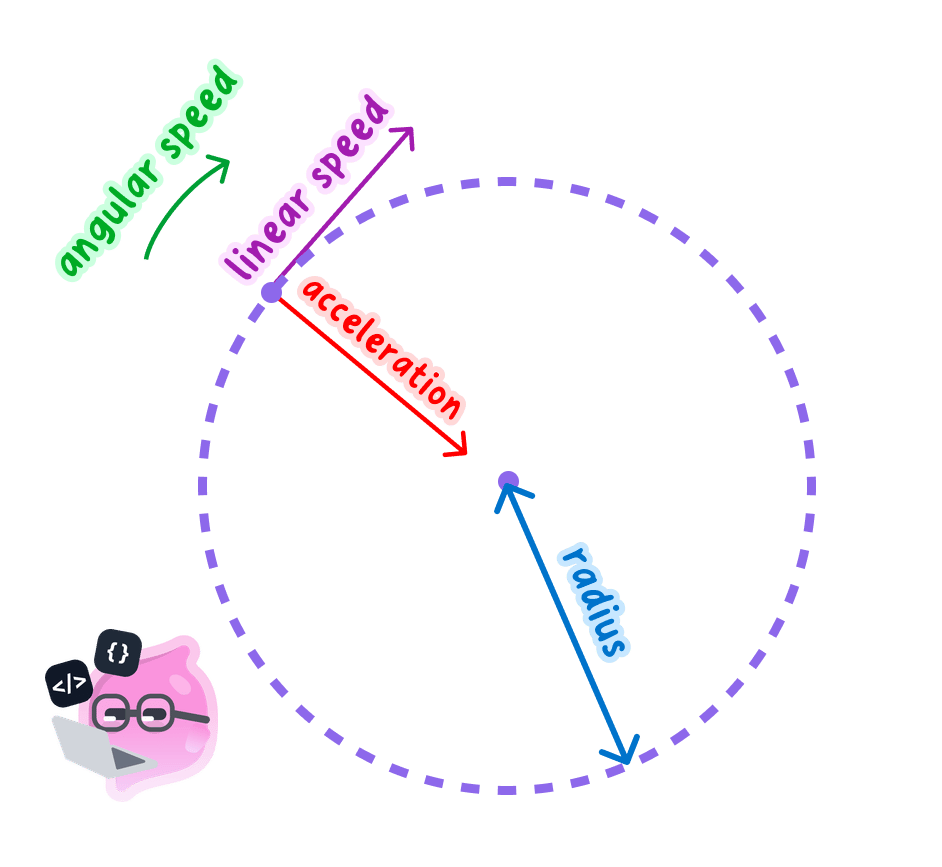
Changing the force, speed, mass or radius
- With the mass and radius kept the same, a larger force lets the object move at a higher speed around the circle.
- With the mass and speed kept the same, a larger force pulls the object into a smaller radius, a tighter circle.
- With the speed and radius kept the same, a larger mass needs a larger force to keep it on the circle.
Example
Whirl a rubber bung on a string in a horizontal circle: the tension pulls it towards your hand at the centre. Speed it up and you must pull harder; let the string go and the bung flies off in a straight line.
Common Mistake
- There is no outward force on the object; the resultant force points towards the centre, and the outward feeling is just the object's tendency to go straight on.
- Steady circular motion is not motion at constant velocity: the speed is constant but the direction, and so the velocity, keeps changing.
- You are not expected to use F=mv2/rF = mv^2/rF=mv2/r here; describe the effects qualitatively in words.
Exam technique
- Explain that a resultant force is needed because the direction of the velocity is changing, and state that the force acts towards the centre.
- When comparing cases, change one factor at a time and say clearly what is held constant, matching how the question is worded.
Self review
- Why is an object moving in a circle at steady speed accelerating?
- In which direction does the resultant force on it act?
- Does this force change the object's speed, its direction, or both?
- Keeping mass and speed constant, how does increasing the force change the radius?
- What happens to the object if the inward force is suddenly removed?
