1.6.1 Momentum and impulse
Momentum: the quantity that says how hard something is to stop
Momentum
The product of an object's mass and its velocity.
p=mv p = mv p=mvwhere ppp is momentum in kg m/s\text{kg}\,\text{m/s}kgm/s, mmm is mass in kg\text{kg}kg and vvv is velocity in m/s\text{m/s}m/s.
- A loaded lorry crawling through a car park and a cricket ball flying off the bat are both difficult to stop, for opposite reasons: one has a huge mass, the other a large velocity.
- Momentum is the single quantity that folds those two ideas together, so it tells you what it really takes to bring a moving object to rest.
- Momentum is a vector. It points in the same direction as the velocity, so two objects can carry equal amounts of momentum in opposite directions.
- Before any calculation, choose a positive direction and write down what you chose. Anything travelling the other way then has a negative velocity, and therefore a negative momentum.
- Momentum has no special unit name of its own. Write it as kg m/s\text{kg}\,\text{m/s}kgm/s, which you may also see written as kg m s−1\text{kg}\,\text{m}\,\text{s}^{-1}kgms−1.
- A large momentum means that stopping the object needs a large force, a long time, or both. That link is made exact by impulse, below.
Impulse: force multiplied by the time it acts
Impulse
The product of a force and the time for which that force acts, which is equal to the change in momentum it produces.
impulse=FΔt=Δ(mv) \text{impulse} = F\Delta t = \Delta(mv) impulse=FΔt=Δ(mv)where FFF is the force in N\text{N}N, Δt\Delta tΔt is the time in s\text{s}s, and Δ(mv)\Delta(mv)Δ(mv) is the change in momentum in kg m/s\text{kg}\,\text{m/s}kgm/s.
- The second half of that equation carries the physics: a resultant force acting for a time changes an object's momentum, and the impulse tells you by exactly how much.
- A bigger force changes the momentum more. So does the same force acting for longer. Only the product of the two matters.
- Impulse is measured in newton seconds, N s\text{N}\,\text{s}Ns. Because impulse equals a change of momentum, N s\text{N}\,\text{s}Ns and kg m/s\text{kg}\,\text{m/s}kgm/s are the same unit, and either is accepted for an impulse answer.
- Impulse is a vector acting in the direction of the force, so a force applied backwards gives a negative change of momentum and slows the object down.
- Rearranging gives F=Δ(mv)ΔtF = \dfrac{\Delta(mv)}{\Delta t}F=ΔtΔ(mv), which says that spreading a fixed change of momentum over a longer time makes the force smaller.
- That single line explains crumple zones, airbags, crash mats and bending your knees as you land. Your change of momentum is already fixed by how fast you were moving, so the only way to survive it comfortably is to stretch out the contact time.
- Momentum is not a moment. A moment is force ×\times× perpendicular distance from a pivot, measured in N m\text{N}\,\text{m}Nm; momentum is mass ×\times× velocity, measured in kg m/s\text{kg}\,\text{m/s}kgm/s.
- Momentum is not kinetic energy. Momentum is a vector using vvv once; kinetic energy is a scalar using v2v^2v2. Two objects can share the same momentum and have very different kinetic energies.
- On a rebound, do not simply subtract the two speeds. The velocity reverses, so the change of momentum is larger than the momentum you started with. Writing 0.15×(12−8.0)0.15 \times (12 - 8.0)0.15×(12−8.0) instead of 0.15×(−8.0−12)0.15 \times (-8.0 - 12)0.15×(−8.0−12) is the single most common error here.
- Impulse is measured in N s\text{N}\,\text{s}Ns, never in N/s\text{N/s}N/s.
- You are expected to recall p=mvp = mvp=mv and impulse=FΔt=Δ(mv)\text{impulse} = F\Delta t = \Delta(mv)impulse=FΔt=Δ(mv) without a formula sheet, so write the equation down first: that alone often scores a mark even if the arithmetic later goes wrong.
- Convert grams to kilograms and milliseconds to seconds before substituting, because the equations only work in SI units.
- State your positive direction in words, for example "taking motion to the right as positive", so your negative signs can be followed.
- The final mark usually depends on the unit, and on giving a direction whenever the question asks for one. A bare number will not do.
- State what is meant by the momentum of an object, and give its unit.
- A 1200 kg1200\ \text{kg}1200 kg car travels at 15 m/s15\ \text{m/s}15 m/s. Calculate its momentum.
- Define impulse, and write the equation that links it to change in momentum.
- Explain why a car with a crumple zone exerts a smaller force on its passengers in a crash.
- A ball of mass 0.20 kg0.20\ \text{kg}0.20 kg arrives at a wall at 6.0 m/s6.0\ \text{m/s}6.0 m/s and rebounds at 4.0 m/s4.0\ \text{m/s}4.0 m/s. Calculate the magnitude of the change in its momentum.
1.6.2 Conservation of momentum
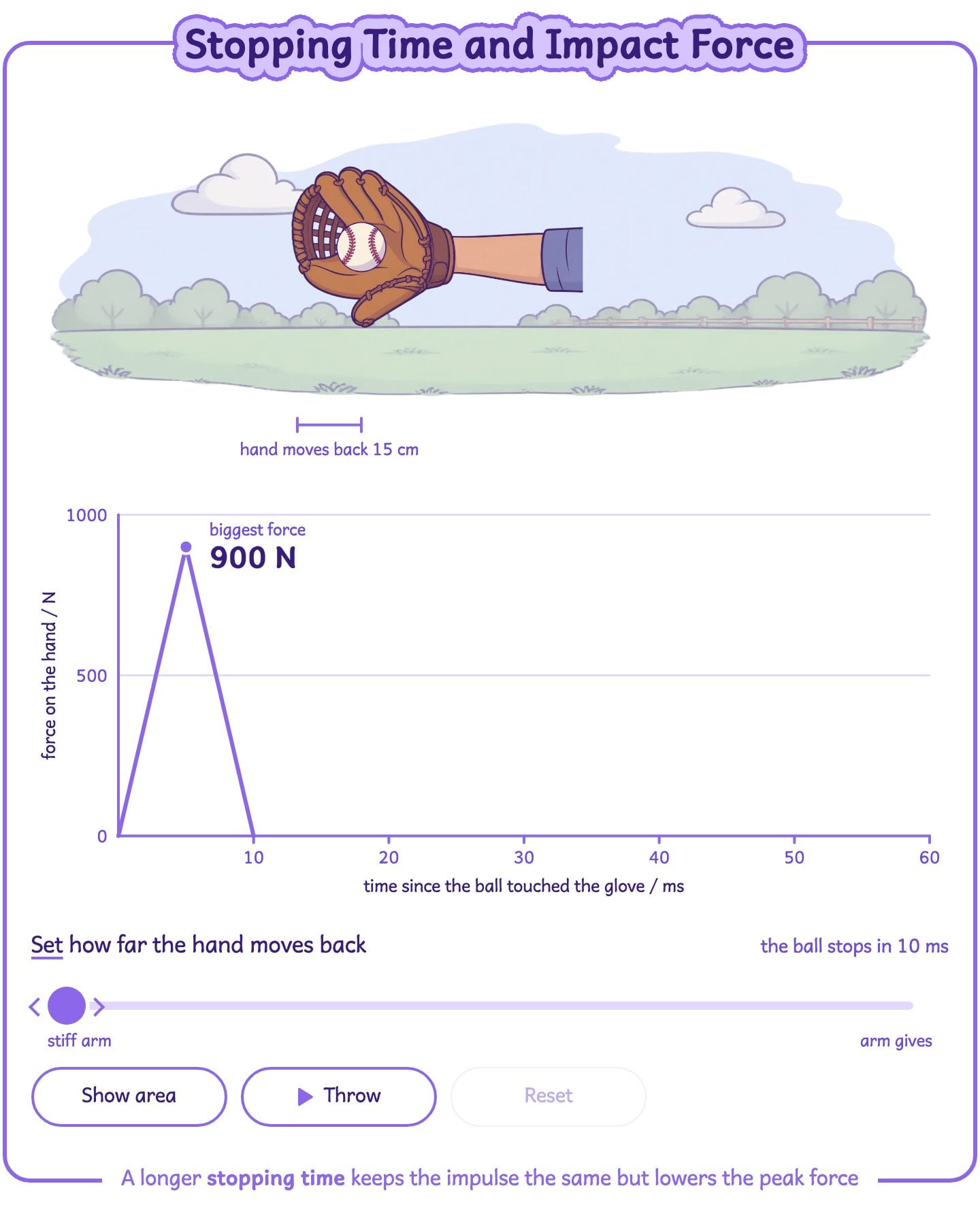
Lengthen the stopping time and notice the impulse stays the same while the peak force gets smaller.
Conservation of momentum: the total before equals the total after
Principle of the conservation of momentum
In a closed system, the total momentum before an interaction is equal to the total momentum after it, provided no external resultant force acts.
m1u1+m2u2=m1v1+m2v2 m_1u_1 + m_2u_2 = m_1v_1 + m_2v_2 m1u1+m2u2=m1v1+m2v2where uuu values are the velocities before the collision and vvv values are the velocities after it.
- A closed system simply means that you have counted every object involved and that nothing outside the system pushes or pulls on it while the interaction happens.
- The principle holds for collisions, where objects run into each other, and for explosions, where objects push apart from rest.
- Momentum is a vector, so the sums only work if you choose a positive direction first and give anything moving the other way a negative velocity.
- In an explosion the total momentum before is zero, because nothing is moving. The two fragments must therefore fly apart with equal and opposite momenta, which is why a rifle recoils and why a balloon shoots forwards as air rushes backwards.
- When two objects stick together after a collision, treat them afterwards as a single object of combined mass moving with one shared velocity.
- Kinetic energy is not always conserved in a collision, even though momentum always is. Objects that crumple, stick or make a noise lose kinetic energy to internal energy and sound, yet their total momentum is unchanged.
Resultant force is the rate at which momentum changes
Resultant force
The change in momentum per unit time produced on an object.
F=ΔpΔt F = \frac{\Delta p}{\Delta t} F=ΔtΔpwhere Δp\Delta pΔp is the change in momentum in kg m/s\text{kg}\,\text{m/s}kgm/s and Δt\Delta tΔt is the time taken in s\text{s}s.
- This is the same statement as impulse=FΔt\text{impulse} = F\Delta timpulse=FΔt, written the other way round, and it is the more general form of F=maF = maF=ma.
- If the mass is constant, Δp=mΔv\Delta p = m\Delta vΔp=mΔv, so F=mΔvΔt=maF = \dfrac{m\Delta v}{\Delta t} = maF=ΔtmΔv=ma. The momentum version is more powerful because it still works when mass itself changes, as it does for a rocket burning fuel.
- The equation says that a force does not produce motion by itself: it produces a rate of change of momentum. A steady force therefore builds momentum steadily.
- Because the change in momentum is fixed by the collision, increasing Δt\Delta tΔt decreases FFF. This is the quantitative reason behind safety features that extend an impact.
- The force calculated this way is an average force over the time interval, since the real force during a collision rises and falls.
- Momentum is conserved; kinetic energy often is not. Saying "energy is conserved so the speeds must stay the same" is wrong: the kinetic energy can drop while momentum stays fixed.
- Signs are not optional. Writing 6.0+4.06.0 + 4.06.0+4.0 for two objects approaching each other, instead of 6.0−4.06.0 - 4.06.0−4.0, is the classic slip. Define positive first.
- Do not forget the objects at rest. They contribute zero momentum, but they still contribute mass to the combined object after a collision.
- F=Δp/ΔtF = \Delta p / \Delta tF=Δp/Δt gives an average force, not the peak force during the impact.
- Start every problem by writing "taking motion to the right as positive" and a before and after sketch with a velocity arrow on each object. Most lost marks here are sign errors, not physics errors.
- Set the working out as total momentum before === total momentum after and substitute into that line, so the examiner can follow each term.
- When two objects join, the mass afterwards is the sum of the masses; when one splits, the masses afterwards must add back to the original.
- A negative answer is a result, not a mistake. Say what it means: "the piece moves in the opposite direction at 7.2 m/s7.2\ \text{m/s}7.2 m/s".
- State the principle of the conservation of momentum, and the condition under which it applies.
- A 3.0 kg3.0\ \text{kg}3.0 kg trolley at 4.0 m/s4.0\ \text{m/s}4.0 m/s hits a stationary 1.0 kg1.0\ \text{kg}1.0 kg trolley and they stick together. Calculate their common velocity.
- Explain why a gun recoils when it is fired.
- Write the equation that defines resultant force in terms of momentum.
- Explain, using that equation, why airbags reduce the force on a driver.