1.3.1 Mass and weight
Mass: the quantity of matter in an object
Mass
A measure of the quantity of matter in an object at rest relative to the observer.
- Mass is measured in kilograms (kg\text{kg}kg), with 1 kg=1000 g1\ \text{kg} = 1000\ \text{g}1 kg=1000 g, and it is a scalar: it has size but no direction.
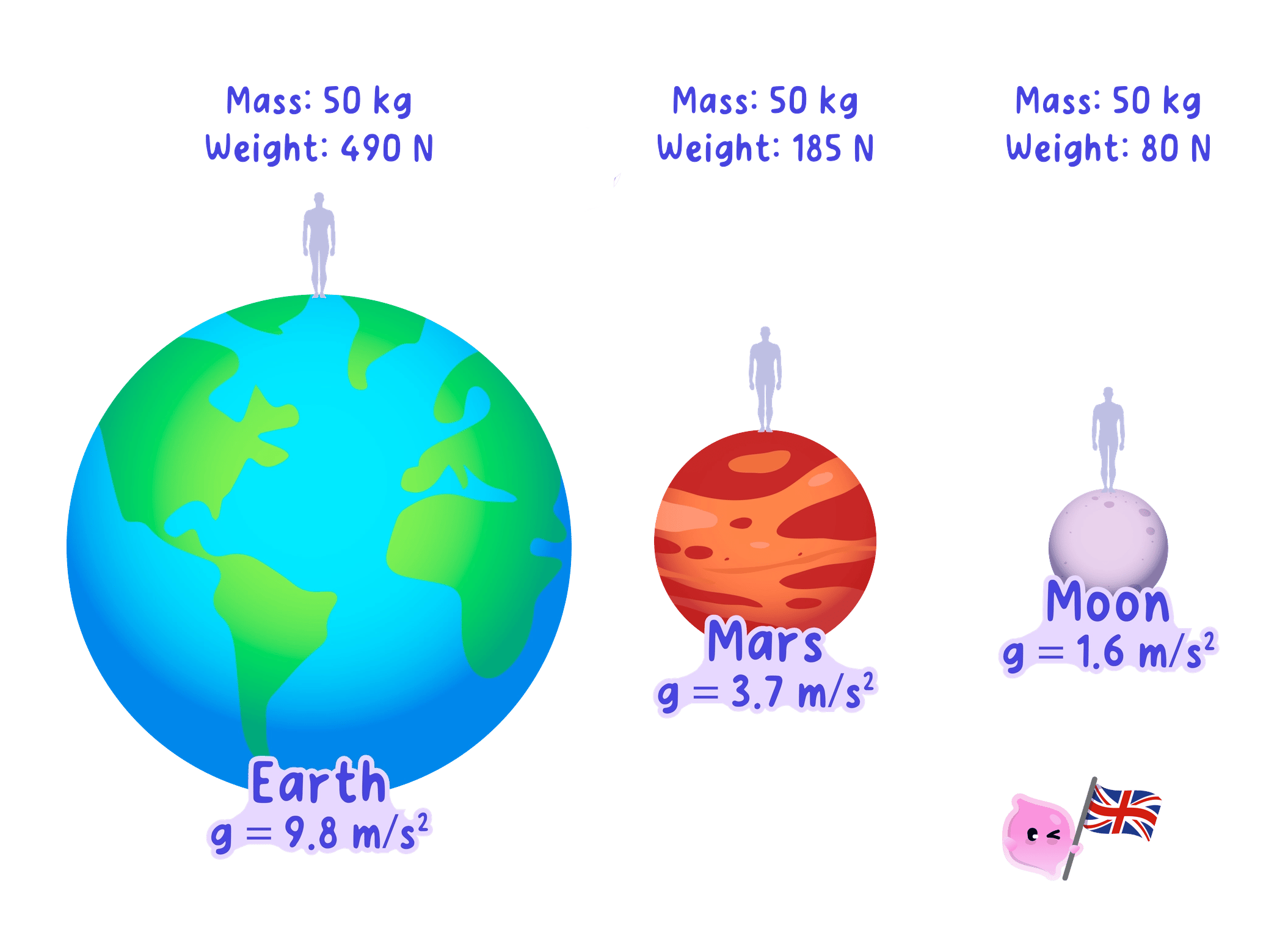
- Because mass counts the matter itself, it does not depend on location: a 2 kg2\ \text{kg}2 kg bag of sugar has a mass of 2 kg2\ \text{kg}2 kg on the Earth, on the Moon and in deep space.
- The only way to change an object's mass is to add or remove matter.
Weight: the gravitational force on a mass
Weight
A gravitational force on an object that has mass.
- Weight is measured in newtons (N\text{N}N), never in kilograms.
- It is a vector, acting vertically downwards towards the centre of the planet or moon producing the field.
- It is measured with a force meter, a spring balance (newtonmeter).
- An object has weight because it has mass and because it sits in the gravitational field of a nearby massive body.
- The same object weighs less on the Moon because the Moon's gravitational field is weaker, so the force on the same amount of matter is smaller.
Mass is the cause; weight is the effect. The matter in an object stays the same wherever you take it, but the gravitational force acting on that matter depends on where the object is.
Comparing masses with a balance
- A balance does not measure mass directly: it compares one weight with another.
- Put the object on one pan and add known standard masses to the other until the beam is level; the gravitational force pulling down on each side is then equal, so the two weights are equal.
- Both pans sit in the same gravitational field, so equal weights can only mean equal masses.
- This is why a beam balance reads the same on the Moon: every weight is reduced in the same proportion, so the same standard masses still balance the object.
- A spring balance behaves differently: it responds to the weight itself, so its reading in newtons falls on the Moon.
- Do not give a weight in kilograms. "My weight is 60 kg60\ \text{kg}60 kg" is everyday language: that is a mass, and the weight is a force in newtons.
- Mass does not change on the Moon. The weight changes, because the gravitational field is weaker; the mass is fixed.
- An astronaut in orbit does not have "no gravity". A gravitational force still acts, so the astronaut still has both mass and weight.
- Write gravitational force, not just "gravity", where the mark scheme wants the full term.
- Define and State questions here are one mark for one precise sentence, so learn both definitions word for word rather than paraphrasing.
- If asked how a balance compares masses, the mark is the linking step: it compares weights, and because the gravitational field is the same on both pans, equal weights mean equal masses.
- Watch the unit: a weight quoted without N\text{N}N, or given in kg\text{kg}kg, loses the mark however good the reasoning.
- Define mass, and give its unit.
- Define weight, and give its unit.
- Why does an object's weight change on the Moon while its mass does not?
- How does a beam balance compare the masses of two objects?
- Why does a beam balance read the same on the Moon, but a spring balance does not?
1.3.2 Gravitational field strength
Gravitational field strength: the force on each kilogram
Gravitational field strength
The force per unit mass acting on an object placed in a gravitational field.
g=Wm g = \frac{W}{m} g=mWwhere ggg is the gravitational field strength in N/kg\text{N/kg}N/kg, WWW is the weight in N\text{N}N and mmm is the mass in kg\text{kg}kg.
- "Per unit mass" means per kilogram, and that phrase is what earns the mark; "the pull of gravity" scores nothing.
- There is no formula sheet, so recall the equation and be ready to rearrange it into W=mgW = mgW=mg and m=W/gm = W/gm=W/g.
- Near the Earth's surface g≈9.8 N/kgg \approx 9.8\ \text{N/kg}g≈9.8 N/kg, though some questions tell you to use 10 N/kg10\ \text{N/kg}10 N/kg; always use the value given.
- On the Moon g≈1.6 N/kgg \approx 1.6\ \text{N/kg}g≈1.6 N/kg, about six times weaker, which is why the same object weighs about six times less there.
Why g is also the acceleration of free fall
- Gravitational field strength is equivalent to the acceleration of free fall: these are the same number written in different units, not two quantities that happen to match.
- Since 1 N=1 kg×1 m/s21\ \text{N} = 1\ \text{kg} \times 1\ \text{m/s}^21 N=1 kg×1 m/s2, dividing a force in newtons by a mass in kilograms leaves m/s2\text{m/s}^2m/s2, so N/kg\text{N/kg}N/kg and m/s2\text{m/s}^2m/s2 are the same unit written two ways.
- An object in free fall has only its weight acting, W=mgW = mgW=mg, so mg=mamg = mamg=ma and therefore a=ga = ga=g; the mass cancels, which is why all objects fall at the same rate when there is no air resistance.
A field strength of 9.8 N/kg9.8\ \text{N/kg}9.8 N/kg and an acceleration of 9.8 m/s29.8\ \text{m/s}^29.8 m/s2 are the same fact stated two ways, because N/kg\text{N/kg}N/kg and m/s2\text{m/s}^2m/s2 are the same unit.
Weight as the effect of a gravitational field
Gravitational field
A region of space in which a mass experiences a force.
- Weight is not something an object carries by itself: it is the effect of a gravitational field on a mass.
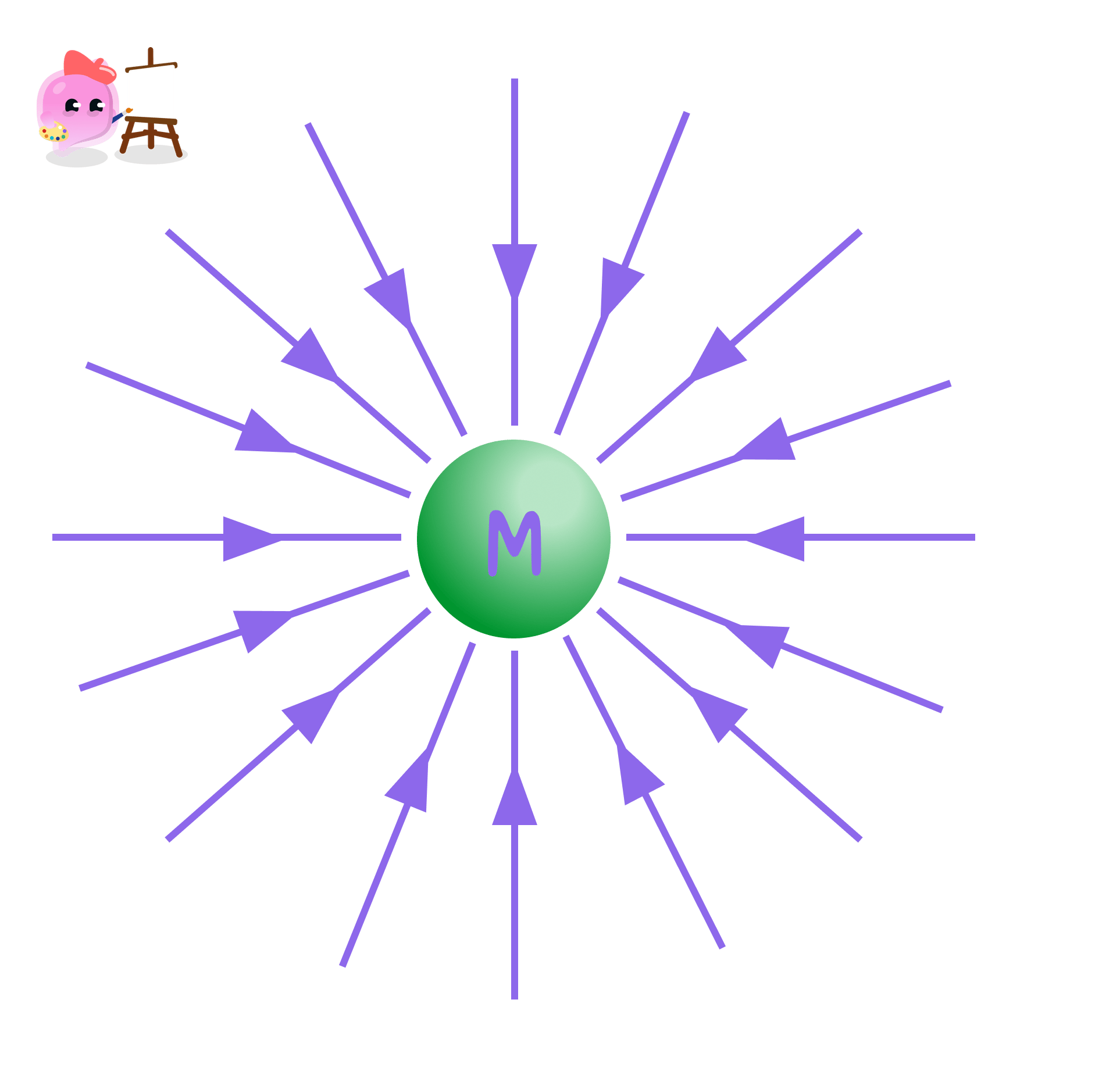
- Every mass creates a field around it; a second mass placed in that field feels a force, and that force is its weight.
- The field decides the weight: move a fixed mass into a stronger field and its weight rises, into a weaker one and its weight falls; the mass never changes.
- The field belongs to the place, not the object: ggg states how many newtons each kilogram would feel there, whether or not anything is present.
- Near the Earth's surface the field is uniform, directed vertically downwards, so weight acts straight down and ggg is effectively constant over the heights met here; far away the field is radial and weakens with distance.
- Do not call ggg "gravity". Mark schemes want "gravitational field strength" (N/kg\text{N/kg}N/kg) or "acceleration of free fall" (m/s2\text{m/s}^2m/s2).
- Mass does not change with location. On the Moon it is the weight and the field strength that fall; ask which of WWW, mmm and ggg the question has actually changed.
- "No gravity" is wrong for an object on the Moon or an astronaut in orbit: a field and a gravitational force still act, and in orbit that force is what keeps the astronaut going round.
- Heavier objects do not fall faster with no air resistance: the mass cancels, so everything in free fall in the same field accelerates at ggg.
- Write the equation from recall first; it can earn a mark on its own when the arithmetic slips, and it keeps an error-carried-forward mark available.
- Convert grams to kilograms before substituting, and always attach the unit: a weight quoted in kg\text{kg}kg is marked wrong.
- For a two-planet question the route is almost always: find the mass with m=W/gm = W/gm=W/g, keep that mass, then apply the other ggg.
- For define gravitational field strength, "force per unit mass" is the mark.
- Define gravitational field strength, and give its unit.
- Write the equation linking ggg, WWW and mmm, and rearrange it to make weight the subject.
- Why is a field strength of 9.8 N/kg9.8\ \text{N/kg}9.8 N/kg the same as an acceleration of 9.8 m/s29.8\ \text{m/s}^29.8 m/s2?
- A rock weighs less on the Moon than on Earth; which of WWW, mmm and ggg have changed?
- What is a gravitational field?