Every magnet has two poles, and that is where the pull is strongest
Definition
Magnetic pole
A region at the end of a magnet where the magnetic force is strongest, and which sets in a definite direction when the magnet is free to turn.
- Roll a bar magnet through iron filings and they cling in thick tufts at the two ends and almost nowhere along the middle, which shows the force is concentrated at the poles.
- Hang the same magnet from a thread so it can swing freely and it always settles with the same end pointing towards the Earth's geographic north.
- That end is the north-seeking pole, written N pole, and the opposite end is the south-seeking pole, written S pole.
- Poles always come in pairs, so snapping a bar magnet in half does not give you a lone N pole: you get two shorter magnets, each with its own N pole and S pole.
- A bar that behaves like this is magnetised, while an identical-looking bar with no poles and no preferred direction is unmagnetised.
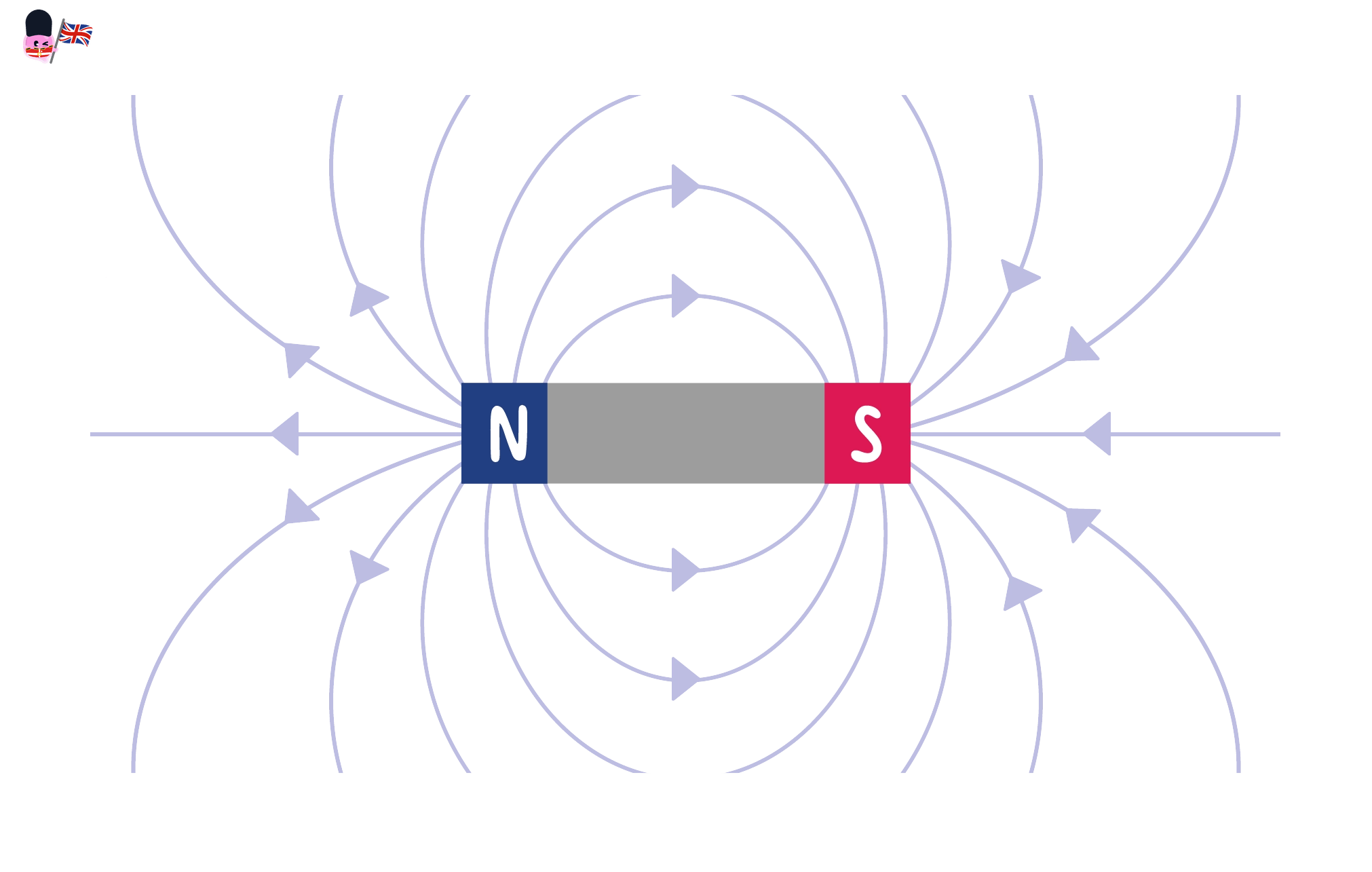
Like poles repel, unlike poles attract
- Bring the N pole of one magnet up to the N pole of a second magnet hanging on a thread and the hanging magnet swings away, which is repulsion.
- Two S poles do exactly the same, so the rule is that like poles repel.
- Bring an N pole up to an S pole and the hanging magnet swings towards it, so unlike poles attract.
- Both are non-contact forces: they act across an air gap, with no need for the magnets to touch.
- The force grows rapidly as the gap closes, which is why two strong magnets snap together over the last few millimetres.
- The two magnets always push or pull on each other equally and in opposite directions, so a large magnet does not feel a smaller force than the small one it is pulling.
Repulsion is the only proof that a bar is magnetised
- An unmagnetised magnetic material, such as an iron nail, is attracted by either pole of a magnet, because the magnet first turns the nail into a magnet and then pulls on it.
- A magnetised bar is attracted by one pole of a test magnet and repelled by the other.
- Attraction therefore cannot separate the two cases, because both a magnet and a plain iron nail get pulled in.
- Repulsion can only happen between two magnets, so a push is decisive evidence.
- To test an unlabelled steel bar, bring each of its ends near a known N pole in turn: if either end is pushed away, the bar is a magnet.
Common Mistake
- Do not offer attraction as your evidence that a bar is magnetised, because an unmagnetised iron nail is attracted just as strongly.
- State repulsion as the test when a question asks how you would check, and say which pole you brought near.
Magnetic materials are a short list of metals, not metals in general
Definition
Magnetic material
A material that is attracted by a magnet and that can itself be magnetised. The examples you need are iron, steel, cobalt and nickel.
- Steel is mostly iron, so anything made of steel is magnetic: paper clips, food tins, screws and the body panels of a car.
- Non-magnetic materials are not attracted at all and cannot be magnetised, and they include copper, aluminium, brass, gold, plastic, wood, glass and rubber.
- Copper and aluminium are excellent electrical conductors yet a magnet ignores them completely, so being a metal and being magnetic are separate properties.
- You can test this with loose change: a magnet picks up a 1p and a 5p because both are steel underneath their plating, but leaves a 20p behind because it is cupronickel.
- Recycling plants use the same difference: a large magnet lifts the steel cans off the conveyor belt and leaves the aluminium ones behind.
Exam technique
- Name the poles as N pole and S pole, never as positive and negative, because charge language is marked wrong here.
- When you describe a force, say which pole is near which and then whether the result is attraction or repulsion.
- "Magnetic" means attracted by a magnet, so do not argue that copper is magnetic because it is a metal or because it conducts.
- If asked for magnetic materials, give named substances such as iron, steel, cobalt and nickel rather than the word "metals".
Self review
- What is the difference between a magnetised and an unmagnetised iron bar?
- State what happens when the N pole of one magnet is brought near the S pole of another.
- Which single observation proves that a steel bar is a magnet, and why is attraction not enough?
- Name four magnetic materials and three non-magnetic ones.
- Why is a copper wire not attracted by a magnet even though copper is a metal?
