Gravitational field strength: the pull felt by every kilogram
Definition
Gravitational field strength
The gravitational force acting per unit mass at a point, measured in N/kg\text{N/kg}N/kg.
g=Wm g = \frac{W}{m} g=mW- A field strength of 9.8 N/kg9.8\ \text{N/kg}9.8 N/kg is a plain statement of fact about force: every kilogram placed there feels a pull of 9.8 N9.8\ \text{N}9.8 N.
- That pull is the object's weight, so weight and field strength are tied together by W=mgW = mgW=mg.
- Mass is the amount of matter in an object and never changes, whereas weight changes the moment you move to a place with a different field strength.
- A 50 kg50\ \text{kg}50 kg student is still 50 kg50\ \text{kg}50 kg on the Moon, but the weight drops from about 490 N490\ \text{N}490 N to about 80 N80\ \text{N}80 N because the Moon's surface field is only about 1.6 N/kg1.6\ \text{N/kg}1.6 N/kg.
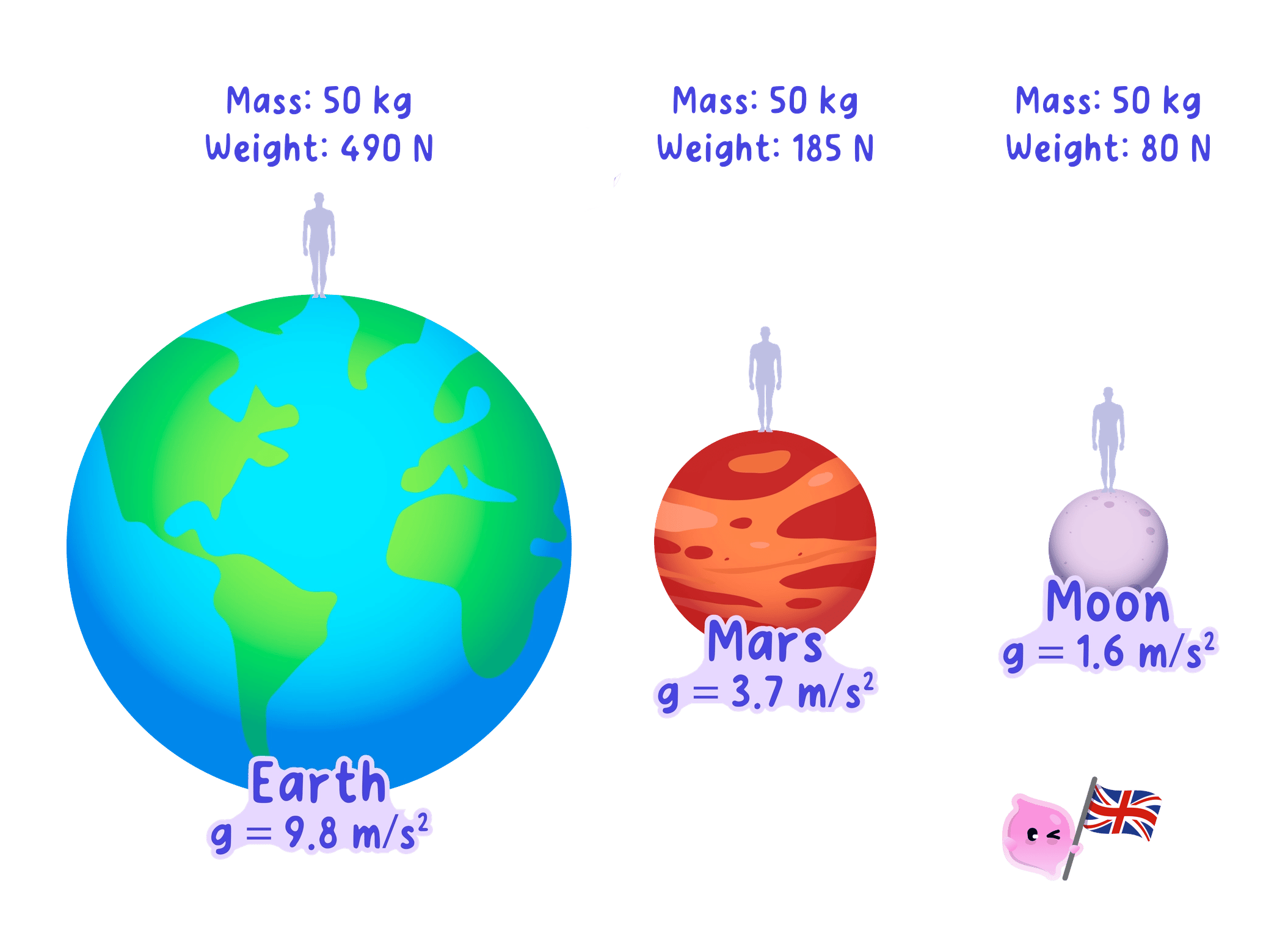
At the surface, the field strength depends on the planet's mass
- The strength of the gravitational field at the surface of a planet depends on the mass of that planet.
- More mass means more matter doing the attracting, so a more massive planet pulls harder on each kilogram sitting on it.
- Mars is far less massive than the Earth, so its surface field of about 3.7 N/kg3.7\ \text{N/kg}3.7 N/kg is well under half of the Earth's.
- Mass is not the whole story when you compare planets, because the surface of a large planet sits much further from its centre, and distance weakens the field.
- For that reason, use any surface field strengths a question gives you rather than assuming the most massive planet automatically has the strongest surface field.
Key Idea
Two separate things set the field at a surface: how much mass is doing the pulling and how far the surface is from the centre.
Move away from a planet and the field gets weaker, but never switches off
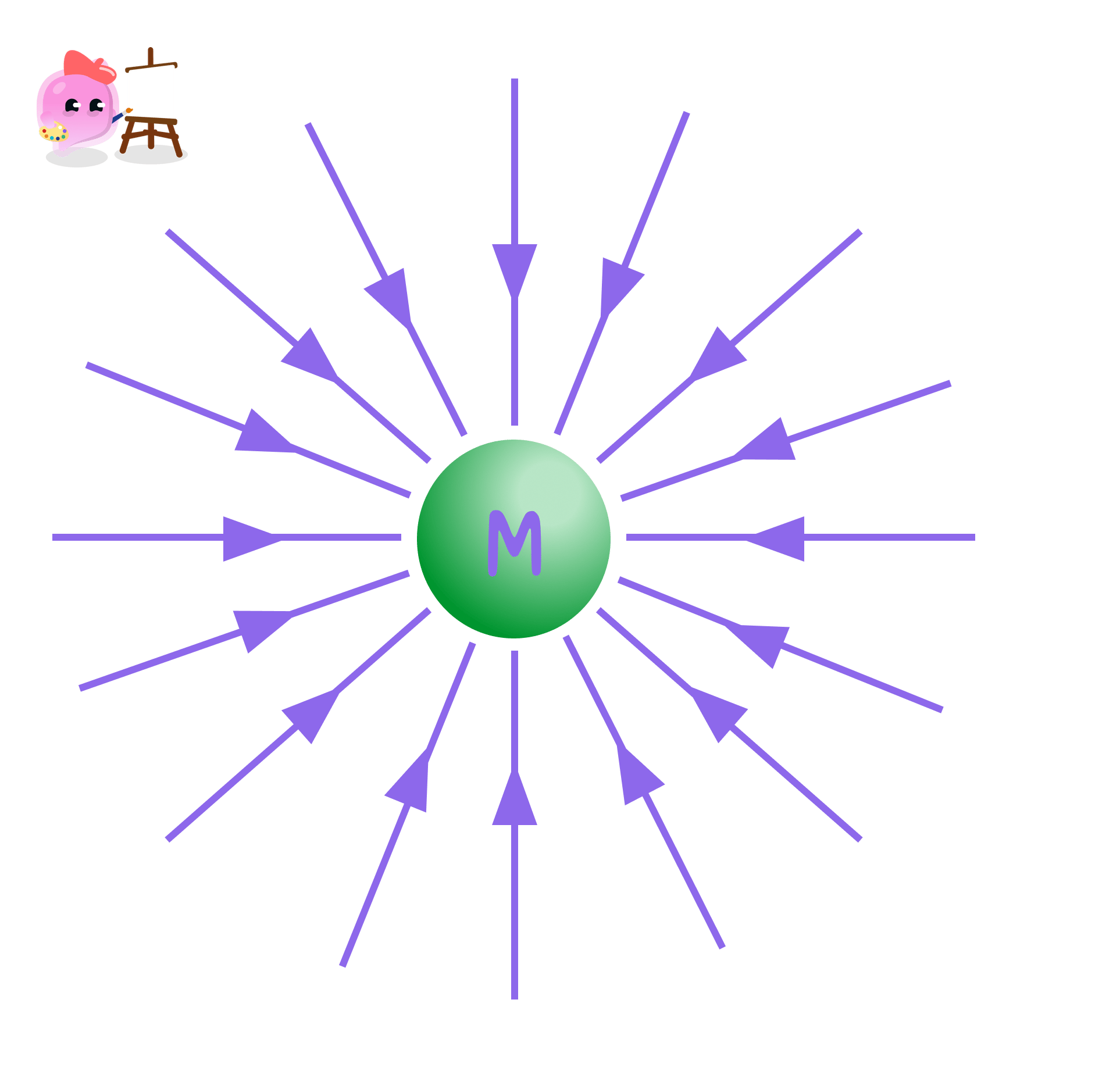
- The gravitational field around a planet decreases as the distance from the planet increases.
- Field lines point inwards towards the centre of the planet, showing the direction of the force on any mass placed in the field.
- Those lines spread apart with distance, and lines further apart mean a weaker field, which is the picture version of the same statement.
- The same object therefore weighs less high above a planet than it does on the ground, because W=mgW = mgW=mg and ggg has fallen.
- The field fades with distance but never reaches zero and never stops abruptly, which is why a moon or a spacecraft is still firmly inside the planet's field.
- That surviving pull is exactly what keeps an orbiting object in orbit: without it, the object would carry straight on and leave.
Common Mistake
- Do not write that there is no gravity in space or in orbit, because an astronaut floating on a space station is being pulled by the Earth the whole time.
- Do not swap the words mass and weight, since mass is in kilograms and never changes while weight is a force in newtons that does.
- Do not mix up a planet's distance from the Sun with distance from that planet's own centre, because only the second one controls its surface field.
Reading a table of planetary data without inventing a pattern
- A data question typically gives five columns: orbital distance, orbital duration, density, surface temperature and surface gravitational field strength.
- Treat the quoted field strength as a uniform value near that planet's surface, which is what makes W=mgW = mgW=mg usable there.
- Two trends do hold across the table, and they are the safe ones to quote.
- Planets further from the Sun have longer orbital durations, because they have much further to travel.
- Planets further from the Sun generally have lower surface temperatures, though a thick atmosphere can break the pattern.
- Three claims do not hold, and questions are built to catch you asserting them.
- Density does not rise or fall steadily with orbital distance.
- Surface field strength has no simple relationship with orbital distance.
- A denser planet does not automatically have the stronger surface field.
Example
Comparing Venus and Jupiter from a data table
- Venus: orbital distance 1.08×10⁸ km1.08 \times 10^{8}\ \text{km}1.08×10⁸ km, orbital duration 225 days225\ \text{days}225 days, density 5240 kg/m35240\ \text{kg/m}^{3}5240 kg/m3, surface temperature 464 ∘C464\ ^{\circ}\text{C}464 ∘C, surface field strength 8.9 N/kg8.9\ \text{N/kg}8.9 N/kg.
- Jupiter: orbital distance 7.78×10⁸ km7.78 \times 10^{8}\ \text{km}7.78×10⁸ km, orbital duration 4333 days4333\ \text{days}4333 days, density 1330 kg/m31330\ \text{kg/m}^{3}1330 kg/m3, surface temperature −110 ∘C-110\ ^{\circ}\text{C}−110 ∘C, surface field strength 24.8 N/kg24.8\ \text{N/kg}24.8 N/kg.
- Trends that hold: Jupiter is about seven times further from the Sun, takes about nineteen times longer to orbit and is far colder at the surface, so both expected trends are supported.
- Comparing the field strengths numerically:
- Jupiter's surface field is about 2.82.82.8 times that of Venus.
- The exception worth naming: Jupiter is the less dense of the two yet has by far the stronger surface field, which shows density alone does not set the field. Jupiter also sits much further from the Sun, so orbital distance does not set it either.
Exam technique
- Quote actual numbers from the table with their units, because an answer that only says "bigger" without a value rarely gets the comparison mark.
- Dividing one value by the other turns a vague comparison into a factor, which is a stronger answer and takes one line.
- Say whether all the rows support a trend, and name any planet that breaks it, since the exception is often where the last mark hides.
- Do not claim two quantities are linked just because they happen to rise together for one pair of planets.
Self review
- Define gravitational field strength and give its unit.
- What property of a planet determines the field strength at its surface?
- What happens to the field as you move further from a planet, and what does that do to the weight of a fixed mass?
- Calculate the weight of a 70 kg70\ \text{kg}70 kg astronaut on Mars, where g=3.7 N/kgg = 3.7\ \text{N/kg}g=3.7 N/kg.
- Give one trend that planetary data does support and one apparent link that it does not.
