3.1.1 Wave motion
Wave motion: the energy travels, the material stays behind
Wave
A travelling disturbance that carries energy from one place to another without carrying matter with it.
- Every wave starts with a source that does work on something: your hand flicks a rope, a loudspeaker cone pushes the air, a dipper taps the water surface.
- That first disturbance drags its neighbouring bit of material with it, which drags the next bit, and so the disturbance is handed on from one part of the material to the next.
- Each part of the material moves away from its rest position and then comes back to it, so once the wave has gone past, that part is exactly where it began.
- What moves steadily forward is the pattern of disturbance, and with it the energy the source supplied.
- You can tell the energy has arrived because it does work at the far end: a water wave rolls pebbles up a beach, and a sound wave sets your eardrum vibrating.
- The bigger the disturbance the source makes, the more energy the wave carries, which is why a storm wave does far more damage than a ripple travelling at the same speed.
The material vibrates about a fixed position; only the disturbance and the energy travel along the wave.
Ropes and springs make wave motion slow enough to watch
- Lay a long rope across the floor, hold one end and flick it sharply up and back down again.
- A single hump, called a pulse, races away from your hand towards the far end.
- Tie a bright ribbon to the middle of the rope and the test becomes obvious: the ribbon flicks up and down as the pulse goes by, then hangs still in the same place it started.
- Keep moving your hand up and down instead of flicking once, and you get a continuous wave instead of a single pulse, but the ribbon still just vibrates on the spot.
- A stretched spring shows the same behaviour, and it is easier to see because you can watch individual coils.
- Shake one end from side to side and a sideways wiggle runs along the coils to the far end.
- Push and pull one end along the spring's own length instead, and a moving pattern of squashed and stretched coils travels along instead.
- Mark one coil with a dab of paint and, in both cases, it ends up back where it started once the wave has passed.
- This is why wave motion is described in terms of vibrations: a vibration is a repeated to-and-fro movement about a rest position, and that is all any one piece of the material ever does.
- A crowd doing a Mexican wave around a stadium is the same physics.
- Each person stands up and sits back down in their own seat, so nobody moves round the ground.
- The visible band of standing people sweeps all the way round, because each person is triggered by their neighbour.
- The spectators are the material, the standing up is the vibration, and the travelling band is the wave.
Water waves carry energy across the surface, not the water itself
- In a ripple tank, a motor vibrates a bar or a small dipper that just touches the water, and ripples spread steadily outwards from it.
- Drop a small piece of cork or a leaf onto the surface and it bobs up and down on the spot as each ripple passes underneath it.
- The cork does not get swept to the far side of the tank, which is the direct evidence that the water is not being transported along with the wave.
- Each patch of water is lifted and lowered by its neighbour, passing the disturbance on and then settling back to the same place.
- On a much larger scale, wind blowing on the Atlantic can send waves thousands of kilometres to break on a Cornish beach, but the water that breaks there is not water blown over from America.
- What crosses the ocean is energy, and the beach feels it as the waves break and shift the sand and shingle.
- Do not write that a wave transfers matter, or that the water travels along with the wave.
- Do not say the material does not move at all either: it vibrates, it just does not travel.
- Do not confuse the wave with the material: the rope, the spring and the water are the things being disturbed, and the wave is the travelling disturbance in them.
- Do not claim the cork stays perfectly still: saying it bobs up and down without drifting along is what earns the mark.
- The word without is where the second mark lives, so write the whole statement: waves transfer energy without transferring matter.
- For two marks, make two separate points: one that energy is transferred, and one that the material only vibrates about its position.
- If the question names a rope, a spring or a floating object, describe that object rather than giving a general answer, because the mark scheme is written around the context you were given.
- This is a describe-and-explain topic with no calculation, so spend the time on precise wording instead of hunting for an equation.
- What does a wave transfer, and what does it not transfer?
- A ribbon is tied to the middle of a rope carrying a wave. Describe how the ribbon moves.
- Describe two different ways a stretched spring can be made to show wave motion.
- How does a cork floating in a ripple tank show that water waves do not transfer matter?
- What is meant by a vibration?
3.1.2 Features of a wave and wave speed
Crest, trough and amplitude describe how far the material moves
Amplitude
The maximum distance a point on the wave moves from its undisturbed rest position, measured in metres (m\text{m}m).
- Draw a wave as a smooth curve about a central line, and that central line is the rest position the material would sit at with no wave passing.
- A crest (also called a peak) is a highest point of the wave, and a trough is a lowest point.
- Amplitude is measured from the rest line up to a crest, or equally from the rest line down to a trough, and never from a crest all the way down to a trough.
- The vertical distance from a crest to the next trough is twice the amplitude, so halve it before quoting an answer.
- Amplitude is a measure of the energy the wave carries: a taller water wave lifts a boat further, and a bigger sound wave is heard as a louder sound.
- Amplitude and speed are unrelated: making the wave taller does not make it travel any faster along the rope or across the water.
Wavelength and frequency: how long each wave is and how often they arrive
Wavelength
The distance between two neighbouring points on a wave that are vibrating in step, for example from one crest to the very next crest. Symbol λ\lambdaλ, measured in metres (m\text{m}m).
Frequency
The number of complete waves passing a fixed point each second. Symbol fff, measured in hertz (Hz\text{Hz}Hz), where 1 Hz1\ \text{Hz}1 Hz is one wave per second.
- Wavelength can be measured crest to crest, trough to trough, or between any two points doing exactly the same thing at the same moment, and all three give the same answer.
- Wavelength is set by the source and the material, and it ranges from hundreds of metres for radio waves down to less than a millionth of a metre for visible light.
- Frequency is fixed by how fast the source vibrates: a dipper tapping the water 555 times a second makes a wave of frequency 5 Hz5\ \text{Hz}5 Hz, whatever the tank is filled with.
- The time for one complete wave to pass is the period, TTT, and it is simply the reciprocal of the frequency.
- T=1fT = \frac{1}{f}T=f1
- So a 5 Hz5\ \text{Hz}5 Hz wave has a period of 0.2 s0.2\ \text{s}0.2 s, because five waves have to fit into every second.
Wavefronts show where a whole crest has reached at one instant
Wavefront
A line joining all the points on a wave that are vibrating in step, usually drawn along the top of one crest.
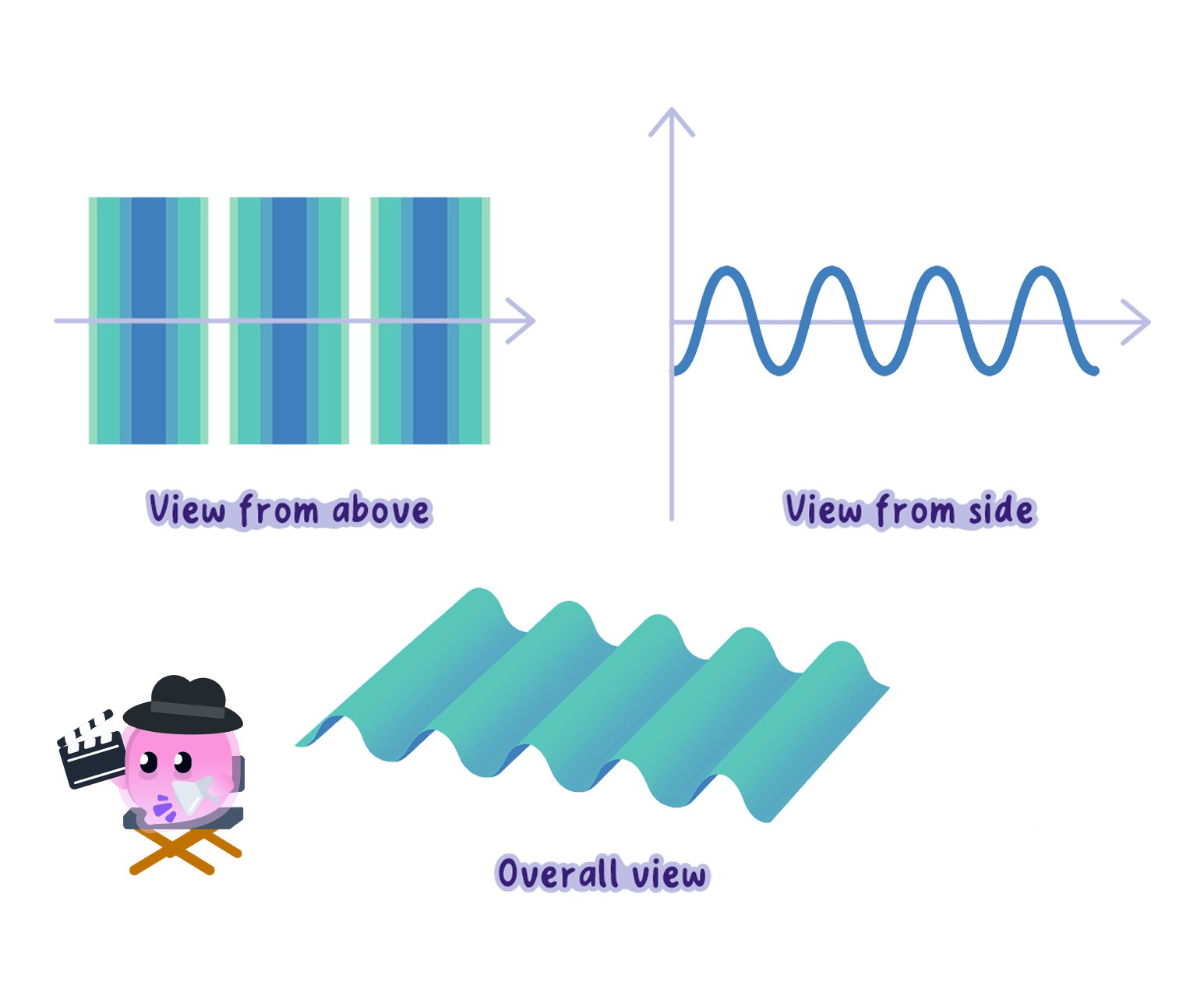
- Looking down on a ripple tank from above, the bright lines you see are crests, and drawing a line along each one gives you the wavefronts.
- Because consecutive wavefronts are drawn along consecutive crests, the gap between neighbouring wavefronts is one wavelength.
- A straight vibrating bar makes straight, parallel wavefronts, while a single dipper makes circular wavefronts spreading out from the point it touches.
- The wave always travels at right angles to its wavefronts, so an arrow drawn perpendicular to the lines shows the direction of travel.
- Wavefront diagrams are the quickest way to record what a wave is doing, because a change in the spacing shows a change in wavelength and a change in the direction of the lines shows the wave has changed course.
Wave speed ties wavelength and frequency together
Wave speed
The distance a crest, or any other point on the wave pattern, travels each second. Symbol vvv, measured in metres per second (m/s\text{m/s}m/s).
v=fλ v = f\lambda v=fλ- The equation is not something to memorise blindly, because you can rebuild it from the definitions in one step.
- In one second, fff complete waves stream past a fixed point.
- Each of those waves is λ\lambdaλ metres long.
- So the pattern must have moved f×λf \times \lambdaf×λ metres in that second, and distance per second is speed.
- Rearranged, the same equation gives f=vλf = \dfrac{v}{\lambda}f=λv and λ=vf\lambda = \dfrac{v}{f}λ=fv, and you have to recall all three forms because no equation sheet is provided.
- The speed is fixed by the material the wave travels through, not by the source, so when a wave enters a new material at the same frequency, the wavelength has to change to match the new speed.
- Frequency, by contrast, is set by the source and stays the same no matter what the wave travels through.
- Do not read the amplitude off a graph as the crest-to-trough height, because that value is twice too big.
- Do not measure wavelength from a crest to the next trough, since that is only half a wavelength.
- Do not substitute a wavelength in centimetres straight into v=fλv = f\lambdav=fλ, or your speed comes out 100100100 times too large.
- Do not assume a bigger amplitude means a faster wave, because speed depends on the material and not on how hard the source is driven.
- Do not mix up hertz and seconds: frequency counts waves per second, while the period is a time in seconds.
- Write v=fλv = f\lambdav=fλ down before you substitute, because the equation itself is often worth a mark even if the arithmetic goes wrong.
- Convert every length to metres and every time to seconds before substituting, then attach the unit to the final answer.
- When a diagram shows several waves across the page, measure across all of them and divide, because measuring one wavelength alone magnifies your reading error.
- If a question asks you to label a wavelength on a diagram, draw a clear double-headed arrow from one crest to the next crest rather than a vague mark.
- The mark most often dropped here is the unit, so check that a speed ends in m/s\text{m/s}m/s, a frequency in Hz\text{Hz}Hz and a wavelength in m\text{m}m.
- Define amplitude, and say where on a wave diagram you would measure it.
- What is a wavefront, and how is the spacing of neighbouring wavefronts related to wavelength?
- State the equation linking wave speed, frequency and wavelength, with the unit of each quantity.
- A wave has frequency 50 Hz50\ \text{Hz}50 Hz and wavelength 6.0 m6.0\ \text{m}6.0 m. Calculate its speed.
- A wave slows down but its source keeps vibrating at the same rate. What happens to its wavelength, and why?
3.1.3 Transverse and longitudinal waves
Transverse waves vibrate across the direction they travel
Transverse wave
A wave in which the direction of vibration is at right angles (90∘90^\circ90∘) to the direction in which the wave transfers energy.
- Shake one end of a stretched rope up and down and the wave races away horizontally while every part of the rope moves only vertically.
- Those two directions, up-and-down for the vibration and left-to-right for the energy, are perpendicular, and that is the whole definition.
- Because the material is displaced sideways, a transverse wave has a shape you can draw straight onto the page as crests and troughs.
- The sideways vibration does not have to be vertical: shaking the rope horizontally, or in a circle, still gives a transverse wave as long as the movement stays perpendicular to the travel direction.
- A stretched spring shows this too if you flick one end from side to side, sending a visible wiggle down the coils.
Longitudinal waves vibrate along the direction they travel
Longitudinal wave
A wave in which the direction of vibration is parallel to the direction in which the wave transfers energy.
- Lay a long spring on a bench, grip one end and push it forwards then pull it back along the spring's own length.
- A moving pattern of bunched-up and spread-out coils travels away from your hand, and each coil slides back and forth along the same line the wave is moving.
- The bunched-up regions are called compressions, where the material is squeezed closer together than normal.
- The stretched-out regions between them are rarefactions, where the material is spread further apart than normal.
- Compressions and rarefactions do the same job as crests and troughs, so one wavelength is the distance from one compression to the next compression.
- A longitudinal wave has no sideways displacement at all, which is why it is drawn as a row of dots rather than as a wavy line.
The only thing that separates the two types is the angle between the vibration and the direction of travel: 90∘90^\circ90∘ for transverse, 0∘0^\circ0∘ for longitudinal.
Real waves are modelled as one type or the other
- Three families of wave are modelled as transverse.
- All electromagnetic radiation, from radio waves through visible light to gamma rays, in which electric and magnetic fields oscillate at right angles to the direction of travel.
- Water waves, in which the surface rises and falls while the wave moves across the surface.
- Seismic S-waves (secondary waves), which shake the rock from side to side as they travel through the Earth.
- Two families are modelled as longitudinal.
- Sound waves, in which a loudspeaker cone pushes the air forwards to make a compression and pulls back to leave a rarefaction, all along the direction the sound travels.
- Seismic P-waves (primary waves), which squeeze and stretch the rock along their own path.
- The word modelled matters: real water particles actually move in small circles, but treating the wave as transverse predicts everything you need at this level.
- Everything else the two types share: both transfer energy without transferring matter, both have a wavelength, frequency, amplitude and speed, and both obey v=fλv = f\lambdav=fλ.
- One practical difference is worth knowing: longitudinal waves can travel through liquids and gases, which is why sound reaches you through air and through water.
- An earthquake sends out both types at once, and the names come from the order they arrive.
- The longitudinal P-waves are faster, so a seismometer records them first as a sharp jolt.
- The transverse S-waves arrive second and shake buildings from side to side, which is what causes most of the damage.
- The gap between the two arrivals is used to work out how far away the earthquake was.
- Do not describe a longitudinal wave as having crests and troughs, because it has compressions and rarefactions instead.
- Do not say sound is transverse because it is often drawn as a wavy line on a screen; that graph is a plot of pressure against time, not a picture of the air moving.
- Do not write that the particles "move along with the wave" in a longitudinal wave; they vibrate back and forth about a fixed position.
- Do not swap the seismic labels: P-waves are primary and longitudinal, S-waves are secondary and transverse.
- Deciding which type a diagram is showing:
- Find the arrow giving the direction of travel first, because every decision is made relative to it.
- Pick one particle, work out which way it moves, and compare that with the arrow.
- Perpendicular means transverse; along the same line means longitudinal.
- A definition here scores only if it names both directions, so write "the vibration is at right angles to the direction of travel" rather than just "it vibrates up and down".
- "Direction of travel", "direction of propagation" and "direction of energy transfer" all mean the same thing and all earn the mark.
- When you are asked for an example, give a named one from the lists above rather than a vague answer like "a wave in a solid".
- If the question asks how the two types are similar, the marks are for energy transfer without matter transfer and for sharing the same wave quantities, not for the difference.
- Define a transverse wave, referring to both directions involved.
- What are compressions and rarefactions, and which type of wave has them?
- Name three kinds of wave modelled as transverse and two modelled as longitudinal.
- Which seismic wave is longitudinal, and which arrives at a seismometer first?
- How would you measure one wavelength on a diagram of a longitudinal wave?
3.1.4 Reflection, refraction and diffraction of waves
Reflection sends a wave back with its angle preserved
Reflection
The bouncing back of a wave when it meets a barrier, so that it stays in the same material instead of crossing into a new one.
- Send straight wavefronts at a flat barrier placed at an angle and they bounce off it as straight wavefronts travelling in a new direction.
- Draw a normal, a construction line at 90∘90^\circ90∘ to the barrier where the wave strikes it, and measure both angles from that line.
- The angle of incidence always equals the angle of reflection, which is why a wave arriving at 30∘30^\circ30∘ leaves at 30∘30^\circ30∘ on the other side of the normal.
- Nothing about the wave itself changes on reflection: the speed, frequency and wavelength all stay the same, because the wave is still in the same water.
- Only the direction of travel changes, so on a wavefront diagram the spacing of the lines is unchanged and only their angle is different.
- This is the behaviour behind an echo off a cliff and behind the image you see in a mirror.
Refraction bends a wave because its speed changes
Refraction
The change in direction of a wave as it crosses a boundary into a new region, caused by a change in its speed.
- Water waves travel more slowly in shallow water than in deep water, so a submerged glass plate creates a shallow region where the speed drops.
- The source is still vibrating at the same rate, so the frequency cannot change as the wave crosses the boundary.
- With v=fλv = f\lambdav=fλ and fff fixed, a smaller vvv forces a smaller λ\lambdaλ, so the wavefronts bunch closer together in the shallow region.
- If the wave meets the boundary at an angle, one end of each wavefront reaches the shallow water and slows down before the other end does.
- That lagging end pivots the whole wavefront round, so the wave changes direction and bends towards the normal on entering the slower region.
- Going back into deep water the wave speeds up again and bends away from the normal.
- If the wavefronts arrive parallel to the boundary, every point slows at the same instant, so the wavelength still shortens but the direction does not change at all.
- This is why sea waves swing round to run almost parallel to a beach: the end of each wave that reaches the shallows first is slowed and held back.
Diffraction spreads a wave out past a gap or an edge
Diffraction
The spreading out of a wave as it passes through a gap or travels past the edge of an obstacle.
- Put two barriers in the tank with a gap between them and send straight wavefronts at the gap.
- A narrow gap, roughly as wide as one wavelength, turns the straight wavefronts into curved ones that fan out into almost the whole region beyond.
- A wide gap lets most of the wave through unchanged, with only the two ends curling round, so the beam stays roughly the width of the gap.
- Replace the gap with a single barrier and the wave curls round its edge into the shadow region behind it, so the water there is not perfectly still.
- Diffraction changes only the shape and direction of the wavefronts, because the water is the same depth throughout and so the speed, frequency and wavelength are all unchanged.
- It explains why you can hear someone talking round a doorway even though you cannot see them: sound has a wavelength close to the width of the door, while light does not.
Investigation: reflection, refraction and diffraction in a ripple tank
- Note: this is normally set up and run by the teacher as a class demonstration, but you still need to be able to describe the method and the result.
- Aim: to show the reflection, refraction and diffraction of water waves and to see how the wavefronts change in each case.
- Apparatus: a ripple tank with a motorised straight vibrating bar, a lamp above the tank and a white screen below it, a stroboscope, straight metal barriers, a flat glass plate and a ruler.
- Method:
- Level the tank and fill it with water to a depth of about 1 cm1\ \text{cm}1 cm, then switch on the lamp so the crests act as lenses and throw bright lines onto the screen beneath.
- Lower the vibrating bar until it just touches the surface and run the motor slowly to send straight wavefronts down the tank.
- View through a stroboscope and adjust its rate until the pattern appears frozen, which makes the wavefronts easy to sketch and measure.
- Reflection: stand a straight barrier across the tank at about 45∘45^\circ45∘ to the oncoming wavefronts and sketch the incident and reflected wavefronts, marking the normal and both angles.
- Refraction: remove the barrier and lay the flat glass plate on the floor of the tank to make a shallow region, first with its edge parallel to the wavefronts and then turned at an angle, sketching the wavefronts each time.
- Diffraction at a gap: take the plate out, set two barriers to leave a gap about one wavelength wide, sketch the pattern beyond it, then widen the gap to several wavelengths and sketch it again.
- Diffraction at an edge: remove one barrier so a single straight edge is left, and sketch how the wavefronts curl into the shadow behind it.
- Measure and plot:
- Measure the angles of incidence and reflection from the sketch with a protractor.
- Find the wavelength in the deep and the shallow water by measuring across ten wavefront spacings and dividing by ten.
- Result: the angle of reflection equals the angle of incidence; in the shallow region the wavefronts are closer together and are turned towards the normal; a gap of about one wavelength spreads the wave strongly while a wide gap barely spreads it, and a single edge lets the wave curl into the shadow.
- Watch out:
- Moving wavefronts are almost impossible to measure by eye, so use the stroboscope or photograph the pattern rather than guessing.
- Keep the water shallow and the tank level, because a sloping tank changes the depth across the tank and refracts the waves where you did not intend it to.
- Waves reflecting off the far wall run back into the pattern, so fit sloping gauze or foam edges to absorb them.
- Safety: flashing stroboscope light can trigger a seizure in a person with photosensitive epilepsy, so the class is asked first, and any water spilt near the electrical supply is mopped up straight away.
Only refraction changes the wavelength, and nothing changes the frequency
- The frequency is fixed by the vibrating bar, so nothing that happens inside the tank can alter it in any of the three effects.
- Reflection and diffraction both leave the wave in water of the same depth, so the speed and wavelength are untouched and only the direction or shape of the wavefronts changes.
- Refraction is the only one of the three that moves the wave into water of a different depth, so it is the only one that changes the speed and therefore the wavelength.
- That makes the spacing of the wavefronts the single most informative thing on any wavefront diagram, because a change in spacing can only mean refraction.
- All three effects can happen to any wave, not just water waves, which is why the ripple tank is used as a model for light and sound as well.
- Do not say the frequency changes when a wave is refracted, because the source sets the frequency and it survives the boundary unchanged.
- Do not claim a wave always bends when it is refracted; hitting the boundary head-on shortens the wavelength but leaves the direction alone.
- Do not draw the diffracted wavefronts closer together or further apart, because diffraction does not change the wavelength.
- Do not measure angles from the barrier itself; every angle is measured from the normal.
- Do not explain refraction as "the wave bends" and stop there; the mark is for the change in speed that causes the bending.
- Working out which effect a wavefront diagram is showing:
- Check the spacing of the wavefronts first, because only refraction changes it.
- Straight wavefronts, unchanged spacing and a new direction after a barrier means reflection.
- Closer spacing and a new direction after a depth change means refraction.
- Curved wavefronts fanning out past a gap or an obstacle, with the spacing unchanged, means diffraction.
- When you are asked to complete a wavefront diagram, keep your lines evenly spaced and parallel, because sloppy spacing loses the mark even when the idea is right.
- Describing the ripple tank is point-marked, so name the barrier or glass plate, the stroboscope and what you sketch, rather than writing "we looked at the waves".
- For refraction, always give the chain: the depth changes, so the speed changes, so the wavelength changes, so the direction changes.
- The mark most often dropped in a diffraction answer is the comparison, so say the spreading is greatest when the gap is about the same size as the wavelength.
- What happens to the speed, frequency and wavelength of a wave when it reflects off a plane barrier?
- Explain why a water wave changes direction when it crosses into shallower water at an angle.
- Describe how a ripple tank is used to demonstrate refraction.
- Sketch the wavefronts beyond a narrow gap and beyond a wide gap, and say how they differ.
- Which of the three effects changes the wavelength, and why do the other two not?
3.1.5 Wavelength, gap size and diffraction
Gap size decides how much a wave spreads out
Diffraction
The spreading out of a wave as it passes through a gap or travels past the edge of an obstacle, with no change to its speed, frequency or wavelength.
- The amount of spreading is not fixed: it depends on the size of the gap compared with the wavelength, not on the gap width on its own.
- Keep the wavelength fixed in a ripple tank and change only the gap, and a clear pattern appears.
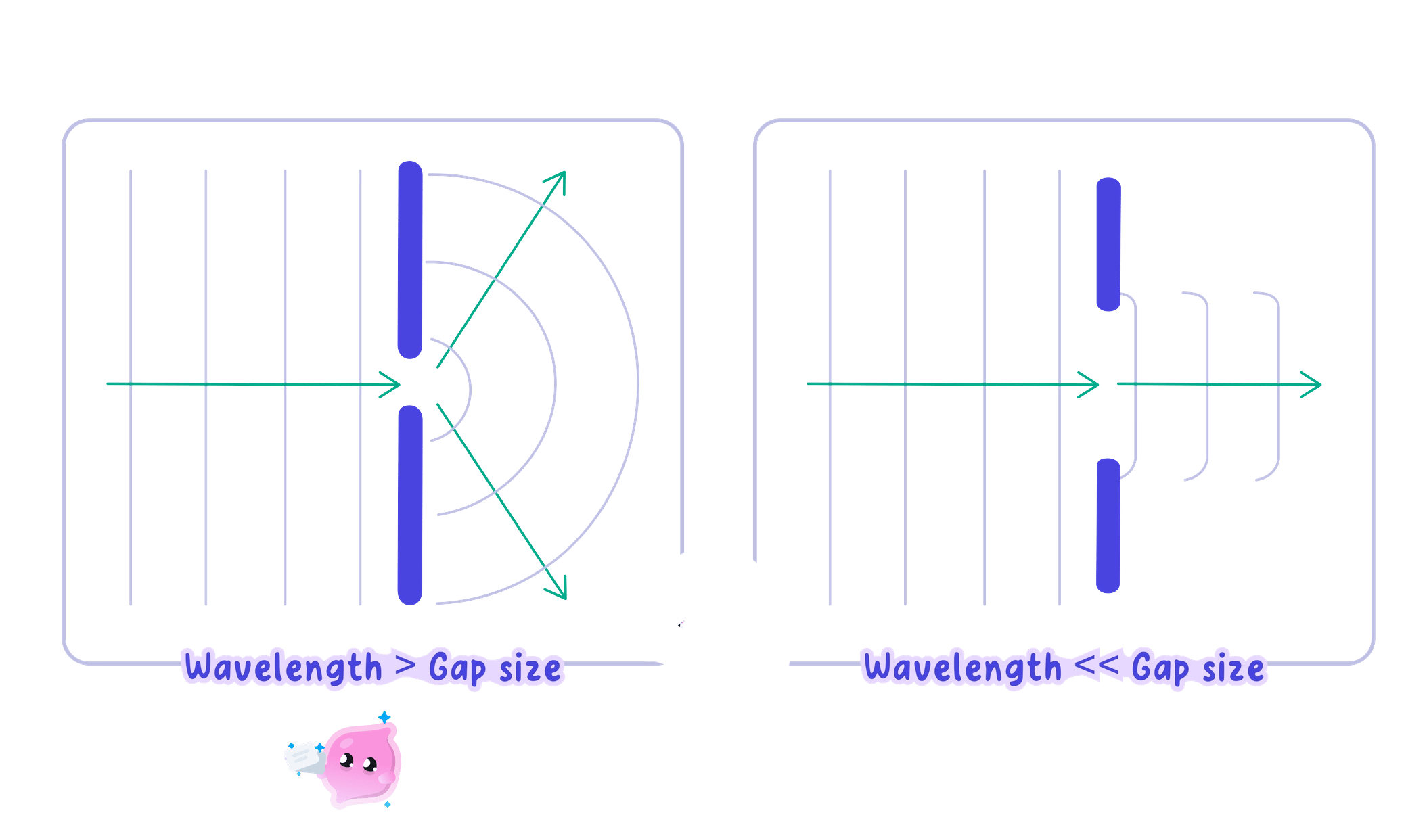
- With a gap much wider than one wavelength, the wave carries straight on as a beam roughly the width of the gap, and only the two ends of each wavefront curl slightly.
- Narrow the gap and the curled ends take up more of each wavefront, so the beam fans out over a wider angle.
- When the gap is about the same size as one wavelength, the wavefronts emerge as almost complete semicircles and fill the region beyond the barriers.
- Narrowing the gap further does not increase the spreading much, but it does cut down how much of the wave gets through, so the waves beyond are weaker.
- Throughout all of this the wavefronts stay the same distance apart, because the water depth is unchanged and so the wavelength itself is unchanged; diffraction alters only the shape and direction of the wavefronts.
Longer waves spread more through the same gap
- Now run the experiment the other way round: fix the gap and change the wavelength by changing the frequency of the vibrating bar.
- Lowering the frequency gives a longer wavelength, since the speed is set by the water depth and λ=v/f\lambda = v/fλ=v/f.
- Those longer waves are now closer in size to the gap, so they spread out more beyond it.
- Raising the frequency gives a shorter wavelength, which is now small compared with the gap, so the wave carries straight on with much less spreading.
- Both experiments are really the same rule seen from two sides: what matters is the ratio of wavelength to gap width, and the spreading grows as that ratio grows towards one.
- This is why "narrow" and "wide" have no meaning on their own: a 1 cm1\ \text{cm}1 cm gap is enormous for light and tiny for long-wave radio.
At an edge, longer waves curl further into the shadow
- Take away one barrier so a single straight edge is left, and the wavefronts that pass it bend round the end of the barrier into the shadow region.
- There is no gap width to compare with now, so the wavelength alone decides how far the wave curls round.
- A longer wavelength curls further behind the edge, so the shadow region is smaller and the waves reaching into it are stronger.
- A shorter wavelength barely bends at all, leaving a sharp-edged shadow with almost undisturbed water behind the barrier.
- The wavefronts in the shadow are curved because they have pivoted about the tip of the barrier, and they are still the same distance apart as the ones that went straight past.
- Drive into a Welsh valley and long-wave radio keeps playing while FM and digital signals drop out.
- Long-wave radio has a wavelength of over a kilometre, comparable with the hills themselves, so it diffracts strongly round them.
- FM radio has a wavelength of about 3 m3\ \text{m}3 m, far smaller than a hill, so it barely bends and leaves a radio shadow in the valley.
- The same rule explains why you hear a conversation through an open doorway before you see the speaker.
- Speech has a wavelength of roughly a metre, close to the width of the door, while light has a wavelength under a millionth of a metre and travels straight on.
- Do not say a narrow gap always gives the most diffraction; it gives the most only when it is comparable with the wavelength.
- Do not judge the gap as "small" or "large" in everyday terms, since the only meaningful comparison is with the wavelength.
- Do not draw the diffracted wavefronts closer together, because the wavelength does not change.
- Do not bring gap size into an answer about an edge, where only the wavelength decides how far the wave curls round.
- Working out how much a wave will spread:
- Pull the wavelength and the gap width out of the question and compare them, rather than judging either one on its own.
- Roughly equal means strong spreading, with semicircular wavefronts filling the space beyond.
- A gap many wavelengths wide means a straight-through beam with only the edges curling.
- For an obstacle, drop the gap from your reasoning and ask only whether the wavelength is large or small compared with the obstacle.
- Whatever you conclude, add that the wavelength itself is unchanged.
- Answers here are almost always comparative, so use "more than" and "less than" rather than "a lot", and name what you are comparing with.
- If a question changes the frequency, add the middle step: the frequency changes, so the wavelength changes, so the spreading changes.
- When you sketch a strongly diffracted pattern, draw the wavefronts as arcs centred on the gap and keep them equally spaced.
- The mark most often dropped is the reference point, so write "the gap is about the same size as the wavelength" rather than "the gap is small".
- Under what condition is diffraction through a gap greatest?
- The gap is kept the same and the frequency of the source is increased. Describe and explain the effect on the diffraction.
- Sketch the wavefronts beyond a gap that is many wavelengths wide.
- How does wavelength affect how far a wave diffracts round the edge of an obstacle?
- Explain why long-wave radio reaches into a valley when FM radio does not.