Crest, trough and amplitude describe how far the material moves
Amplitude
The maximum distance a point on the wave moves from its undisturbed rest position, measured in metres (m\text{m}m).
- Draw a wave as a smooth curve about a central line, and that central line is the rest position the material would sit at with no wave passing.
- A crest (also called a peak) is a highest point of the wave, and a trough is a lowest point.
- Amplitude is measured from the rest line up to a crest, or equally from the rest line down to a trough, and never from a crest all the way down to a trough.
- The vertical distance from a crest to the next trough is twice the amplitude, so halve it before quoting an answer.
- Amplitude is a measure of the energy the wave carries: a taller water wave lifts a boat further, and a bigger sound wave is heard as a louder sound.
- Amplitude and speed are unrelated: making the wave taller does not make it travel any faster along the rope or across the water.
Wavelength and frequency: how long each wave is and how often they arrive
Wavelength
The distance between two neighbouring points on a wave that are vibrating in step, for example from one crest to the very next crest. Symbol λ\lambdaλ, measured in metres (m\text{m}m).
Frequency
The number of complete waves passing a fixed point each second. Symbol fff, measured in hertz (Hz\text{Hz}Hz), where 1 Hz1\ \text{Hz}1 Hz is one wave per second.
- Wavelength can be measured crest to crest, trough to trough, or between any two points doing exactly the same thing at the same moment, and all three give the same answer.
- Wavelength is set by the source and the material, and it ranges from hundreds of metres for radio waves down to less than a millionth of a metre for visible light.
- Frequency is fixed by how fast the source vibrates: a dipper tapping the water 555 times a second makes a wave of frequency 5 Hz5\ \text{Hz}5 Hz, whatever the tank is filled with.
- The time for one complete wave to pass is the period, TTT, and it is simply the reciprocal of the frequency.
- T=1fT = \frac{1}{f}T=f1
- So a 5 Hz5\ \text{Hz}5 Hz wave has a period of 0.2 s0.2\ \text{s}0.2 s, because five waves have to fit into every second.
Wavefronts show where a whole crest has reached at one instant
Wavefront
A line joining all the points on a wave that are vibrating in step, usually drawn along the top of one crest.
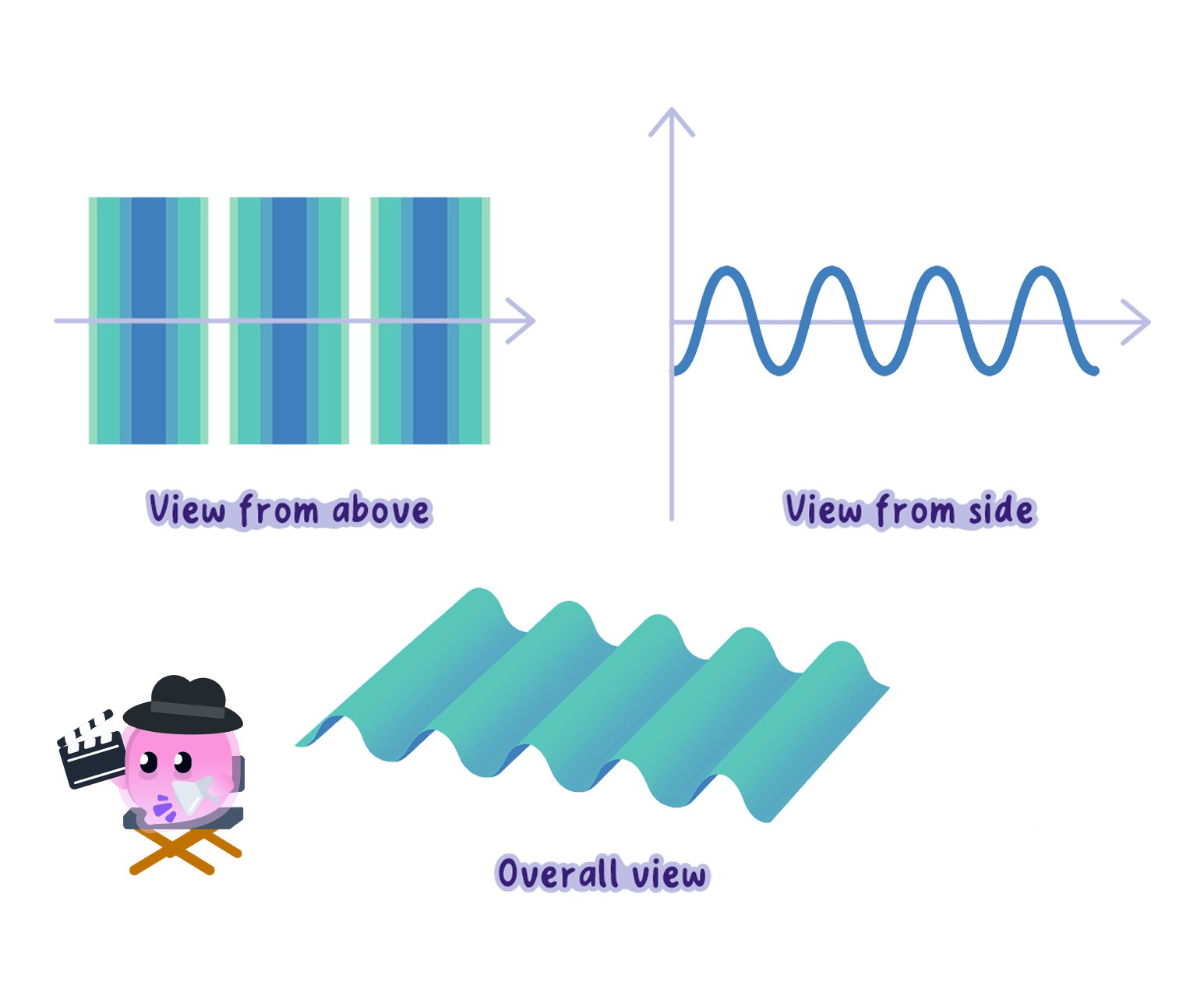
- Looking down on a ripple tank from above, the bright lines you see are crests, and drawing a line along each one gives you the wavefronts.
- Because consecutive wavefronts are drawn along consecutive crests, the gap between neighbouring wavefronts is one wavelength.
- A straight vibrating bar makes straight, parallel wavefronts, while a single dipper makes circular wavefronts spreading out from the point it touches.
- The wave always travels at right angles to its wavefronts, so an arrow drawn perpendicular to the lines shows the direction of travel.
- Wavefront diagrams are the quickest way to record what a wave is doing, because a change in the spacing shows a change in wavelength and a change in the direction of the lines shows the wave has changed course.
Wave speed ties wavelength and frequency together
Wave speed
The distance a crest, or any other point on the wave pattern, travels each second. Symbol vvv, measured in metres per second (m/s\text{m/s}m/s).
v=fλ v = f\lambda v=fλ- The equation is not something to memorise blindly, because you can rebuild it from the definitions in one step.
- In one second, fff complete waves stream past a fixed point.
- Each of those waves is λ\lambdaλ metres long.
- So the pattern must have moved f×λf \times \lambdaf×λ metres in that second, and distance per second is speed.
- Rearranged, the same equation gives f=vλf = \dfrac{v}{\lambda}f=λv and λ=vf\lambda = \dfrac{v}{f}λ=fv, and you have to recall all three forms because no equation sheet is provided.
- The speed is fixed by the material the wave travels through, not by the source, so when a wave enters a new material at the same frequency, the wavelength has to change to match the new speed.
- Frequency, by contrast, is set by the source and stays the same no matter what the wave travels through.
- Do not read the amplitude off a graph as the crest-to-trough height, because that value is twice too big.
- Do not measure wavelength from a crest to the next trough, since that is only half a wavelength.
- Do not substitute a wavelength in centimetres straight into v=fλv = f\lambdav=fλ, or your speed comes out 100100100 times too large.
- Do not assume a bigger amplitude means a faster wave, because speed depends on the material and not on how hard the source is driven.
- Do not mix up hertz and seconds: frequency counts waves per second, while the period is a time in seconds.
- Write v=fλv = f\lambdav=fλ down before you substitute, because the equation itself is often worth a mark even if the arithmetic goes wrong.
- Convert every length to metres and every time to seconds before substituting, then attach the unit to the final answer.
- When a diagram shows several waves across the page, measure across all of them and divide, because measuring one wavelength alone magnifies your reading error.
- If a question asks you to label a wavelength on a diagram, draw a clear double-headed arrow from one crest to the next crest rather than a vague mark.
- The mark most often dropped here is the unit, so check that a speed ends in m/s\text{m/s}m/s, a frequency in Hz\text{Hz}Hz and a wavelength in m\text{m}m.
- Define amplitude, and say where on a wave diagram you would measure it.
- What is a wavefront, and how is the spacing of neighbouring wavefronts related to wavelength?
- State the equation linking wave speed, frequency and wavelength, with the unit of each quantity.
- A wave has frequency 50 Hz50\ \text{Hz}50 Hz and wavelength 6.0 m6.0\ \text{m}6.0 m. Calculate its speed.
- A wave slows down but its source keeps vibrating at the same rate. What happens to its wavelength, and why?
