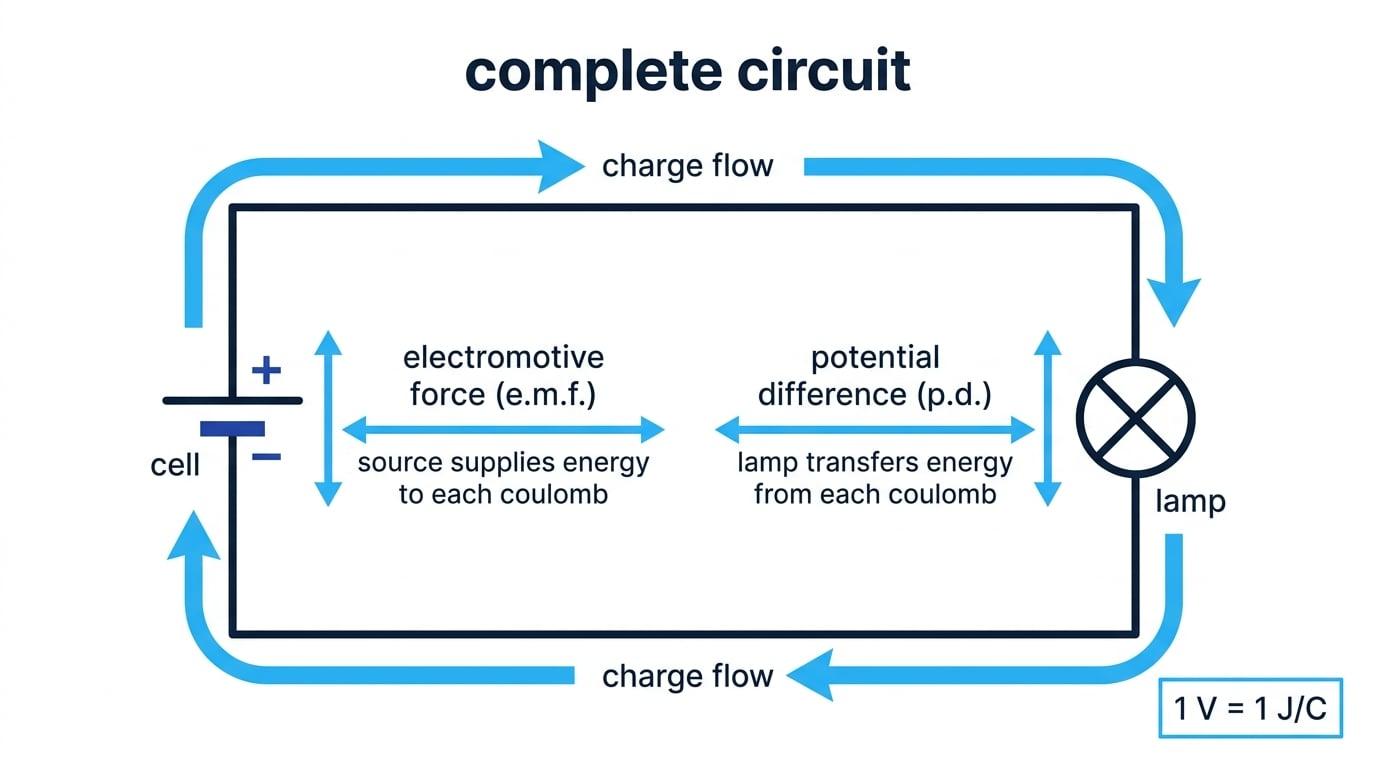
E.m.f. measures the energy a source gives to each coulomb
Definition
Electromotive force (e.m.f.)
The electrical work done by a source in moving a unit charge around a complete circuit.
E=WQ E = \frac{W}{Q} E=QW- A cell does not make charge; the charge is already in the wires, and what the cell supplies is energy.
- Chemical reactions inside the cell transfer energy to every coulomb that passes through it, and that energy transfer is the work done being counted.
- The word "force" in the name is misleading, because e.m.f. is an energy per unit charge and is not measured in newtons.
- E.m.f. describes the whole circuit: the energy handed to one coulomb for a complete trip out of the cell, round the loop and back in again.
- A larger e.m.f. means each coulomb carries more energy, so the source can drive a larger current through the same resistance.
E.m.f. is measured in volts, and a volt is a joule per coulomb
- The unit is the volt, symbol V\text{V}V, and 1 V1\ \text{V}1 V means 1 J1\ \text{J}1 J of energy given to each coulomb.
- So a 1.5 V1.5\ \text{V}1.5 V cell hands 1.5 J1.5\ \text{J}1.5 J to every coulomb that passes through it.
- Cells in series add, so the four 1.5 V1.5\ \text{V}1.5 V cells in a torch give a total e.m.f. of 6.0 V6.0\ \text{V}6.0 V.
- Familiar values give you a sense of scale: an AA cell is 1.5 V1.5\ \text{V}1.5 V, a car battery 12 V12\ \text{V}12 V, and the UK mains 230 V230\ \text{V}230 V.
- A voltmeter placed across a cell that is not connected to anything else reads its e.m.f., because no current is flowing and none of the energy is being lost inside the cell.
Calculating e.m.f. from work and charge
- The equation to recall is E=WQE = \dfrac{W}{Q}E=QW, where EEE is the e.m.f. in V\text{V}V, WWW is the work done in J\text{J}J and QQQ is the charge in C\text{C}C.
- Rearranged it gives W=EQW = EQW=EQ, the energy a source supplies to a known amount of charge.
- Since Q=ItQ = ItQ=It, the energy supplied over a period of time can be written as W=EItW = EItW=EIt.
- Keep work in joules, charge in coulombs and time in seconds, and the answer comes out in volts with no conversion needed.
Common Mistake
- E.m.f. is not a force, so it is never measured in newtons; the unit is the volt.
- E.m.f. belongs to the source and covers the whole circuit, so the energy delivered to one lamp is a potential difference, not an e.m.f.
- Do not substitute a current where the equation asks for a charge; if you are given III and ttt, work out Q=ItQ = ItQ=It first.
- A cell does not supply charge to the circuit, so avoid writing that it "pushes electrons in"; it gives energy to the charge already there.
Exam technique
- The definition needs three parts to score: work done, by the source, and per unit charge round a complete circuit.
- Write the equation out before substituting, and put the unit on the final answer, because both are separately credited.
- When a question gives a current and a time instead of a charge, show the line Q=ItQ = ItQ=It so the marker can follow the step.
- If the question mentions cells in series, add their e.m.f.s before doing anything else.
Self review
- Define electromotive force.
- State the unit of e.m.f. and explain what a value of 1 V1\ \text{V}1 V means.
- Why is e.m.f. a poor name for the quantity?
- A source does 24 J24\ \text{J}24 J of work moving 3.0 C3.0\ \text{C}3.0 C round a circuit. Calculate its e.m.f.
- Three 1.5 V1.5\ \text{V}1.5 V cells are joined in series. State the total e.m.f.