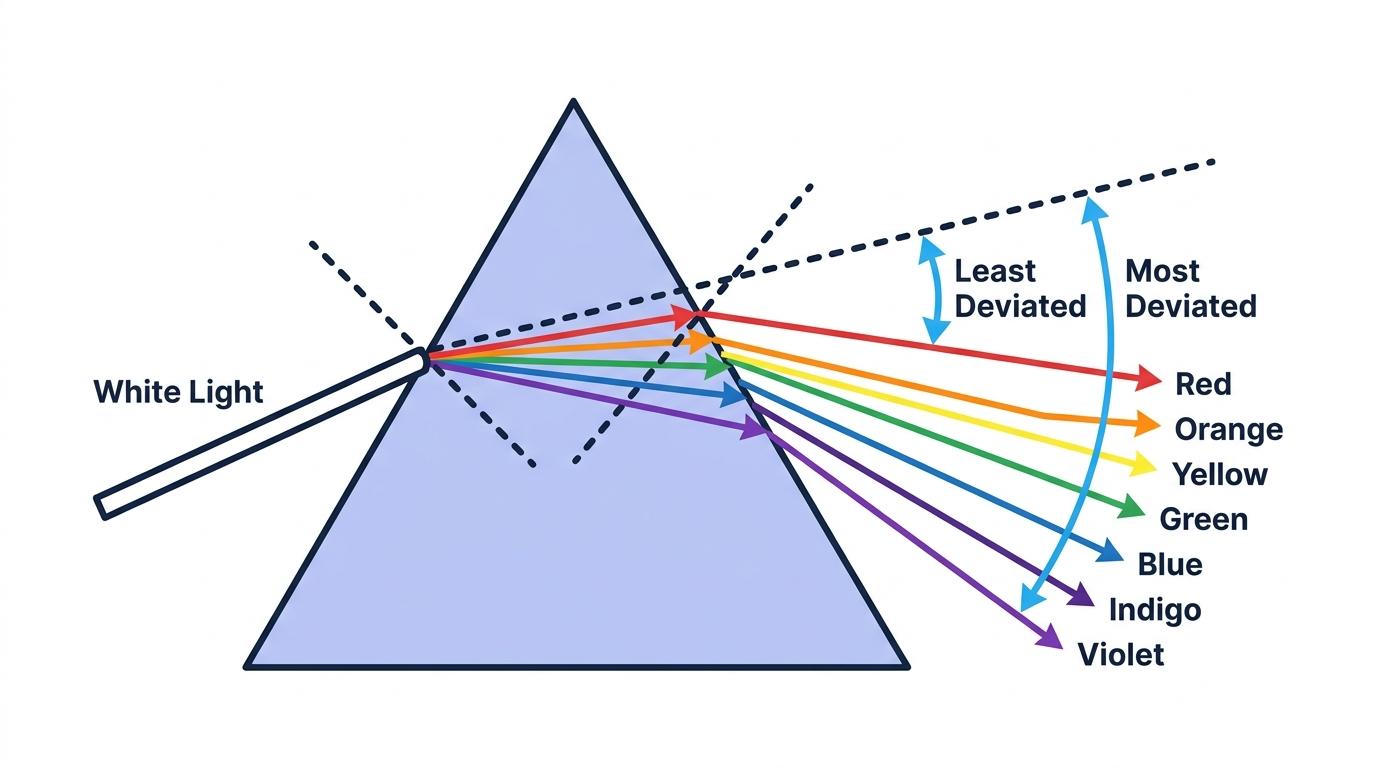
White light is a mixture of colours and a prism spreads them out
Definition
Dispersion
The separation of white light into the colours of the visible spectrum, which happens when the light is refracted because each colour is refracted through a slightly different angle.
- The white light from the Sun or from a filament lamp is not one colour on its own, it is many colours blended together.
- Each of those colours is light of its own frequency, fixed by the source, and that frequency does not change when the light later crosses into glass or water.
- Send a narrow beam of white light through a triangular glass prism and the light leaves as a band of colours lying side by side, called a spectrum.
- A lamp behind a card with a thin slit in it gives you the narrow beam, and a white screen about a metre past the prism catches the colours.
- The prism has not manufactured anything: every colour you see on the screen was already travelling inside the white beam before it reached the glass.
Glass has a slightly different refractive index for each colour, so each colour bends by its own angle
- Light refracts because it changes speed as it crosses into a new material, and the refractive index nnn of the glass is the number that compares those speeds.
- Glass does not have one single value of nnn: the value is slightly different for every colour that passes through it.
- Glass slows violet light the most, so the glass has its largest refractive index for violet.
- It slows red light the least, so the glass has its smallest refractive index for red.
- In a typical crown glass nnn is roughly 1.531.531.53 for violet and roughly 1.511.511.51 for red, a gap of about one part in seventy.
- For the same angle of incidence iii, a larger nnn gives a smaller angle of refraction rrr, so violet is turned further from its original direction than red at each surface.
- The chain runs like this: white light meets the first face of the prism, each colour refracts by its own amount, the colours then travel through the glass in slightly different directions, and at the second face each one refracts again in the same order.
- So violet emerges deviated most from the direction of the incoming beam and red deviated least, with orange, yellow, green, blue and indigo spread out in between.
A prism keeps the colours apart, a flat-sided block hands them back
- In a rectangular glass block the two faces the light crosses are parallel to each other.
- Each colour bends towards the normal by its own amount on the way in, then away from the normal by that same amount on the way out, so the two refractions cancel in direction.
- Every colour therefore leaves the block travelling parallel to the beam that went in, and the light looks white again.
- The colours do fan apart a little inside the glass, so they come out side by side rather than on top of one another, but in a thin block that sideways offset is far too small for your eye to pick out.
- The two refracting faces of a prism are not parallel, they meet at an angle, so the second refraction turns each colour further the same way as the first instead of undoing it.
- The separation builds up rather than cancelling, and by the time the light has crossed the room the spectrum is wide enough to see clearly on a screen.
Red is the low-frequency end of the spectrum and violet the high-frequency end
- In order of increasing frequency, the seven traditional colours run red, orange, yellow, green, blue, indigo, violet.
- In order of increasing wavelength, the same seven run the other way: violet, indigo, blue, green, yellow, orange, red.
- Red sits at one end with the lowest frequency and the longest wavelength of any light you can see.
- Violet sits at the other end with the highest frequency and the shortest wavelength.
- The two orders are mirror images of each other because all these colours travel at the same speed through a given material.
- v=fλv = f\lambdav=fλ
- With vvv effectively the same for all of them, a higher frequency fff has to come with a shorter wavelength λ\lambdaλ.
- These seven colours are one narrow band inside a much wider family of electromagnetic waves, and they are the only part of it your eyes respond to.
Light of a single frequency cannot be split any further
Definition
Monochromatic
Describes visible light of a single frequency.
- A monochromatic beam carries one frequency and nothing else, so it is a single pure colour rather than a mixture.
- Send such a beam into a prism and it still refracts, but it leaves as one ray of that one colour with no spectrum, because there is nothing in it to separate.
- A red laser pointer and the orange-yellow glow of a low-pressure sodium street lamp are both close to monochromatic.
- White light is the opposite case: it holds a whole range of frequencies, which is why a prism can disperse it.
- Define the word using frequency rather than wavelength, since the frequency of the light stays the same in glass and water while its wavelength does not.
Example
- Sunlight falling on a raindrop is refracted as it enters the water, and because water also has a slightly different refractive index for each colour, the colours begin to separate straight away.
- Each colour then reflects off the inside of the back of the drop and refracts once more on the way out, leaving the drop at its own angle.
- Millions of drops do this at once with the Sun behind you, and you see red on the outer edge of the bow and violet on the inner edge.
Common Mistake
- Do not write that the prism adds or creates the colours, because it only separates colours the white light already contained.
- Never say red refracts most: red has the smallest refractive index in glass, so it is deviated least, and violet is deviated most.
- Keep dispersion and diffraction apart: dispersion is refraction splitting white light into colours, while diffraction is a wave spreading out past a gap or an edge.
- Do not assume the order flips the moment a question mentions wavelength, and never write a bare list of seven colours: say increasing or decreasing and name the colour you started from.
Exam technique
- A description of dispersion by a prism scores on four separate ideas, so write all four: white light is a mixture of colours, the glass has a different refractive index for each colour, each colour is refracted through a different angle, and the colours emerge separated as a spectrum.
- A mark usually hangs on the direction of the effect, so commit yourself with “violet is refracted through the largest angle” instead of the vaguer “the colours bend by different amounts”.
- When you draw the prism, put in the narrow white beam, the normal at each face, and just two rays out of it labelled red and violet, with violet the more deviated of the two; a rainbow smear with no labels earns nothing.
- The word frequency has to appear in a definition of monochromatic; “one colour” on its own is too loose to credit.
Self review
- Why is it wrong to talk about a single refractive index for a piece of glass when white light passes through it?
- Which colour leaves a prism deviated most, and what is true of that colour inside the glass?
- A rectangular block gives back white light while a prism gives a spectrum: what is different about their faces?
- Write the seven colours in order of increasing wavelength, then state which end of your list has the highest frequency.
- What must be true of a beam for it to be monochromatic, and what does such a beam look like after a prism?