Revision notes for Oxford AQA IGCSE Maths Quadratic Inequalities. Open the guide for explanations and worked examples. Written against the Oxford AQA IGCSE Maths (9260) specification, so the content matches what's examinable rather than general Maths background.
Quadratic Inequalities
What you'll learn
- How to turn a quadratic inequality into an equation you can solve.
- How roots split the number line into regions.
- How to decide whether the answer is “between” the roots or “outside” the roots.
- How to deal with rearranging, inclusive signs, coefficients, and integer solutions.
Quick recap: quadratics, factorising and roots
A quadratic expression is an expression where the highest power of xxx is x2x^2x2, such as x2−5x+6x^2-5x+6x2−5x+6 or 3x2+7x−63x^2+7x-63x2+7x−6.
To solve quadratic inequalities, you must first be confident solving the related quadratic equation.
Definition
Roots of a quadratic
The roots of a quadratic are the values of xxx that make the quadratic equal to zero. On a graph, they are the points where the curve crosses or touches the x-axis.
A common way to find roots is by factorising. This means rewriting the quadratic as a product of two brackets.
Example
Finding the boundary values
Find the roots of x2−x−12=0x^2-x-12=0x2−x−12=0.
-
Factorise the quadratic.
x2−x−12=(x−4)(x+3)x^2-x-12=(x-4)(x+3)x2−x−12=(x−4)(x+3) -
Use the zero product rule: if two factors multiply to make zero, at least one factor must be zero.
x−4=0⇒x=4x+3=0⇒x=−3\begin{aligned} x-4&=0 \Rightarrow x=4\\ x+3&=0 \Rightarrow x=-3 \end{aligned}x−4x+3=0⇒x=4=0⇒x=−3 -
The roots are x=−3x=-3x=−3 and x=4x=4x=4.
What is a quadratic inequality?
Definition
Quadratic inequality
A quadratic inequality asks where a quadratic expression is greater than, less than, greater than or equal to, or less than or equal to zero. Examples include x2+4x+3>0x^2+4x+3>0x2+4x+3>0 and 2x2−11x+9<02x^2-11x+9<02x2−11x+9<0.
Instead of finding just the points where the quadratic equals zero, you are finding whole ranges of values of xxx.
The roots are still important because they split the number line into regions. In each region, the quadratic is either positive or negative.
Example
Testing regions
Solve (x−2)(x−6)<0(x-2)(x-6)<0(x−2)(x−6)<0.
-
Find the boundary values by setting each bracket equal to zero.
x−2=0⇒x=2x−6=0⇒x=6\begin{aligned} x-2&=0 \Rightarrow x=2\\ x-6&=0 \Rightarrow x=6 \end{aligned}x−2x−6=0⇒x=2=0⇒x=6 -
The roots split the number line into three regions: x<2x<2x<2, 2<x<62<x<62<x<6, and x>6x>6x>6.
-
Test one value from each region.
- If x=0x=0x=0, then (x−2)(x−6)=(−2)(−6)=12(x-2)(x-6)=(-2)(-6)=12(x−2)(x−6)=(−2)(−6)=12, which is positive.
- If x=3x=3x=3, then (x−2)(x−6)=(1)(−3)=−3(x-2)(x-6)=(1)(-3)=-3(x−2)(x−6)=(1)(−3)=−3, which is negative.
- If x=7x=7x=7, then (x−2)(x−6)=(5)(1)=5(x-2)(x-6)=(5)(1)=5(x−2)(x−6)=(5)(1)=5, which is positive.
-
The question asks for where the expression is less than zero, so choose the negative region.
2<x<62<x<62<x<6
The graph idea: inside or outside?
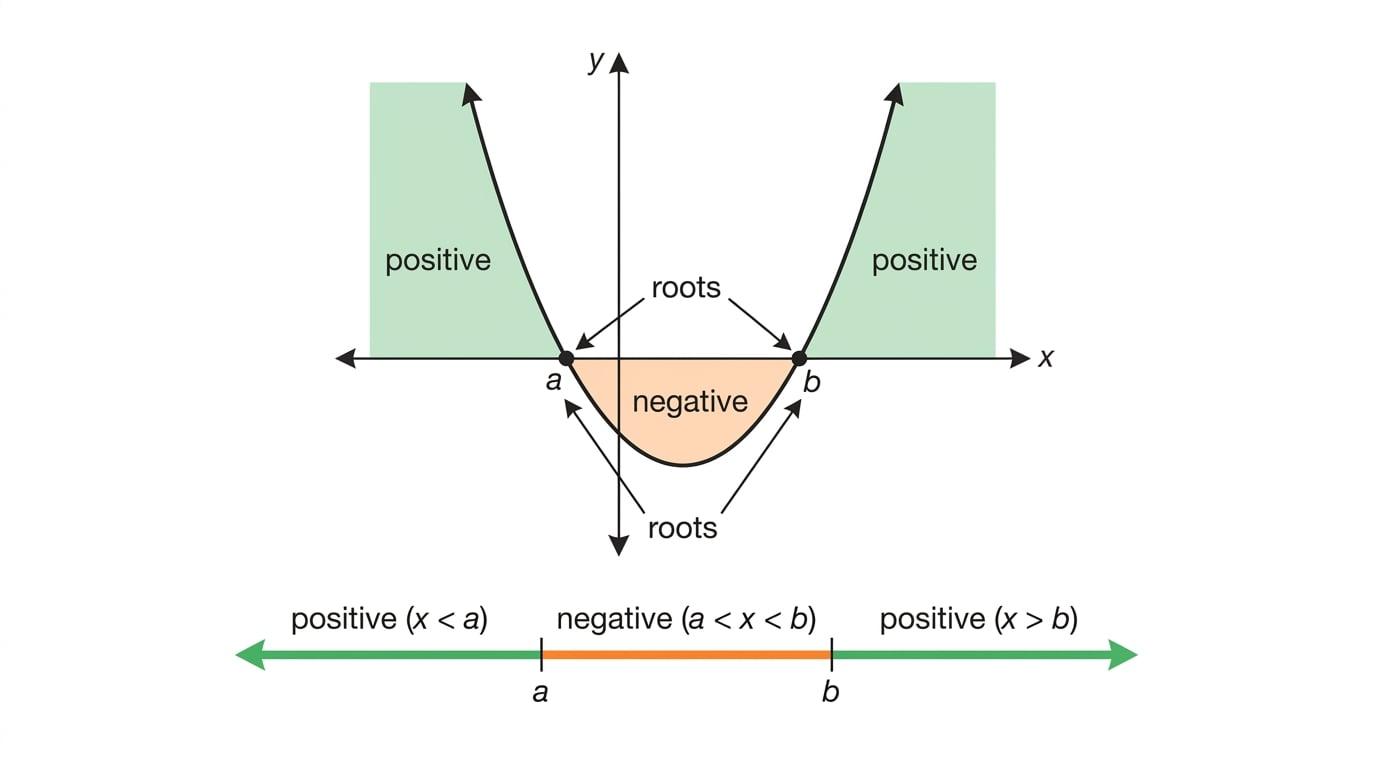
The graph of a quadratic is a U-shaped curve called a parabola. The coefficient of x2x^2x2, often called the leading coefficient, is the number multiplying x2x^2x2. If this coefficient is positive, the parabola opens upwards.
The diagram below shows the sign pattern for an upward-opening quadratic with two roots.
Key Idea
The key pattern
For an upward-opening quadratic with two roots, the quadratic is positive outside the roots and negative between the roots.
So for a positive x2x^2x2 coefficient:
- >0>0>0 or ≥0\ge 0≥0 usually means outside the roots.
- <0<0<0 or ≤0\le 0≤0 usually means between the roots.
Example
Choosing an outside region
Solve x2+7x+10>0x^2+7x+10>0x2+7x+10>0.
-
Factorise the quadratic.
x2+7x+10=(x+5)(x+2)x^2+7x+10=(x+5)(x+2)x2+7x+10=(x+5)(x+2) -
Find the roots.
x+5=0⇒x=−5x+2=0⇒x=−2\begin{aligned} x+5&=0 \Rightarrow x=-5\\ x+2&=0 \Rightarrow x=-2 \end{aligned}x+5x+2=0⇒x=−5=0⇒x=−2 -
The coefficient of x2x^2x2 is positive, so the parabola opens upwards.
-
The inequality asks for greater than zero, so choose the outside regions.
x<−5orx>−2x<-5 \quad \text{or} \quad x>-2x<−5orx>−2
Common Mistake
Using and instead of or
For outside regions, you need two separate parts of the number line, so write “or”. For example, x<−5x<-5x<−5 or x>−2x>-2x>−2, not one combined inequality.
Strict and inclusive inequalities
The inequality sign tells you whether to include the roots.
- <<< and >>> are strict inequalities, so the roots are not included.
- ≤\le≤ and ≥\ge≥ are inclusive inequalities, so the roots are included.
Think of the roots as the places where the expression equals zero. If the inequality allows equality, include them.
Example
Including the endpoints
Solve x2−6x+8≤0x^2-6x+8\le 0x2−6x+8≤0.
-
Factorise the quadratic.
x2−6x+8=(x−2)(x−4)x^2-6x+8=(x-2)(x-4)x2−6x+8=(x−2)(x−4) -
Find the roots.
x=2andx=4x=2 \quad \text{and} \quad x=4x=2andx=4 -
The parabola opens upwards, and the inequality asks for less than or equal to zero, so choose the region between the roots including the endpoints.
2≤x≤42\le x\le 42≤x≤4
Tip
Endpoint check
If the sign includes a line underneath, as in ≤\le≤ or ≥\ge≥, your final answer should include the boundary values.
Rearranging first
Quadratic inequalities are easiest when one side is zero. This is called putting the inequality into standard form, such as ax2+bx+c<0ax^2+bx+c<0ax2+bx+c<0.
You can add or subtract terms from both sides without changing the inequality sign. If you multiply or divide both sides by a negative number, you must reverse the inequality sign.
Example
Rearranging before solving
Solve 8x+20>x28x+20>x^28x+20>x2.
-
Move everything to one side, keeping the x2x^2x2 coefficient positive.
0>x2−8x−200>x^2-8x-200>x2−8x−20 -
Rewrite this with the quadratic on the left.
x2−8x−20<0x^2-8x-20<0x2−8x−20<0 -
Factorise.
x2−8x−20=(x−10)(x+2)x^2-8x-20=(x-10)(x+2)x2−8x−20=(x−10)(x+2) -
The roots are x=−2x=-2x=−2 and x=10x=10x=10.
-
The parabola opens upwards, and the inequality asks for less than zero, so choose the region between the roots.
−2<x<10-2<x<10−2<x<10
Common Mistake
Forgetting to rearrange
Do not try to read the answer straight from something like 8x+20>x28x+20>x^28x+20>x2. First make one side zero, then solve the quadratic inequality.
When the coefficient of x2x^2x2 is not 1
Some quadratic inequalities have a coefficient in front of x2x^2x2, such as 6x2+11x−10<06x^2+11x-10<06x2+11x−10<0. The method is the same, but factorising may be a little more careful.
Example
Factorising with a coefficient
Solve 4x2−4x−15<04x^2-4x-15<04x2−4x−15<0.
-
Factorise the quadratic.
4x2−4x−15=(2x−5)(2x+3)4x^2-4x-15=(2x-5)(2x+3)4x2−4x−15=(2x−5)(2x+3) -
Find the roots.
2x−5=0⇒x=522x+3=0⇒x=−32\begin{aligned} 2x-5&=0 \Rightarrow x=\frac{5}{2}\\ 2x+3&=0 \Rightarrow x=-\frac{3}{2} \end{aligned}2x−52x+3=0⇒x=25=0⇒x=−23 -
Put the roots in order on the number line: −32-\frac{3}{2}−23 then 52\frac{5}{2}25.
-
The coefficient of x2x^2x2 is positive, and the inequality asks for less than zero, so choose the region between the roots.
−32<x<52-\frac{3}{2}<x<\frac{5}{2}−23<x<25
Special case: inequalities with x2x^2x2
For inequalities like x2≤64x^2\le 64x2≤64, remember that both positive and negative values can square to make the same result. For example, both 8 and -8 square to 64.
Example
Solving an inequality
Solve x2≤64x^2\le 64x2≤64.
-
Move everything to one side.
x2−64≤0x^2-64\le 0x2−64≤0 -
Factorise using the difference of two squares.
x2−64=(x−8)(x+8)x^2-64=(x-8)(x+8)x2−64=(x−8)(x+8) -
The roots are x=−8x=-8x=−8 and x=8x=8x=8.
-
The parabola opens upwards, and the inequality asks for less than or equal to zero, so choose the region between the roots including the endpoints.
−8≤x≤8-8\le x\le 8−8≤x≤8
Common Mistake
Only taking the positive square root
From x2≤64x^2\le 64x2≤64, do not write just x≤8x\le 8x≤8. Negative values also work, so you need the full range −8≤x≤8-8\le x\le 8−8≤x≤8.
Integer values and non-factorising quadratics
An integer is a whole number, such as -3, -2, -1, 0, 1, 2, 3.
Sometimes the quadratic does not factorise neatly. In that case, find the roots using the quadratic formula:
x=−b±b2−4ac2ax=\frac{-b\pm\sqrt{b^2-4ac}}{2a}x=2a−b±b2−4acThen use the roots to decide which integers fit.
Example
Finding integer solutions
Work out the integer values satisfying x2−6x+7<0x^2-6x+7<0x2−6x+7<0.
-
Find the roots by solving x2−6x+7=0x^2-6x+7=0x2−6x+7=0. Here a=1a=1a=1, b=−6b=-6b=−6, and c=7c=7c=7.
x=−(−6)±(−6)2−4(1)(7)2(1)x=\frac{-(-6)\pm\sqrt{(-6)^2-4(1)(7)}}{2(1)}x=2(1)−(−6)±(−6)2−4(1)(7) -
Simplify the roots.
x=6±36−282x=6±82x=3±2\begin{aligned} x&=\frac{6\pm\sqrt{36-28}}{2}\\ x&=\frac{6\pm\sqrt{8}}{2}\\ x&=3\pm\sqrt{2} \end{aligned}xxx=26±36−28=26±8=3±2 -
Estimate the roots: 3−2≈1.593-\sqrt{2}\approx 1.593−2≈1.59 and 3+2≈4.413+\sqrt{2}\approx 4.413+2≈4.41.
-
The parabola opens upwards, and the inequality asks for less than zero, so the values must lie between the roots.
3−2<x<3+23-\sqrt{2}<x<3+\sqrt{2}3−2<x<3+2 -
The integer values in this range are 2, 3 and 4.
Common Mistake
When there are no roots
If a quadratic has no real roots, the graph never crosses the x-axis. Test one value of xxx, such as x=0x=0x=0, to decide whether the inequality is true for all values of xxx or for no values.
Exam technique
In the exam
- Rearrange first so one side is zero, preferably with a positive x2x^2x2 coefficient.
- Find the roots carefully, then mark them in order on a quick number line.
- Decide between “inside” and “outside”, and check whether the inequality sign includes the endpoints.
Self review
Check yourself
- Can you explain why x2−9>0x^2-9>0x2−9>0 gives two separate regions?
- When should the roots be included in your final answer?
- If a quadratic inequality asks for integer values, why might you need to estimate the roots first?

Recap questions
Test yourself with 5 quick questions on this guide. Answer them all correctly to complete it.
You've reached the end
Test yourself on this topic, or move on to the next guide.
How was this guide?