Revision notes for Oxford AQA IGCSE Maths Factorising Harder Quadratics. Open the guide for explanations and worked examples. Written against the Oxford AQA IGCSE Maths (9260) specification, so the content matches what's examinable rather than general Maths background.
Factorising Harder Quadratics
What you'll learn
- How to factorise quadratics like 2x2+7x+32x^2+7x+32x2+7x+3, where the coefficient of x2x^2x2 is not 1.
- How to choose the correct pair of numbers by using the product and sum.
- How to solve quadratic equations after factorising.
- How to handle special cases, including difference of two squares and quadratics with xxx and yyy.
Recap: what factorising means
Definition
Factorising
To factorise an expression means to rewrite it as a product of factors. For quadratics, this often means rewriting a three-term expression as two brackets multiplied together.
A quadratic is an expression where the highest power of the variable is 2, such as x2+5x+6x^2+5x+6x2+5x+6 or 3x2−10x+83x^2-10x+83x2−10x+8.
For easier quadratics like x2+7x+12x^2+7x+12x2+7x+12, you look for two numbers that:
- multiply to give the constant term, 12
- add to give the coefficient of xxx, which is 7
So the numbers are 3 and 4, giving:
x2+7x+12=(x+3)(x+4)x^2+7x+12=(x+3)(x+4)x2+7x+12=(x+3)(x+4)Example
Recap: factorising when the coefficient of is 1
Factorise x2+9x+20x^2+9x+20x2+9x+20.
-
Look for two numbers that multiply to 20 and add to 9.
-
The pair is 4 and 5.
-
Write the expression as two brackets:
x2+9x+20=(x+4)(x+5)x^2+9x+20=(x+4)(x+5)x2+9x+20=(x+4)(x+5)
Key Idea
The easy case
When the quadratic starts with x2x^2x2, the bracket beginnings are usually just xxx and xxx.
What makes a quadratic “harder”?
A harder quadratic has a coefficient in front of x2x^2x2 that is not 1, for example:
2x2+7x+32x^2+7x+32x2+7x+3Here, the coefficient of x2x^2x2 is 2. That means the brackets may start with something like 2x2x2x and xxx, or 3x3x3x and 2x2x2x, depending on the expression.
Definition
Coefficient
A coefficient is the number multiplying a variable. In 5x2−3x+85x^2-3x+85x2−3x+8, the coefficient of x2x^2x2 is 5 and the coefficient of xxx is -3.
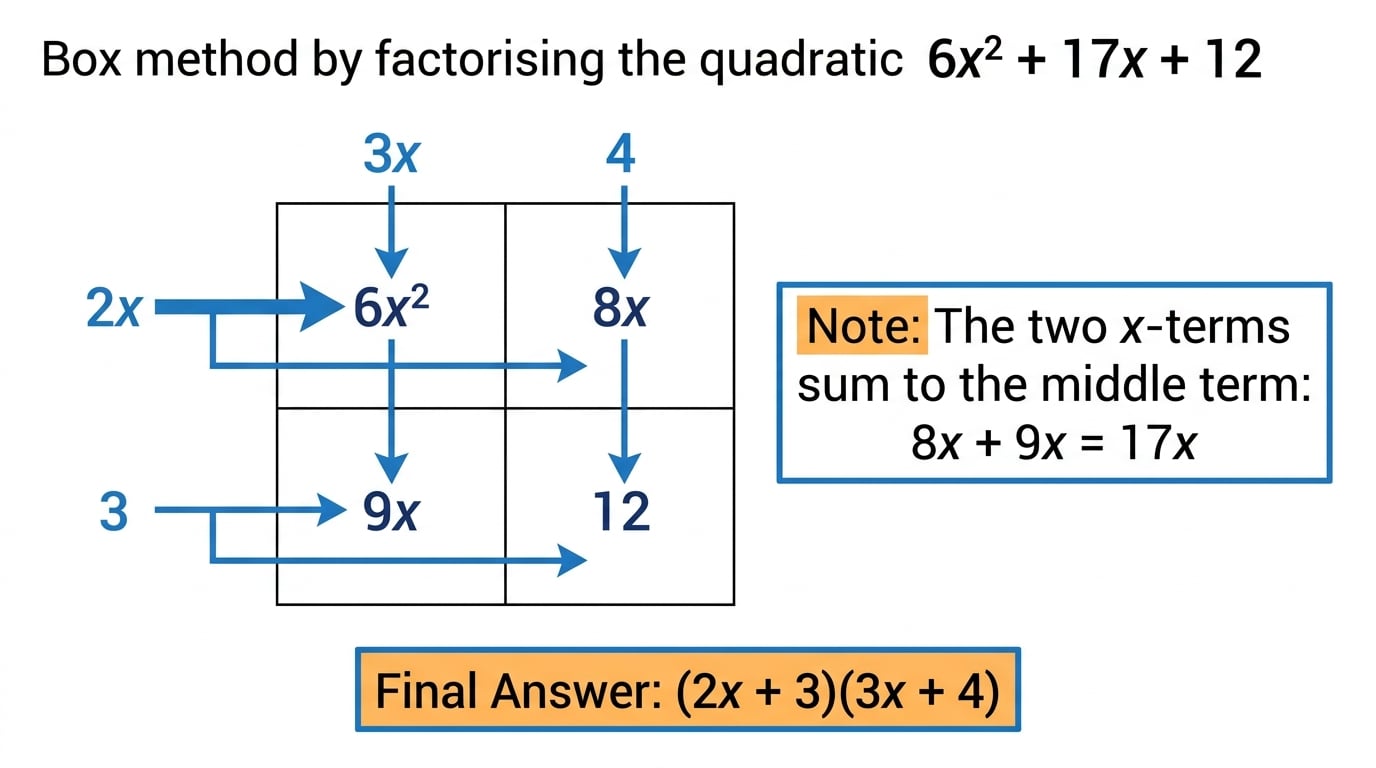
The split-the-middle method
For a quadratic of the form ax2+bx+cax^2+bx+cax2+bx+c, the reliable method is:
- Multiply aaa and ccc.
- Find two numbers that multiply to acacac and add to bbb.
- Split the middle term using those two numbers.
- Factorise by grouping.
This method is sometimes called splitting the middle term.
Example
Factorising a harder quadratic with positive terms
Factorise 3x2+14x+83x^2+14x+83x2+14x+8.
-
Identify aaa, bbb and ccc:
a=3,b=14,c=8a=3,\quad b=14,\quad c=8a=3,b=14,c=8 -
Multiply aaa and ccc:
3×8=243 \times 8=243×8=24 -
Find two numbers that multiply to 24 and add to 14. The pair is 12 and 2.
-
Split the middle term:
3x2+14x+8=3x2+12x+2x+83x^2+14x+8=3x^2+12x+2x+83x2+14x+8=3x2+12x+2x+8 -
Factorise the first pair and the second pair:
3x2+12x+2x+8=3x(x+4)+2(x+4)3x^2+12x+2x+8=3x(x+4)+2(x+4)3x2+12x+2x+8=3x(x+4)+2(x+4) -
The repeated bracket is x+4x+4x+4, so factorise it out:
3x(x+4)+2(x+4)=(3x+2)(x+4)3x(x+4)+2(x+4)=(3x+2)(x+4)3x(x+4)+2(x+4)=(3x+2)(x+4)
Tip
The repeated bracket is your check
After grouping, both parts should contain the same bracket. If they do not, recheck your pair of numbers or your signs.
Handling negative signs
The signs are where many mistakes happen. Use the product and sum carefully.
For ax2+bx+cax^2+bx+cax2+bx+c:
- If ccc is positive and bbb is positive, both numbers are positive.
- If ccc is positive and bbb is negative, both numbers are negative.
- If ccc is negative, one number is positive and one is negative.
Example
Factorising when the constant term is negative
Factorise 2x2+x−152x^2+x-152x2+x−15.
-
Identify aaa, bbb and ccc:
a=2,b=1,c=−15a=2,\quad b=1,\quad c=-15a=2,b=1,c=−15 -
Multiply aaa and ccc:
2×(−15)=−302 \times (-15)=-302×(−15)=−30 -
Find two numbers that multiply to -30 and add to 1. The pair is 6 and -5.
-
Split the middle term:
2x2+x−15=2x2+6x−5x−152x^2+x-15=2x^2+6x-5x-152x2+x−15=2x2+6x−5x−15 -
Factorise by grouping:
2x2+6x−5x−15=2x(x+3)−5(x+3)2x^2+6x-5x-15=2x(x+3)-5(x+3)2x2+6x−5x−15=2x(x+3)−5(x+3) -
Take out the repeated bracket:
2x(x+3)−5(x+3)=(2x−5)(x+3)2x(x+3)-5(x+3)=(2x-5)(x+3)2x(x+3)−5(x+3)=(2x−5)(x+3)
Common Mistake
Forgetting the negative sign
If the product is negative, your two split numbers must have opposite signs. For example, to multiply to -30 and add to 1, you need 6 and -5, not 5 and -6.
Solving quadratic equations by factorising
Definition
Root
A root of an equation is a value of the variable that makes the equation true. For a factorised quadratic, roots come from making each bracket equal to zero.
Once a quadratic equation is factorised, use the zero product property:
AB=0meansA=0 or B=0AB=0 \quad \text{means} \quad A=0 \text{ or } B=0AB=0meansA=0 or B=0So if:
(2x+3)(x−4)=0(2x+3)(x-4)=0(2x+3)(x−4)=0then either:
2x+3=0orx−4=02x+3=0 \quad \text{or} \quad x-4=02x+3=0orx−4=0Example
Solving a harder quadratic equation
Solve 4x2+4x−15=04x^2+4x-15=04x2+4x−15=0.
-
First factorise 4x2+4x−154x^2+4x-154x2+4x−15. Multiply aaa and ccc:
4×(−15)=−604 \times (-15)=-604×(−15)=−60 -
Find two numbers that multiply to -60 and add to 4. The pair is 10 and -6.
-
Split the middle term:
4x2+4x−15=4x2+10x−6x−154x^2+4x-15=4x^2+10x-6x-154x2+4x−15=4x2+10x−6x−15 -
Factorise by grouping:
4x2+10x−6x−15=2x(2x+5)−3(2x+5)4x^2+10x-6x-15=2x(2x+5)-3(2x+5)4x2+10x−6x−15=2x(2x+5)−3(2x+5) -
Write the factorised form:
4x2+4x−15=(2x−3)(2x+5)4x^2+4x-15=(2x-3)(2x+5)4x2+4x−15=(2x−3)(2x+5) -
Set each bracket equal to zero:
2x−3=0or2x+5=02x-3=0 \quad \text{or} \quad 2x+5=02x−3=0or2x+5=0 -
Solve both linear equations:
x=32orx=−52x=\frac{3}{2} \quad \text{or} \quad x=-\frac{5}{2}x=23orx=−25
Tip
Factorise first, solve second
For a question that says “solve”, do not stop at the brackets. You need the values of xxx.
Factorising fully
Sometimes a quadratic has a common factor first. Factorising fully means taking out every possible factor.
Example
Taking out a common factor first
Factorise fully 6x2−246x^2-246x2−24.
-
Look for the highest common factor of both terms. The highest common factor of 6 and 24 is 6.
-
Take out the common factor:
6x2−24=6(x2−4)6x^2-24=6(x^2-4)6x2−24=6(x2−4) -
Notice that x2−4x^2-4x2−4 is a difference of two squares:
x2−4=x2−22x^2-4=x^2-2^2x2−4=x2−22 -
Factorise the difference of two squares:
6(x2−4)=6(x−2)(x+2)6(x^2-4)=6(x-2)(x+2)6(x2−4)=6(x−2)(x+2)
Definition
Difference of two squares
A difference of two squares has the form a2−b2a^2-b^2a2−b2 and factorises as (a−b)(a+b)(a-b)(a+b)(a−b)(a+b).
Common Mistake
Stopping too early
If you write 6(x2−4)6(x^2-4)6(x2−4), you have factorised, but not fully. Because x2−4x^2-4x2−4 factorises again, the fully factorised answer is 6(x−2)(x+2)6(x-2)(x+2)6(x−2)(x+2).
Quadratics with xxx and yyy
You may also see quadratics such as:
2x2+7xy+3y22x^2+7xy+3y^22x2+7xy+3y2These work in a very similar way. The brackets will usually contain both xxx and yyy, for example:
(2x+y)(x+3y)(2x+y)(x+3y)(2x+y)(x+3y)When multiplying, remember:
x×y=xy,y×y=y2x \times y=xy,\quad y \times y=y^2x×y=xy,y×y=y2Example
Factorising a quadratic with two variables
Factorise 3x2−13xy+4y23x^2-13xy+4y^23x2−13xy+4y2.
-
Identify aaa, bbb and ccc, treating xyxyxy like the middle term:
a=3,b=−13,c=4a=3,\quad b=-13,\quad c=4a=3,b=−13,c=4 -
Multiply aaa and ccc:
3×4=123 \times 4=123×4=12 -
Find two numbers that multiply to 12 and add to -13. The pair is -12 and -1.
-
Split the middle term:
3x2−13xy+4y2=3x2−12xy−xy+4y23x^2-13xy+4y^2=3x^2-12xy-xy+4y^23x2−13xy+4y2=3x2−12xy−xy+4y2 -
Factorise by grouping:
3x2−12xy−xy+4y2=3x(x−4y)−y(x−4y)3x^2-12xy-xy+4y^2=3x(x-4y)-y(x-4y)3x2−12xy−xy+4y2=3x(x−4y)−y(x−4y) -
Take out the repeated bracket:
3x(x−4y)−y(x−4y)=(3x−y)(x−4y)3x(x-4y)-y(x-4y)=(3x-y)(x-4y)3x(x−4y)−y(x−4y)=(3x−y)(x−4y)
Common Mistake
Watch the variable in the last term
If the last term is 4y24y^24y2, your brackets must contain yyy terms, not just numbers. For example, x−4yx-4yx−4y makes sense because multiplying yyy by yyy gives y2y^2y2.
Quick checking by expanding
After factorising, you can check by expanding your brackets. This is especially useful in exams if your answer has awkward signs.
Example
Checking a factorisation
Check whether (2x−3)(x+5)(2x-3)(x+5)(2x−3)(x+5) is the factorisation of 2x2+7x−152x^2+7x-152x2+7x−15.
-
Expand the first terms:
2x×x=2x22x \times x=2x^22x×x=2x2 -
Expand the outside and inside terms:
2x×5=10x,−3×x=−3x2x \times 5=10x,\quad -3 \times x=-3x2x×5=10x,−3×x=−3x -
Expand the last terms:
−3×5=−15-3 \times 5=-15−3×5=−15 -
Combine the middle terms:
2x2+10x−3x−15=2x2+7x−152x^2+10x-3x-15=2x^2+7x-152x2+10x−3x−15=2x2+7x−15
Exam technique
In the exam
-
Multiply the first and last coefficients to find the product target, then find two numbers that add to the middle coefficient.
-
If the question says “solve”, factorise first and then set each bracket equal to zero.
-
Always check signs by expanding your brackets quickly, especially when the constant term is negative.
Self review
Check yourself
- Can you factorise a quadratic like 2x2+9x+102x^2+9x+102x2+9x+10 by splitting the middle term?
- If (3x−2)(x+4)=0(3x-2)(x+4)=0(3x−2)(x+4)=0, can you find both values of xxx?
- Can you spot when a quadratic should be factorised further using difference of two squares?

Recap questions
Test yourself with 5 quick questions on this guide. Answer them all correctly to complete it.
You've reached the end
Test yourself on this topic, or move on to the next guide.
How was this guide?