Revision notes for Oxford AQA IGCSE Maths The Magnitude of a Vector. Open the guide for explanations and worked examples. Written against the Oxford AQA IGCSE Maths (9260) specification, so the content matches what's examinable rather than general Maths background.
The Magnitude of a Vector
What you'll learn
- How to read a column vector as horizontal and vertical movement.
- How to find the magnitude, or length, of a vector using Pythagoras.
- How to combine vectors in triangles, parallelograms and trapezia before finding a magnitude.
- How to give exact answers using square roots and simplified surds.
Vectors as movements
A vector describes a movement with both size and direction. In geometry, AB⃗\vec{AB}AB means “the vector from A to B”. The order of the letters matters.
Definition
Column vector and components
A column vector is a vector written in the form
(xy)\begin{pmatrix} x \\ y \end{pmatrix}(xy)where the top number, xxx, is the horizontal component and the bottom number, yyy, is the vertical component.
For example,
AB⃗=(5−2)\vec{AB}=\begin{pmatrix} 5 \\ -2 \end{pmatrix}AB=(5−2)means “move 5 units to the right and 2 units down” from A to B.
If you reverse a vector, you change the signs of both components:
BA⃗=−AB⃗\vec{BA}=-\vec{AB}BA=−ABSo if AB⃗=(5−2)\vec{AB}=\begin{pmatrix} 5 \\ -2 \end{pmatrix}AB=(5−2), then
BA⃗=(−52)\vec{BA}=\begin{pmatrix} -5 \\ 2 \end{pmatrix}BA=(−52)Example
Using the order of letters
Suppose
AB⃗=(4−3)CB⃗=(−26)\vec{AB}=\begin{pmatrix} 4 \\ -3 \end{pmatrix} \quad \vec{CB}=\begin{pmatrix} -2 \\ 6 \end{pmatrix}AB=(4−3)CB=(−26)Find AC⃗\vec{AC}AC.
-
You want to travel from A to C. A useful route is A to B, then B to C:
AC⃗=AB⃗+BC⃗\vec{AC}=\vec{AB}+\vec{BC}AC=AB+BC -
You are given CB⃗\vec{CB}CB, but you need BC⃗\vec{BC}BC. Reverse the vector by changing both signs:
BC⃗=−CB⃗=(2−6)\vec{BC}=-\vec{CB} = \begin{pmatrix} 2 \\ -6 \end{pmatrix}BC=−CB=(2−6) -
Add the components:
AC⃗=(4−3)+(2−6)=(6−9)\vec{AC} = \begin{pmatrix} 4 \\ -3 \end{pmatrix} + \begin{pmatrix} 2 \\ -6 \end{pmatrix} = \begin{pmatrix} 6 \\ -9 \end{pmatrix}AC=(4−3)+(2−6)=(6−9)
Common Mistake
Mixing up and
CB⃗\vec{CB}CB and BC⃗\vec{BC}BC have the same length, but they point in opposite directions. Always change both signs when reversing a vector.
Magnitude means length
Definition
Magnitude of a vector
The magnitude of a vector is its length. The magnitude of v⃗\vec{v}v is written as ∣v⃗∣|\vec{v}|∣v∣.
For a column vector v⃗=(xy)\vec{v}=\begin{pmatrix} x \\ y \end{pmatrix}v=(xy), the horizontal and vertical components form a right-angled triangle. So we use Pythagoras:
∣v⃗∣=x2+y2|\vec{v}|=\sqrt{x^2+y^2}∣v∣=x2+y2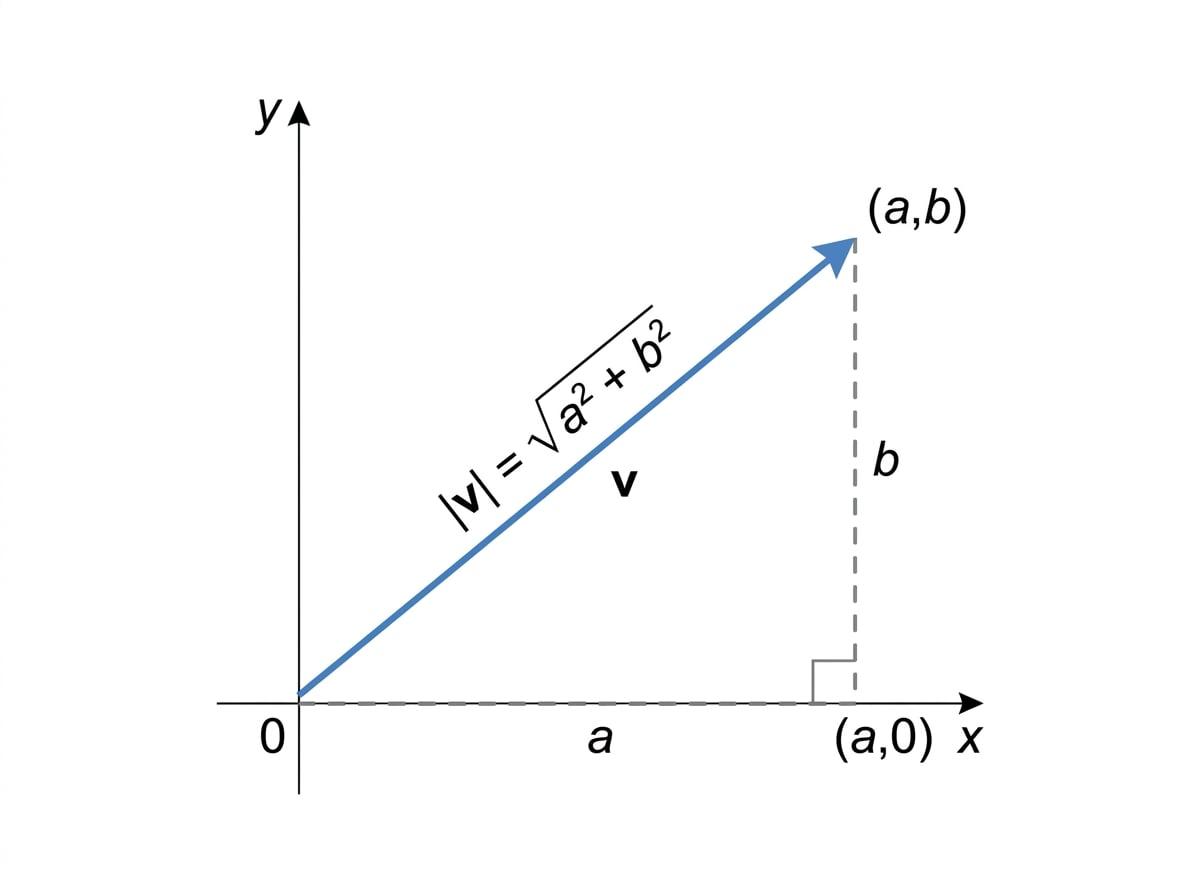
Key Idea
The magnitude formula
To find the length of (xy)\begin{pmatrix} x \\ y \end{pmatrix}(xy), square both components, add them, then square root.
Example
Finding the magnitude of a column vector
Find the magnitude of
v⃗=(−815)\vec{v}=\begin{pmatrix} -8 \\ 15 \end{pmatrix}v=(−815)-
Identify the two components:
x=−8y=15x=-8 \quad y=15x=−8y=15 -
Substitute into the magnitude formula:
∣v⃗∣=(−8)2+152|\vec{v}|=\sqrt{(-8)^2+15^2}∣v∣=(−8)2+152 -
Square the components and add:
∣v⃗∣=64+225=289|\vec{v}|=\sqrt{64+225}=\sqrt{289}∣v∣=64+225=289 -
Square root the answer:
∣v⃗∣=17|\vec{v}|=17∣v∣=17
Common Mistake
Forgetting that negatives square to positives
If a component is negative, keep it in brackets when squaring. For example, (−8)2=64(-8)^2=64(−8)2=64, not -64.
Exact magnitudes and surds
Sometimes the square root is not a whole number. In that case, you may be asked for the exact magnitude.
Definition
Exact answer and surd
An exact answer has not been rounded. A surd is a square root that is left in exact form, such as 29\sqrt{29}29.
If possible, simplify the square root by taking out a square factor:
116=4×29=229\sqrt{116}=\sqrt{4 \times 29}=2\sqrt{29}116=4×29=229Example
Giving an exact magnitude
Find the exact magnitude of
p⃗=(10−4)\vec{p}=\begin{pmatrix} 10 \\ -4 \end{pmatrix}p=(10−4)-
Use the magnitude formula:
∣p⃗∣=102+(−4)2|\vec{p}|=\sqrt{10^2+(-4)^2}∣p∣=102+(−4)2 -
Simplify inside the square root:
∣p⃗∣=100+16=116|\vec{p}|=\sqrt{100+16}=\sqrt{116}∣p∣=100+16=116 -
Take out the square factor 4:
116=4×29=229\sqrt{116}=\sqrt{4 \times 29}=2\sqrt{29}116=4×29=229
Tip
Spot square factors
When simplifying a square root, look for factors like 4, 9, 16, 25, 36, 49 and 64.
Find the vector first, then find its magnitude
Many exam questions do not give you the vector you need directly. You must build it from other vectors first.
A helpful rule is:
AC⃗=AB⃗+BC⃗\vec{AC}=\vec{AB}+\vec{BC}AC=AB+BCRearranging gives:
BC⃗=AC⃗−AB⃗\vec{BC}=\vec{AC}-\vec{AB}BC=AC−AB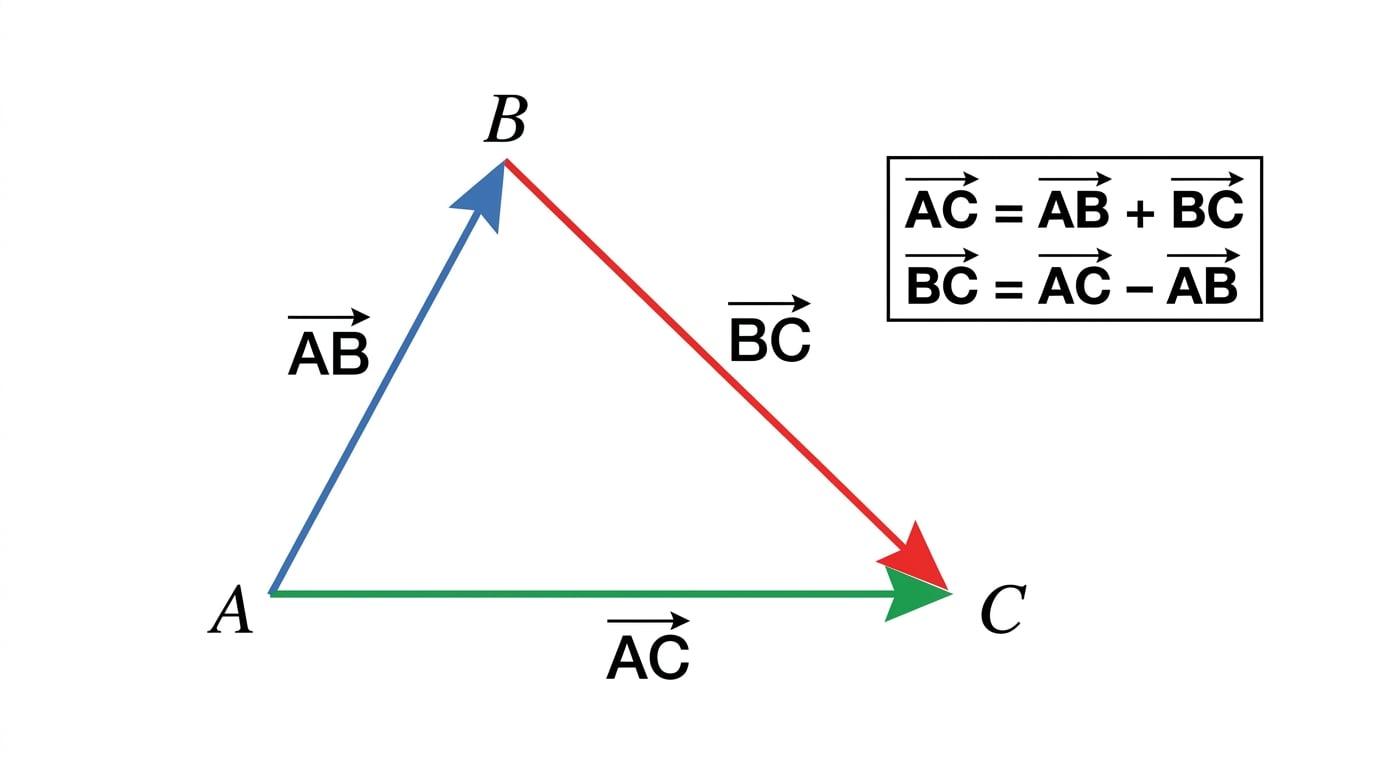
Key Idea
Two-stage method
For magnitude questions in geometry, first find the correct column vector, then apply ∣v⃗∣=x2+y2|\vec{v}|=\sqrt{x^2+y^2}∣v∣=x2+y2.
Example
Finding a hidden vector before its magnitude
Given
AB⃗=(5−7)CB⃗=(−14)\vec{AB}=\begin{pmatrix} 5 \\ -7 \end{pmatrix} \quad \vec{CB}=\begin{pmatrix} -1 \\ 4 \end{pmatrix}AB=(5−7)CB=(−14)find the magnitude of AC⃗\vec{AC}AC.
-
Use the route from A to B to C:
AC⃗=AB⃗+BC⃗\vec{AC}=\vec{AB}+\vec{BC}AC=AB+BC -
Reverse CB⃗\vec{CB}CB to get BC⃗\vec{BC}BC:
BC⃗=−CB⃗=(1−4)\vec{BC}=-\vec{CB} = \begin{pmatrix} 1 \\ -4 \end{pmatrix}BC=−CB=(1−4) -
Add the vectors:
AC⃗=(5−7)+(1−4)=(6−11)\vec{AC} = \begin{pmatrix} 5 \\ -7 \end{pmatrix} + \begin{pmatrix} 1 \\ -4 \end{pmatrix} = \begin{pmatrix} 6 \\ -11 \end{pmatrix}AC=(5−7)+(1−4)=(6−11) -
Find the magnitude:
∣AC⃗∣=62+(−11)2=36+121=157|\vec{AC}|=\sqrt{6^2+(-11)^2} = \sqrt{36+121} = \sqrt{157}∣AC∣=62+(−11)2=36+121=157
Parallelograms and diagonals
Definition
Parallelogram
A parallelogram is a quadrilateral with both pairs of opposite sides parallel and equal in length.
In a parallelogram ABCDABCDABCD, the diagonal AC⃗\vec{AC}AC can be made by going along AB⃗\vec{AB}AB and then BC⃗\vec{BC}BC:
AC⃗=AB⃗+BC⃗\vec{AC}=\vec{AB}+\vec{BC}AC=AB+BCSo if you know AB⃗\vec{AB}AB and AC⃗\vec{AC}AC, you can find:
BC⃗=AC⃗−AB⃗\vec{BC}=\vec{AC}-\vec{AB}BC=AC−ABExample
Magnitude in a parallelogram
ABCDABCDABCD is a parallelogram.
AB⃗=(32)AC⃗=(11−4)\vec{AB}=\begin{pmatrix} 3 \\ 2 \end{pmatrix} \quad \vec{AC}=\begin{pmatrix} 11 \\ -4 \end{pmatrix}AB=(32)AC=(11−4)Find the magnitude of BC⃗\vec{BC}BC.
-
Use the diagonal relationship:
AC⃗=AB⃗+BC⃗\vec{AC}=\vec{AB}+\vec{BC}AC=AB+BC -
Rearrange to find BC⃗\vec{BC}BC:
BC⃗=AC⃗−AB⃗\vec{BC}=\vec{AC}-\vec{AB}BC=AC−AB -
Subtract the column vectors component by component:
BC⃗=(11−4)−(32)=(8−6)\vec{BC} = \begin{pmatrix} 11 \\ -4 \end{pmatrix} - \begin{pmatrix} 3 \\ 2 \end{pmatrix} = \begin{pmatrix} 8 \\ -6 \end{pmatrix}BC=(11−4)−(32)=(8−6) -
Find the magnitude:
∣BC⃗∣=82+(−6)2=64+36=100=10|\vec{BC}|=\sqrt{8^2+(-6)^2} = \sqrt{64+36} = \sqrt{100} = 10∣BC∣=82+(−6)2=64+36=100=10
Tip
Subtracting column vectors
Subtract top from top, and bottom from bottom. Keep the order exactly as written.
Trapezia and scalar multiples
Definition
Trapezium and scalar multiple
A trapezium is a quadrilateral with at least one pair of parallel sides. A scalar multiple means a vector has been multiplied by a number, such as 3AB⃗3\vec{AB}3AB.
If you are told DC⃗=3AB⃗\vec{DC}=3\vec{AB}DC=3AB, then DC⃗\vec{DC}DC points in the same direction as AB⃗\vec{AB}AB and is three times as long.
To solve these questions, build the missing side carefully using vector paths.
Example
Exact magnitude in a trapezium
ABCDABCDABCD is a trapezium and
DC⃗=3AB⃗\vec{DC}=3\vec{AB}DC=3ABAlso,
DA⃗=(2−1)DB⃗=(53)\vec{DA}=\begin{pmatrix} 2 \\ -1 \end{pmatrix} \quad \vec{DB}=\begin{pmatrix} 5 \\ 3 \end{pmatrix}DA=(2−1)DB=(53)Find the exact magnitude of BC⃗\vec{BC}BC.
-
First find AB⃗\vec{AB}AB. Going from D to A, then A to B, gives D to B:
DA⃗+AB⃗=DB⃗\vec{DA}+\vec{AB}=\vec{DB}DA+AB=DB -
Rearrange:
AB⃗=DB⃗−DA⃗\vec{AB}=\vec{DB}-\vec{DA}AB=DB−DA -
Substitute and subtract:
AB⃗=(53)−(2−1)=(34)\vec{AB} = \begin{pmatrix} 5 \\ 3 \end{pmatrix} - \begin{pmatrix} 2 \\ -1 \end{pmatrix} = \begin{pmatrix} 3 \\ 4 \end{pmatrix}AB=(53)−(2−1)=(34) -
Use DC⃗=3AB⃗\vec{DC}=3\vec{AB}DC=3AB:
DC⃗=3(34)=(912)\vec{DC} = 3\begin{pmatrix} 3 \\ 4 \end{pmatrix} = \begin{pmatrix} 9 \\ 12 \end{pmatrix}DC=3(34)=(912) -
To get from B to C, go from B to D, then D to C:
BC⃗=BD⃗+DC⃗\vec{BC}=\vec{BD}+\vec{DC}BC=BD+DC -
Since BD⃗=−DB⃗\vec{BD}=-\vec{DB}BD=−DB, substitute both vectors:
BC⃗=(−5−3)+(912)=(49)\vec{BC} = \begin{pmatrix} -5 \\ -3 \end{pmatrix} + \begin{pmatrix} 9 \\ 12 \end{pmatrix} = \begin{pmatrix} 4 \\ 9 \end{pmatrix}BC=(−5−3)+(912)=(49) -
Find the exact magnitude:
∣BC⃗∣=42+92=16+81=97|\vec{BC}|=\sqrt{4^2+9^2} = \sqrt{16+81} = \sqrt{97}∣BC∣=42+92=16+81=97
Common Mistake
Do not assume the diagram is to scale
In vector geometry, the written vector information is more reliable than how the shape looks. Use the vector equations, not visual guessing.
Exam technique
In the exam
-
Write a vector path for the vector you need, such as AC⃗=AB⃗+BC⃗\vec{AC}=\vec{AB}+\vec{BC}AC=AB+BC.
-
Reverse vectors carefully: BA⃗=−AB⃗\vec{BA}=-\vec{AB}BA=−AB, so both components change sign.
-
Only find the magnitude after you have the final column vector, then use ∣v⃗∣=x2+y2|\vec{v}|=\sqrt{x^2+y^2}∣v∣=x2+y2.
Self review
Check yourself
-
If PQ⃗=(−38)\vec{PQ}=\begin{pmatrix} -3 \\ 8 \end{pmatrix}PQ=(−38), what is QP⃗\vec{QP}QP?
-
Why does a negative component not make the magnitude negative?
-
In a parallelogram, how can you find BC⃗\vec{BC}BC if you know AB⃗\vec{AB}AB and AC⃗\vec{AC}AC?

Recap questions
Test yourself with 5 quick questions on this guide. Answer them all correctly to complete it.
You've reached the end
Test yourself on this topic, or move on to the next guide.
How was this guide?