Revision notes for Oxford AQA IGCSE Maths SOHCAHTOA (Trigonometry). Open the guide for explanations and worked examples. Written against the Oxford AQA IGCSE Maths (9260) specification, so the content matches what's examinable rather than general Maths background.
SOHCAHTOA (Trigonometry)
What you'll learn
- How to label the opposite, adjacent and hypotenuse in a right-angled triangle.
- How to choose between sin\sinsin, cos\coscos and tan\tantan using SOHCAHTOA.
- How to find missing side lengths and missing angles.
- How to handle diagrams with letters, hidden right triangles and answers to 1 decimal place.
1. Start with the right triangle
Trigonometry at this level is about right-angled triangles: triangles with one angle of 90°. The 90° angle is usually marked with a small square.
The side names are always based on the angle you are using.
Definition
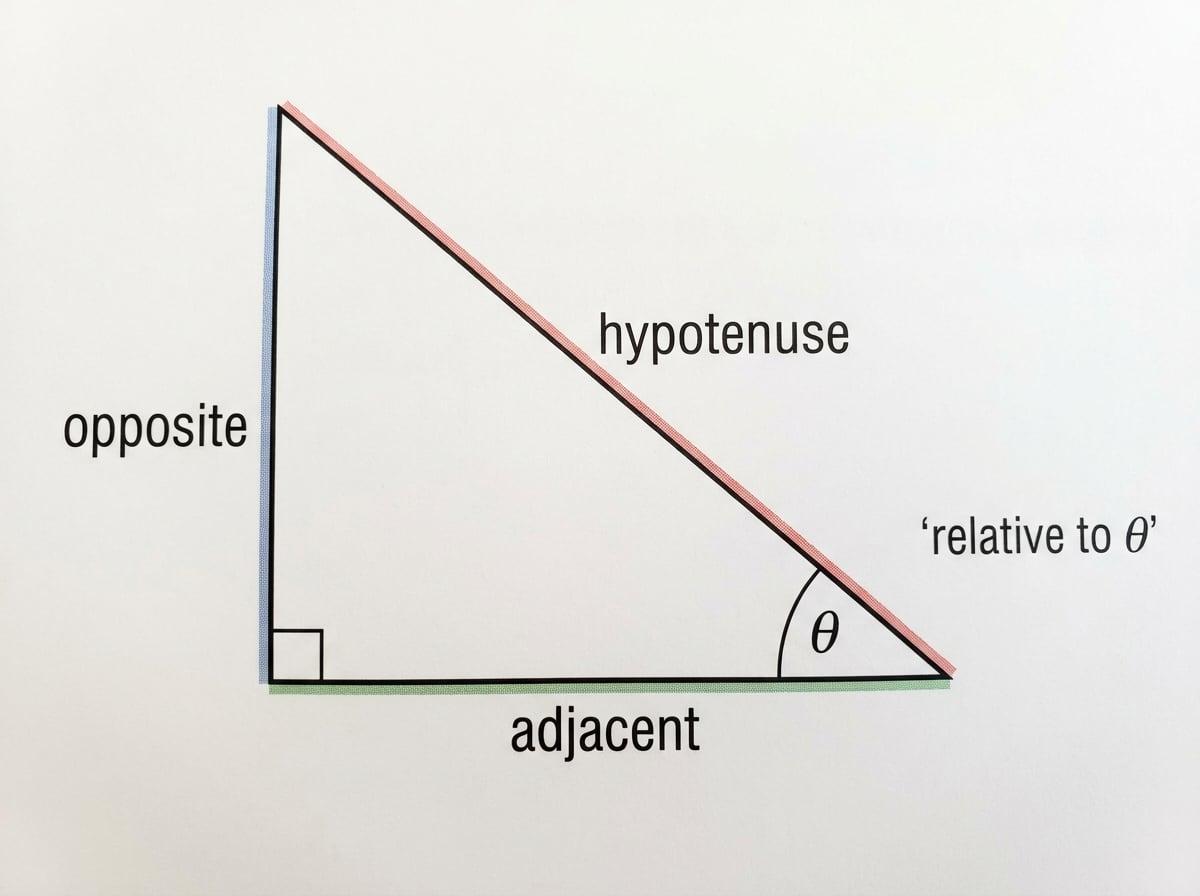
Sides in a right-angled triangle
- The hypotenuse is the longest side, opposite the right angle.
- The opposite side is opposite the angle you are focusing on.
- The adjacent side is next to the angle you are focusing on, but it is not the hypotenuse.
The opposite and adjacent sides can swap if you choose a different angle, but the hypotenuse is always the same side.
Key Idea
The angle decides the labels
Before doing any calculations, mark the angle you are using, then label the sides as opposite, adjacent and hypotenuse from that angle.
Example
Labelling the sides
A right-angled triangle has a 40° angle at the bottom right. The side opposite this angle is 12 cm, the bottom side is 18 cm, and the sloping side is the longest side. Name the opposite, adjacent and hypotenuse.
-
The hypotenuse is the longest side, so the sloping side is the hypotenuse.
-
The side directly across from the 40° angle is the opposite side, so 12 cm is the opposite.
-
The side next to the 40° angle that is not the hypotenuse is the adjacent side, so 18 cm is the adjacent.
Common Mistake
Adjacent is not always the bottom side
The adjacent side means “next to the chosen angle”, not “horizontal”. Rotate the triangle in your mind if needed.
2. The three trigonometric ratios
SOHCAHTOA is a memory aid for the three main trigonometric ratios.
Definition
SOHCAHTOA
For a right-angled triangle:
- SOH means sinθ=oppositehypotenuse\sin \theta = \frac{\text{opposite}}{\text{hypotenuse}}sinθ=hypotenuseopposite
- CAH means cosθ=adjacenthypotenuse\cos \theta = \frac{\text{adjacent}}{\text{hypotenuse}}cosθ=hypotenuseadjacent
- TOA means tanθ=oppositeadjacent\tan \theta = \frac{\text{opposite}}{\text{adjacent}}tanθ=adjacentopposite
Here, θ\thetaθ is a Greek letter called theta, often used to mean “the angle”.
How to choose the right ratio
You choose the ratio using the two sides involved in the question:
- Opposite and hypotenuse: use sine.
- Adjacent and hypotenuse: use cosine.
- Opposite and adjacent: use tangent.
Tip
Cover-up method
Write SOHCAHTOA, then circle the two sides you have or need. The matching group tells you whether to use sine, cosine or tangent.
Example
Choosing the correct ratio
In a right-angled triangle, the angle is 35°. The side opposite the angle is 20 cm and the hypotenuse is xxx cm. Work out which trig ratio to use.
-
Label the sides relative to the 35° angle: 20 cm is opposite and xxx is the hypotenuse.
-
The sides involved are opposite and hypotenuse.
-
Opposite and hypotenuse go with SOH, so use sine:
sinθ=oppositehypotenuse\sin \theta = \frac{\text{opposite}}{\text{hypotenuse}}sinθ=hypotenuseopposite
3. Finding a missing side
When finding a side length, you normally know one angle and one side. Your job is to set up the correct trig equation and rearrange.
Example where the missing side is the hypotenuse
Example
Finding the hypotenuse
A right-angled triangle has an angle of 35°. The side opposite this angle is 20 cm. The hypotenuse is xxx cm. Find xxx.
-
Label the sides: 20 cm is opposite and xxx is the hypotenuse.
-
Choose the ratio. Opposite and hypotenuse means sine:
sin35∘=20x\sin 35^\circ = \frac{20}{x}sin35∘=x20 -
Rearrange by multiplying both sides by xxx:
xsin35∘=20x\sin 35^\circ = 20xsin35∘=20 -
Divide by sin35∘\sin 35^\circsin35∘:
x=20sin35∘x = \frac{20}{\sin 35^\circ}x=sin35∘20 -
Use your calculator:
x=34.9 cmx = 34.9\text{ cm}x=34.9 cm
Example where the missing side is not the hypotenuse
Example
Finding an adjacent side
A right-angled triangle has an angle of 42°. The side opposite this angle is 11 cm. The adjacent side is xxx cm. Find xxx.
-
Label the sides: 11 cm is opposite and xxx is adjacent.
-
Choose the ratio. Opposite and adjacent means tangent:
tan42∘=11x\tan 42^\circ = \frac{11}{x}tan42∘=x11 -
Multiply both sides by xxx:
xtan42∘=11x\tan 42^\circ = 11xtan42∘=11 -
Divide by tan42∘\tan 42^\circtan42∘:
x=11tan42∘x = \frac{11}{\tan 42^\circ}x=tan42∘11 -
Calculate:
x=12.2 cmx = 12.2\text{ cm}x=12.2 cm
Common Mistake
Calculator mode
For IGCSE angle questions, your calculator should normally be in degrees mode, not radians. If your answer looks completely unreasonable, check this first.
4. Finding a missing angle
When the angle is missing, you still use SOHCAHTOA, but then you use the inverse trig buttons:
- sin−1\sin^{-1}sin−1 for sine
- cos−1\cos^{-1}cos−1 for cosine
- tan−1\tan^{-1}tan−1 for tangent
These do not mean “one divided by sine”. They mean “the angle whose sine/cosine/tangent is…”.
Definition
Inverse trigonometry
Inverse trigonometry works backwards from a ratio of sides to find an angle.
Example
Finding an angle using cosine
A right-angled triangle has a side next to angle xxx of 16 cm and a hypotenuse of 24 cm. Find angle xxx.
-
Label the sides relative to angle xxx: 16 cm is adjacent and 24 cm is the hypotenuse.
-
Choose the ratio. Adjacent and hypotenuse means cosine:
cosx=1624\cos x = \frac{16}{24}cosx=2416 -
Use inverse cosine:
x=cos−1(1624)x = \cos^{-1}\left(\frac{16}{24}\right)x=cos−1(2416) -
Calculate:
x=48.2∘x = 48.2^\circx=48.2∘
Example
Finding an angle using tangent
A right-angled triangle has opposite side 11 cm and adjacent side 15 cm relative to angle xxx. Find xxx.
-
The sides involved are opposite and adjacent.
-
Opposite and adjacent means tangent:
tanx=1115\tan x = \frac{11}{15}tanx=1511 -
Use inverse tangent:
x=tan−1(1115)x = \tan^{-1}\left(\frac{11}{15}\right)x=tan−1(1511) -
Calculate:
x=36.3∘x = 36.3^\circx=36.3∘
Common Mistake
Using normal tan instead of inverse tan
If the angle is unknown, you usually need sin−1\sin^{-1}sin−1, cos−1\cos^{-1}cos−1 or tan−1\tan^{-1}tan−1. Typing tan(11÷15)\tan(11 \div 15)tan(11÷15) finds the tangent of a number, not the angle.
5. Diagrams with letters
In IGCSE questions, triangles are often labelled with letters such as AAA, BBB and CCC. A side like ABABAB means the length from point AAA to point BBB. An angle like ACBACBACB means the angle at the middle letter, so ACBACBACB is the angle at CCC.
Tip
Middle letter rule
For angle ABCABCABC, the angle is at BBB. The middle letter tells you the vertex.
Example
Using named vertices
Triangle ABCABCABC is right-angled at BBB. The side BCBCBC is 20 cm and angle CCC is 35°. Calculate ABABAB.
-
Focus on angle CCC.
-
Side ABABAB is opposite angle CCC, and side BCBCBC is adjacent to angle CCC.
-
Opposite and adjacent means tangent:
tan35∘=AB20\tan 35^\circ = \frac{AB}{20}tan35∘=20AB -
Multiply by 20:
AB=20tan35∘AB = 20\tan 35^\circAB=20tan35∘ -
Calculate:
AB=14.0 cmAB = 14.0\text{ cm}AB=14.0 cm
6. Hidden right triangles in larger shapes
Some questions place the right triangle inside a bigger shape. You may need to draw an extra line or compare lengths before using trigonometry.
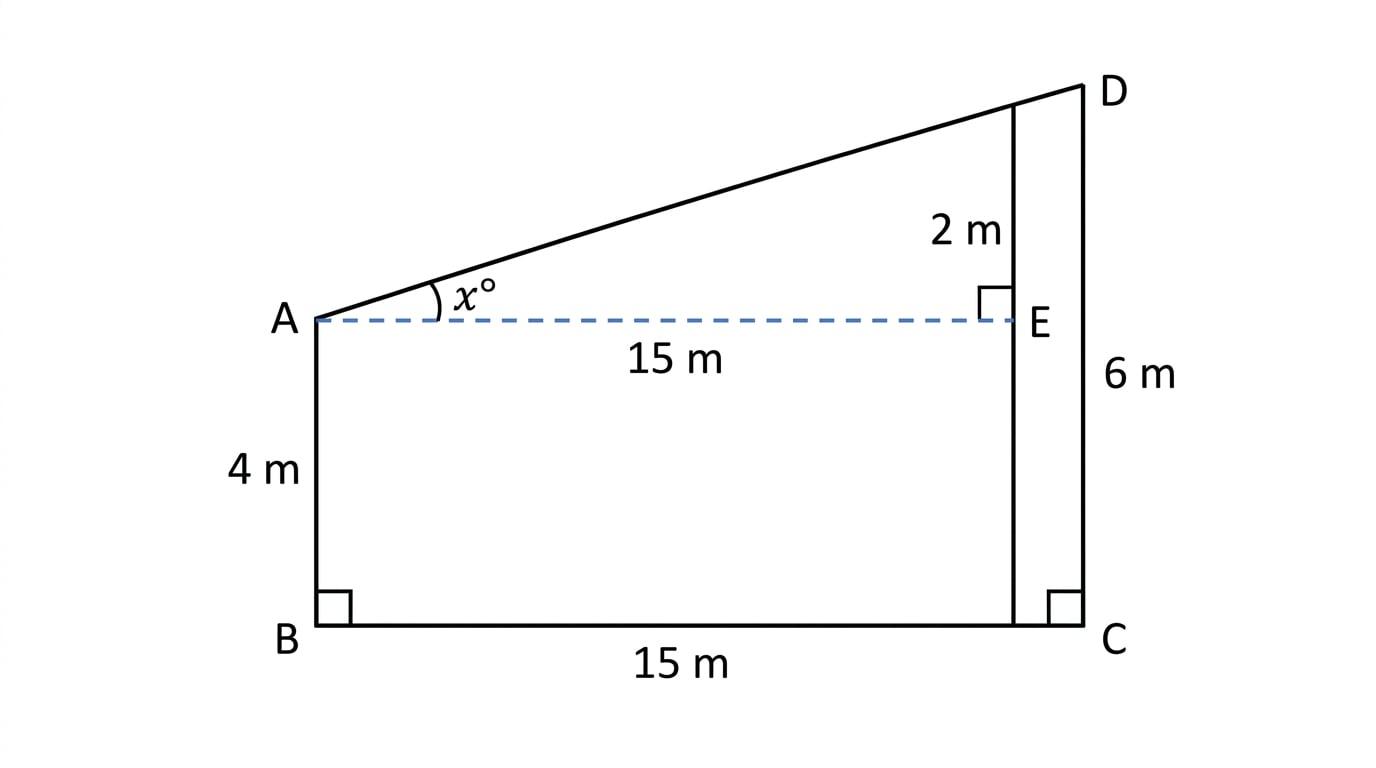
In this trapezium, the vertical sides are different lengths. Drawing a horizontal line from the shorter vertical side creates a small right triangle at the top.
Example
Trigonometry in a trapezium
A right-angled trapezium has vertical sides 4 m and 6 m, and the distance between them is 15 m. Find the angle between the shorter vertical side and the sloping top. Give your answer to 1 decimal place.
-
The height difference between the two vertical sides is:
6−4=26 - 4 = 26−4=2 -
The horizontal distance across the shape is 15 m, so the small right triangle has opposite side 2 m and adjacent side 15 m.
-
Use tangent:
tanθ=215\tan \theta = \frac{2}{15}tanθ=152 -
Find the small angle above the horizontal:
θ=tan−1(215)\theta = \tan^{-1}\left(\frac{2}{15}\right)θ=tan−1(152) -
Calculate:
θ=7.6∘\theta = 7.6^\circθ=7.6∘ -
The required angle with the vertical side is the complement of this angle:
90∘−7.6∘=82.4∘90^\circ - 7.6^\circ = 82.4^\circ90∘−7.6∘=82.4∘
Common Mistake
Forgetting the 90° adjustment
If you find the angle to the horizontal but the question asks for the angle to the vertical, subtract from 90°.
7. Rounding and accuracy
If a question says “give your answer to 1 decimal place”, keep the full calculator value until the final line. Only round at the end.
Example
Combining Pythagoras and trigonometry
A right-angled triangle has shorter sides 20 cm and 16 cm. The hypotenuse is xxx cm. Find xxx to 1 decimal place.
-
This question is asking for the hypotenuse and gives the two shorter sides, so Pythagoras is the quickest method.
-
Use a2+b2=c2a^2 + b^2 = c^2a2+b2=c2:
x2=202+162x^2 = 20^2 + 16^2x2=202+162 -
Work out the squares:
x2=400+256=656x^2 = 400 + 256 = 656x2=400+256=656 -
Square root:
x=656x = \sqrt{656}x=656 -
Round to 1 decimal place:
x=25.6 cmx = 25.6\text{ cm}x=25.6 cm
Exam technique
In the exam
-
Mark the angle you are using, then label opposite, adjacent and hypotenuse before writing any formula.
-
Choose the ratio from the two sides involved: SOH, CAH or TOA.
-
If finding an angle, use the inverse trig button and check your calculator is in degrees.
-
Round only at the end, and include units such as cm, m or degrees.
Self review
Check yourself
- Can you explain why the hypotenuse is always opposite the right angle?
- Given opposite and adjacent sides, which trig ratio would you use?
- If a question asks for angle ABCABCABC, which point is the angle at?

Recap questions
Test yourself with 5 quick questions on this guide. Answer them all correctly to complete it.
You've reached the end
Test yourself on this topic, or move on to the next guide.
How was this guide?