Revision notes for Oxford AQA IGCSE Maths Scale Drawings. Open the guide for explanations and worked examples. Written against the Oxford AQA IGCSE Maths (9260) specification, so the content matches what's examinable rather than general Maths background.
Scale Drawings
What you'll learn
- How to read an accurate scale drawing and estimate real sizes.
- How a scale such as 1:50000 links map or model lengths to real lengths.
- How to convert centimetres to metres or kilometres.
- How to use a scale drawing to find a perimeter.
1. What is a scale drawing?
A scale drawing is used when the real object is too big, too small, or too far away to draw at its actual size. Maps, house plans, model cars, and diagrams of fields are all common examples.
Definition
Scale drawing
A scale drawing is a drawing where every length has been enlarged or reduced by the same multiplier. An accurate scale drawing is carefully drawn so that you can measure it and use those measurements to estimate real sizes.
The real size means the actual size in real life. A ratio compares two quantities of the same type, such as two lengths. In a scale drawing, matching lengths keep the same ratio.
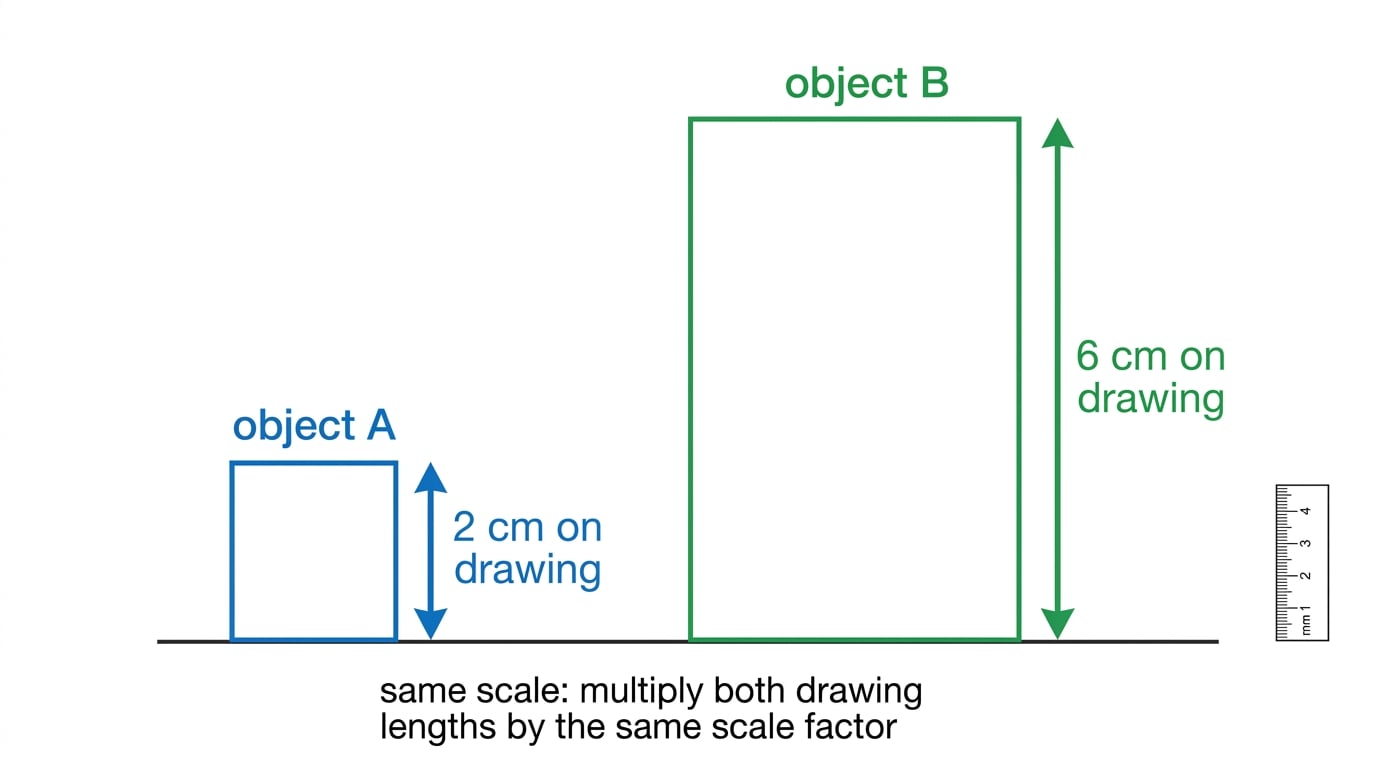
The diagram below shows two drawn objects on the same scale. If one drawn height is three times another drawn height, then the matching real height is also three times as large.
Key Idea
Same scale, same multiplier
When two lengths are shown on the same scale drawing, compare drawing length with drawing length first. Then use the same multiplier for the real lengths.
Worked example: estimating a real length
Example
Estimating the length of a van
A scale drawing shows a van. On the drawing, the van is 1.8 cm high and 5.4 cm long. The real van is 1.6 m high. Estimate the real length of the van.
-
Compare the drawing length with the drawing height.
5.4÷1.8=35.4 \div 1.8 = 35.4÷1.8=3 -
The van is 3 times as long as it is high on the drawing, so it is 3 times as long as it is high in real life.
-
Multiply the real height by 3. The real length is about 4.8 m.
1.6×3=4.81.6 \times 3 = 4.81.6×3=4.8
Common Mistake
Mixing drawing lengths and real lengths
Do not compare a drawing length directly with a real length. First find the multiplier using lengths from the drawing, then apply it to the matching real measurement.
2. Using a written scale
Sometimes the scale is written as a ratio, such as 1:50 or 1:50000.
Definition
Written scale
A written scale such as 1:501:501:50 means 1 unit on the drawing or model represents 50 of the same units in real life. A scale factor is the multiplier used to change one length into the matching length.
For IGCSE questions at this level, you will usually go from a drawing or model to the real object.
- From drawing/model to real life: multiply by the scale number.
- From real life to drawing/model: divide by the scale number.
The important phrase is “the same units”. If the model length is in centimetres, the first real answer will also be in centimetres. Convert units at the end.
Worked example: model to real size
Example
Finding the real length of a model car
A model car is 9 cm long. The scale is 1:501:501:50. Work out the real length of the car in metres.
-
The scale 1:501:501:50 means 1 cm on the model represents 50 cm in real life.
-
Multiply the model length by 50. The real length is 450 cm.
9×50=4509 \times 50 = 4509×50=450 -
Convert centimetres to metres by dividing by 100. The real car is 4.5 m long.
450÷100=4.5450 \div 100 = 4.5450÷100=4.5
Tip
Quick unit conversions
- To change centimetres to metres, divide by 100.
- To change centimetres to kilometres, divide by 100000.
- In scale questions, multiply by the scale number first, then convert units.
3. Maps and distances in kilometres
A map is a scale drawing of a place, usually viewed from above. Map scales often use large numbers, for example 1:50000 or 1:75000, because a small distance on the map represents a much larger real distance.
For a map scale:
- Measure or read the map distance in centimetres.
- Multiply by the scale number to get the real distance in centimetres.
- Convert centimetres to kilometres if the question asks for kilometres.
Worked example: map distance
Example
Using a map scale
A map has scale 1:750001:750001:75000. The distance between two villages on the map is 14 cm. Work out the real distance in kilometres.
-
The scale means 1 cm on the map represents 75000 cm in real life.
-
Multiply the map distance by 75000. The real distance is 1050000 cm.
14×75000=105000014 \times 75000 = 105000014×75000=1050000 -
Convert centimetres to kilometres by dividing by 100000. The real distance is 10.5 km.
1050000÷100000=10.51050000 \div 100000 = 10.51050000÷100000=10.5
Common Mistake
Reading the scale as kilometres
A scale of 1:750001:750001:75000 does not mean 1 cm represents 75000 km. It means 1 cm represents 75000 cm. Convert to kilometres only at the end.
4. Finding a perimeter from a scale drawing
Sometimes a diagram gives one real length, and you have to use it to estimate another length. This is common with rectangles, fields, gardens, and rooms.
Definition
Perimeter
The perimeter of a 2D shape is the total distance around the outside of the shape.
For a rectangle, the perimeter is found by adding all four sides. If the length is lll and the width is www, then:
P=2(l+w)P = 2(l+w)P=2(l+w)To use a scale drawing for perimeter:
- Measure the known side on the drawing.
- Use the known real length to find what 1 cm on the drawing represents.
- Use that to estimate any missing real side.
- Use the perimeter formula.
Worked example: rectangular field
Example
Estimating the perimeter of a field
A scale drawing shows a rectangular field. The real length of the field is 75 m. On the drawing, the length is 5 cm and the width is 2 cm. Estimate the real perimeter of the field.
-
Use the known length to find the real distance represented by 1 cm on the drawing. Here, 1 cm represents 15 m.
75÷5=1575 \div 5 = 1575÷5=15 -
Use this to find the real width. The real width is 30 m.
2×15=302 \times 15 = 302×15=30 -
Use the rectangle perimeter formula. The perimeter is 210 m.
2(75+30)=2102(75+30)=2102(75+30)=210
Tip
Why the word estimate appears
When you measure a printed scale drawing with a ruler, your measurement might be slightly different from someone else’s. That is why many answers are called estimates. Sensible rounding is usually accepted.
5. Choosing the right method
Scale drawing questions often look different, but they usually use one of three ideas:
- Comparing two objects on the same drawing: find how many times bigger one drawn length is, then use that multiplier on the real length.
- Using a written scale: multiply by the scale number, then convert units.
- Finding a perimeter: first find the missing real side lengths, then use the perimeter formula.
Exam technique
In the exam
-
Measure carefully with a ruler, starting from the zero mark, and write down the drawing length you used.
-
If a written scale is given, multiply by the scale number first, then convert units at the end.
-
Check your answer is realistic: cars are a few metres long, houses are several metres high, and distances between towns are usually in kilometres.
Self review
Check yourself
-
If a map has scale 1:500001:500001:50000, what real length in centimetres does 1 cm on the map represent?
-
A model is 6 cm long at scale 1:2001:2001:200. Which operation gives the real length?
-
For a rectangular field, what two real lengths do you need before using the perimeter formula?

Recap questions
Test yourself with 5 quick questions on this guide. Answer them all correctly to complete it.
You've reached the end
Test yourself on this topic, or move on to the next guide.
How was this guide?