Revision notes for Oxford AQA IGCSE Maths Fractions, Decimals and Percentages. Open the guide for explanations and worked examples. Written against the Oxford AQA IGCSE Maths (9260) specification, so the content matches what's examinable rather than general Maths background.
Fractions, Decimals and Percentages
What you'll learn
- How fractions, decimals and percentages describe the same value in different ways.
- How to convert between decimals, percentages and fractions.
- How to simplify fractions after converting.
- How to compare and order mixed numbers like 60%, 35\frac{3}{5}53 and 0.58.
The big idea: three ways to say the same thing
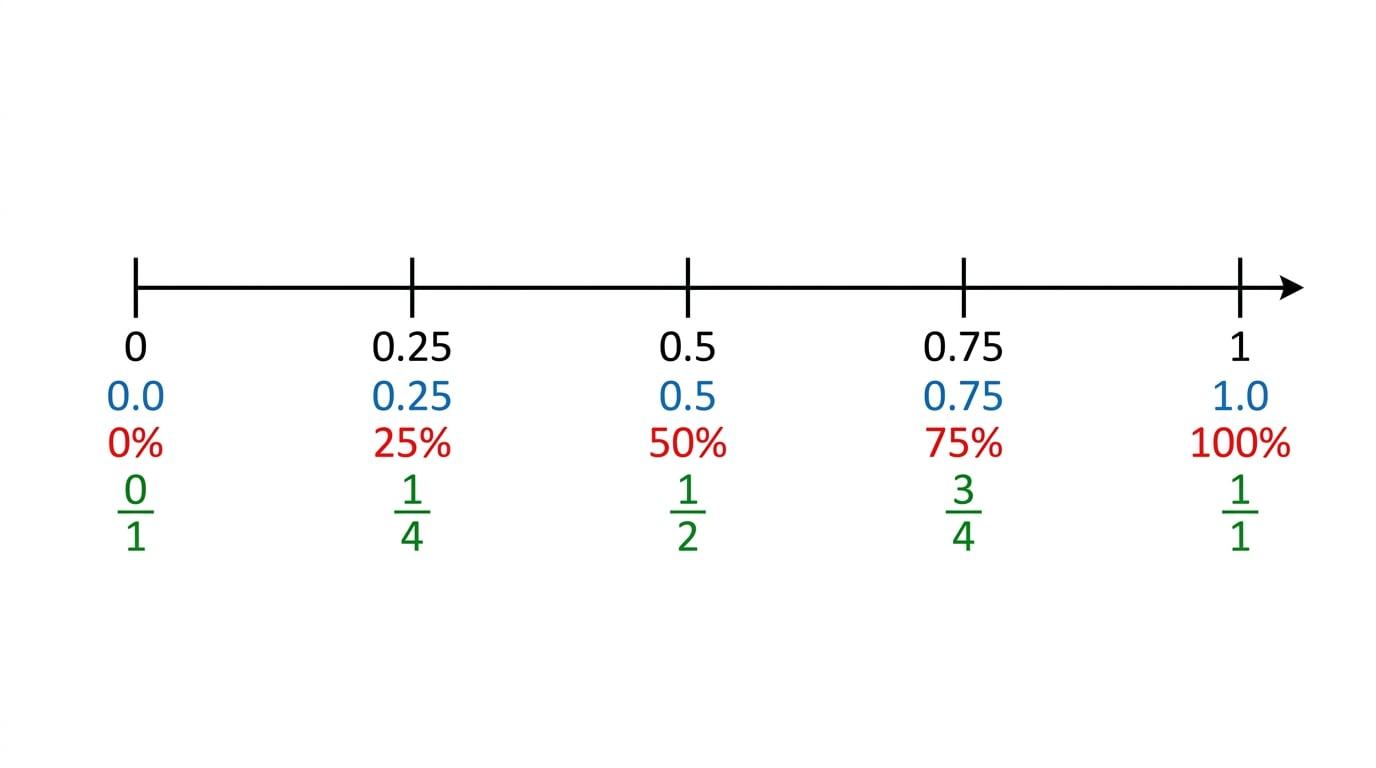
A fraction, decimal and percentage can all represent the same part of a whole.
For example, half of something can be written as:
- the fraction 12\frac{1}{2}21
- the decimal 0.5
- the percentage 50%
Definition
Key words
- A fraction shows a part of a whole. In 35\frac{3}{5}53, the top number 3 is the numerator and the bottom number 5 is the denominator.
- A decimal is a number written using place value after a decimal point, such as 0.72.
- A percentage means “out of 100”. So 23% means 23 out of 100.
- Equivalent means “equal in value”, even if the numbers look different.
Key Idea
Same value, different form
When you are converting, you are not changing the amount. You are only changing how it is written.
Place value in decimals
Decimals are based on tenths, hundredths, thousandths, and so on.
- 0.3 means 3 tenths.
- 0.03 means 3 hundredths.
- 0.003 means 3 thousandths.
This matters because decimals often convert directly into fractions.
Example
Writing a decimal as a fraction
Write 0.06 as a fraction.
-
Read the place value. The 6 is in the hundredths column, so 0.06 means 6 hundredths.
-
Write this as a fraction.
6100\frac{6}{100}1006 -
Simplify by dividing the numerator and denominator by 2.
6100=350\frac{6}{100}=\frac{3}{50}1006=503
Common Mistake
Forgetting the zero
0.06 is not the same as 0.6. The zero after the decimal point changes the place value: 0.06 means 6 hundredths, but 0.6 means 6 tenths.
Percentages mean “out of 100”
The word percent comes from “per cent”, meaning “out of 100”.
So:
- 18% means 18100\frac{18}{100}10018
- 4% means 4100\frac{4}{100}1004
- 100% means one whole
This makes percentage-to-fraction questions very direct.
Example
Writing a percentage as a fraction
Write 17% as a fraction.
-
Percent means out of 100, so write 17 over 100.
17%=1710017\%=\frac{17}{100}17%=10017 -
Check whether the fraction simplifies. 17 and 100 have no common factor other than 1.
-
The final answer is 17100\frac{17}{100}10017.
Example
Writing a small percentage as a decimal
Write 4% as a decimal.
-
Write 4% as a fraction out of 100.
4%=41004\%=\frac{4}{100}4%=1004 -
Divide by 100 to convert to a decimal.
4100=0.04\frac{4}{100}=0.041004=0.04
Converting decimals to percentages
To change a decimal to a percentage, multiply by 100.
This works because a percentage is the number of hundredths.
Tip
Decimal to percentage shortcut
To multiply a decimal by 100, move the decimal point two places to the right. For example, 0.29 becomes 29%.
Example
Writing a decimal as a percentage
Write 0.79 as a percentage.
-
Multiply the decimal by 100.
0.79×100=790.79 \times 100 = 790.79×100=79 -
Add the percentage sign.
0.79=79%0.79 = 79\%0.79=79%
Example
Another decimal to percentage example
Write 0.06 as a percentage.
-
Multiply by 100.
0.06×100=60.06 \times 100 = 60.06×100=6 -
Add the percentage sign.
0.06=6%0.06 = 6\%0.06=6%
Converting percentages to decimals
To change a percentage to a decimal, divide by 100.
This is the reverse of changing a decimal to a percentage.
Example
Writing a percentage as a decimal
Write 18% as a decimal.
-
Divide 18 by 100.
18÷100=0.1818 \div 100 = 0.1818÷100=0.18 -
So 18% as a decimal is 0.18.
Common Mistake
One-place percentages
30% is 0.3, not 0.30%. Once you have converted to a decimal, remove the percentage sign.
Converting fractions to decimals
A fraction bar means divide. So to change a fraction to a decimal, divide the numerator by the denominator.
For common fractions, you can also use equivalent fractions with denominator 10 or 100.
Example
Writing a fraction as a decimal
Write 710\frac{7}{10}107 as a decimal.
-
The denominator is 10, so the fraction is 7 tenths.
-
Write 7 tenths as a decimal.
710=0.7\frac{7}{10}=0.7107=0.7
Example
Converting fifths to decimals
Write 25\frac{2}{5}52 as a decimal.
-
Make an equivalent fraction with denominator 10. Multiply the numerator and denominator by 2.
25=410\frac{2}{5}=\frac{4}{10}52=104 -
Write 4 tenths as a decimal.
410=0.4\frac{4}{10}=0.4104=0.4
Converting fractions to percentages
To change a fraction to a percentage, you can either:
- change the fraction to a decimal, then multiply by 100
- make an equivalent fraction out of 100, if possible
Example
Writing a fraction as a percentage
Write 350\frac{3}{50}503 as a percentage.
-
Percent means out of 100, so make the denominator 100.
-
Multiply the numerator and denominator by 2.
350=6100\frac{3}{50}=\frac{6}{100}503=1006 -
Since 6100\frac{6}{100}1006 means 6 out of 100, the percentage is 6%.
Example
Using a decimal first
Write 920\frac{9}{20}209 as a percentage.
-
Make the denominator 100. Since 20 multiplied by 5 gives 100, multiply the numerator by 5 as well.
920=45100\frac{9}{20}=\frac{45}{100}209=10045 -
So the percentage is 45%.
Simplifying fractions
A fraction is in its simplest form when the numerator and denominator have no common factor except 1.
For example, 25100\frac{25}{100}10025 can be simplified because 25 divides into both 25 and 100.
Example
Writing a decimal as a simplified fraction
Write 0.25 as a fraction.
-
0.25 means 25 hundredths.
0.25=251000.25=\frac{25}{100}0.25=10025 -
Divide the numerator and denominator by 25.
25100=14\frac{25}{100}=\frac{1}{4}10025=41
Tip
Useful fraction facts
Try to remember these common equivalents: 12=0.5=50%\frac{1}{2}=0.5=50\%21=0.5=50%, 14=0.25=25%\frac{1}{4}=0.25=25\%41=0.25=25%, and 34=0.75=75%\frac{3}{4}=0.75=75\%43=0.75=75%.
Comparing fractions, decimals and percentages
When numbers are written in different forms, convert them all into the same form before comparing.
Decimals are often the easiest form for ordering.
Example
Checking a statement
A student says 16% is greater than 0.2. Is the student correct?
-
Convert 16% to a decimal by dividing by 100.
16%=0.1616\%=0.1616%=0.16 -
Compare 0.16 and 0.2. You can write 0.2 as 0.20 to compare the digits.
-
Since 0.16 is less than 0.20, the student is not correct.
Example
Comparing two people’s savings
Two people earn the same monthly salary. Alex saves 40% of it. Sam spends 35\frac{3}{5}53 of it and saves the rest. Who saves more?
-
Work out Sam’s saving fraction. If Sam spends 35\frac{3}{5}53, then the remaining fraction is 25\frac{2}{5}52.
-
Convert Sam’s saving fraction to a percentage.
25=40100=40%\frac{2}{5}=\frac{40}{100}=40\%52=10040=40% -
Alex saves 40% and Sam saves 40%, so they save the same amount.
Example
Putting mixed forms in order
Put these in order from smallest to largest: 80%, 34\frac{3}{4}43, 0.77, 0.9, 710\frac{7}{10}107.
-
Convert everything to decimals.
80%=0.880\%=0.880%=0.8 34=0.75\frac{3}{4}=0.7543=0.75 710=0.7\frac{7}{10}=0.7107=0.7 -
Now compare the decimal values: 0.8, 0.75, 0.77, 0.9, 0.7.
-
Put them in increasing order.
0.7, 0.75, 0.77, 0.8, 0.90.7,\ 0.75,\ 0.77,\ 0.8,\ 0.90.7, 0.75, 0.77, 0.8, 0.9 -
Change back to the original forms.
710, 34, 0.77, 80%, 0.9\frac{7}{10},\ \frac{3}{4},\ 0.77,\ 80\%,\ 0.9107, 43, 0.77, 80%, 0.9
Common Mistake
Ordering without converting
Do not assume a percentage is bigger just because it has a larger-looking number. For example, 75% is 0.75, so it is smaller than 0.8.
Quick conversion rules
Here are the most useful rules to memorise:
- Decimal to percentage: multiply by 100.
- Percentage to decimal: divide by 100.
- Percentage to fraction: put it over 100, then simplify if possible.
- Decimal to fraction: use place value, then simplify.
- Fraction to decimal: divide the numerator by the denominator.
- Fraction to percentage: convert to a decimal or make the denominator 100.
Exam technique
In the exam
-
Convert mixed forms into the same type before comparing or ordering.
-
For one-mark conversion questions, write the answer clearly and check whether a fraction should be simplified.
-
In reasoning questions, show one clear conversion, such as changing 35% to 0.35 or changing 35\frac{3}{5}53 to 60%.
Self review
Check yourself
- Can you explain why 0.03 is 3100\frac{3}{100}1003 and not 310\frac{3}{10}103?
- Can you convert 45% into both a decimal and a fraction?
- If you had 0.6, 58\frac{5}{8}85 and 58%, which form would you convert them to before ordering?

Recap questions
Test yourself with 5 quick questions on this guide. Answer them all correctly to complete it.
You've reached the end
Test yourself on this topic, or move on to the next guide.
How was this guide?