Revision notes for Oxford AQA IGCSE Maths Averages. Open the guide for explanations and worked examples. Written against the Oxford AQA IGCSE Maths (9260) specification, so the content matches what's examinable rather than general Maths background.
Averages
What you'll learn
- How to find the range, mode, median and mean from a list of numbers.
- Why putting values in order is often the first useful step.
- How to work backwards when a mean is given but one number is missing.
- How to update or combine means using totals.
Starting point: data values and ordering
In averages questions, you are usually given a list of numbers. Each number is called a data value.
Averages help describe what a set of data is “typically” like. The range is slightly different: it describes how spread out the data is.
Definition
The key words
- Data means the numbers or information you are working with.
- An average is a number that represents a typical value in the data. The main averages here are the mean, median and mode.
- The range tells you how spread out the data is.
Before finding the median, and sometimes before checking the mode, it helps to put the numbers in ascending order, which means from smallest to largest.
Example
Putting values in order
A set of cards shows these numbers:
9, 3, 12, 7, 3, 10
Put the numbers in ascending order.
-
Find the smallest number first. The smallest is 3.
-
There are two 3s, so write both of them.
-
Continue from smallest to largest:
3, 3, 7, 9, 10, 123,\ 3,\ 7,\ 9,\ 10,\ 123, 3, 7, 9, 10, 12 -
The ordered list is 3, 3, 7, 9, 10, 12.
Tip
Keep repeats
If a number appears more than once, write it more than once when ordering the list. Repeated values matter for the mode, median and mean.
The range
The range tells you the gap between the largest value and the smallest value.
Definition
Range
The range is found by subtracting the smallest value from the largest value.
range=largest value−smallest value\text{range}=\text{largest value}-\text{smallest value}range=largest value−smallest valueRange is not an average, but it often appears in the same topic because it tells you about the spread of the data.
Example
Finding the range
The weights of six parcels, in grams, are:
114, 96, 130, 121, 118, 105
Find the range.
-
Identify the smallest value and the largest value. The smallest is 96 and the largest is 130.
-
Subtract the smallest from the largest:
130−96=34130 - 96 = 34130−96=34 -
The range is 34 grams.
Tip
Range sanity check
The range should never be bigger than the largest value unless the data includes negative numbers. For these Grade 2 questions, your range will usually be a positive number.
The mode
The mode is the value that appears most often.
Definition
Mode
The mode is the most frequent value in the data.
You do not calculate the mode using a formula. You just count how many times each value appears.
Example
Finding the mode
A list of numbers is:
4, 8, 6, 8, 10, 5, 8, 6
Find the mode.
-
Count how many times each repeated number appears.
-
The number 6 appears twice.
-
The number 8 appears three times.
-
No other number appears as often as 8, so the mode is 8.
Common Mistake
Choosing the biggest number
The mode is not the largest number. It is the number that appears the most often.
The median
The median is the middle value when the data is in order.
Definition
Median
The median is the middle value after the data has been arranged from smallest to largest.
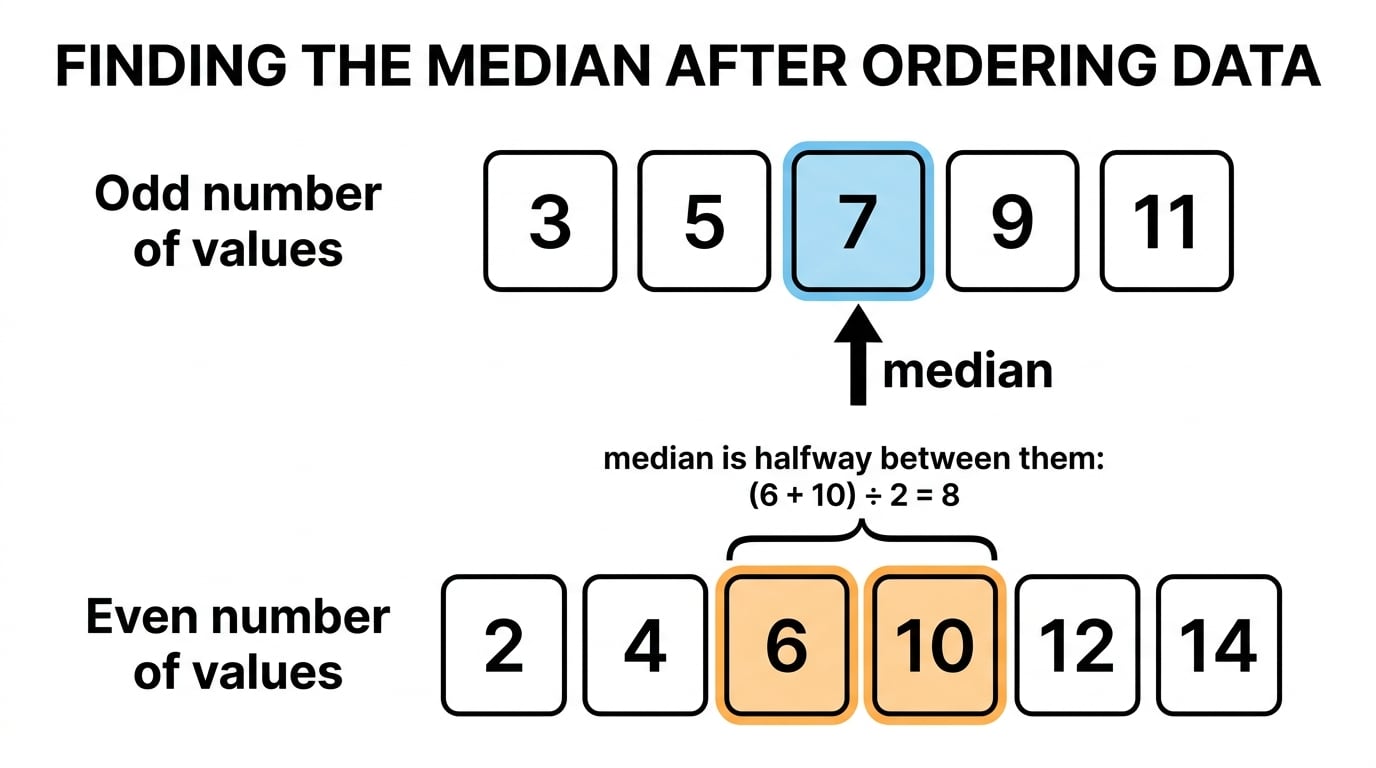
This diagram shows why ordering matters, and what changes when there is an odd or even number of values.
Median with an odd number of values
If there is an odd number of values, there is one middle value.
Example
Median of an odd-sized list
Find the median of:
13, 6, 9, 15, 7
-
Put the numbers in ascending order:
6, 7, 9, 13, 156,\ 7,\ 9,\ 13,\ 156, 7, 9, 13, 15 -
There are five values, so the middle one is the third value.
-
The third value is 9, so the median is 9.
Median with an even number of values
If there is an even number of values, there are two middle values. The median is halfway between them, so you add the two middle values and divide by 2.
Example
Median of an even-sized list
The masses of six potatoes, in grams, are:
142, 118, 135, 126, 110, 129
Find the median mass.
-
Put the values in ascending order:
110, 118, 126, 129, 135, 142110,\ 118,\ 126,\ 129,\ 135,\ 142110, 118, 126, 129, 135, 142 -
There are six values, so the two middle values are the third and fourth values: 126 and 129.
-
Find the mean of these two middle values:
126+1292=127.5\frac{126+129}{2}=127.52126+129=127.5 -
The median mass is 127.5 grams.
Common Mistake
Median before ordering
You cannot just pick the number written in the middle of the original list. The median is the middle value after the numbers have been put in order.
Example
Explaining why a median answer is wrong
A student says, “The median of 18, 12, 15, 20, 12 is 15 because it is in the middle of the list.”
Explain why this is not correct.
-
The student has used the middle position in the original list.
-
For the median, the numbers must first be put in order:
12, 12, 15, 18, 2012,\ 12,\ 15,\ 18,\ 2012, 12, 15, 18, 20 -
The middle value of the ordered list is 15, so in this particular case the answer happens to be 15, but the student’s method was not safe.
-
A correct explanation is: the list must be ordered before choosing the middle value.
The mean
The mean is what many people call “the average”. You find it by adding all the values, then dividing by how many values there are.
Definition
Mean
The mean is the total of the values divided by the number of values.
mean=total of valuesnumber of values\text{mean}=\frac{\text{total of values}}{\text{number of values}}mean=number of valuestotal of valuesKey Idea
Mean as a fair share
The mean tells you what each value would be if the total were shared out equally between all the values.
Example
Calculating the mean
A list of five numbers is:
9, 4, 12, 8, 7
Calculate the mean.
-
Add all the values:
9+4+12+8+7=409+4+12+8+7=409+4+12+8+7=40 -
Count how many values there are. There are five values.
-
Divide the total by the number of values:
40÷5=840 \div 5 = 840÷5=8 -
The mean is 8.
Tip
Show the total
For mean questions, write down the total first. It earns method marks and makes hidden-number questions much easier.
Working backwards from the mean
Sometimes the mean is given, but one value is missing. In that case, use:
total=mean×number of values\text{total}=\text{mean}\times\text{number of values}total=mean×number of valuesThen subtract the values you already know.
Example
Finding a hidden value from the mean
Seven numbers have a mean of 9:
8, 12, 5, 10, 9, 7, ?
Find the hidden number.
-
There are seven numbers and the mean is 9, so find the total:
9×7=639 \times 7 = 639×7=63 -
Add the six known numbers:
8+12+5+10+9+7=518+12+5+10+9+7=518+12+5+10+9+7=51 -
Subtract the known total from the full total:
63−51=1263-51=1263−51=12 -
The hidden number is 12.
You can also combine mean information with the mode.
Example
Two hidden cards using mean and mode
Six cards have these numbers:
2, 5, 6, 7, ?, ?
The mode is 2. The mean is 5. Find the two hidden numbers.
-
Use the mean to find the total of all six numbers:
5×6=305 \times 6 = 305×6=30 -
Add the four visible numbers:
2+5+6+7=202+5+6+7=202+5+6+7=20 -
The two hidden numbers must add to 10:
30−20=1030-20=1030−20=10 -
Because the mode is 2, one hidden number must be 2.
-
Find the other hidden number:
10−2=810-2=810−2=8 -
The two hidden numbers are 2 and 8.
Common Mistake
Forgetting the number of values
If the mean is 5 for six values, the total is 30, not 5. Always multiply the mean by the number of values first.
Updating or combining means
A mean can change when a new value is added. The safest method is to go back to the total.
Example
Adding one more value
A runner ran a mean distance of 6.4 km over five days. On the sixth day, she ran 11 km. Find the mean distance for all six days.
-
Find the total distance for the first five days:
6.4×5=326.4 \times 5 = 326.4×5=32 -
Add the sixth day’s distance:
32+11=4332+11=4332+11=43 -
Divide by the new number of days:
43÷6=7.166…43 \div 6 = 7.166\ldots43÷6=7.166… -
The mean distance is about 7.17 km.
Sometimes you are given the mean of a whole group and the mean of part of the group. Again, use totals.
Example
Finding the mean of the remaining group
The mean of eight scores is 40. The mean of two of the scores is 28. Work out the mean of the other six scores.
-
Find the total of all eight scores:
40×8=32040 \times 8 = 32040×8=320 -
Find the total of the two known scores:
28×2=5628 \times 2 = 5628×2=56 -
Find the total of the other six scores:
320−56=264320-56=264320−56=264 -
Divide by six to find their mean:
264÷6=44264 \div 6 = 44264÷6=44 -
The mean of the other six scores is 44.
Exam technique
In the exam
-
For the median, always put the data in order first, even if the list looks nearly ordered.
-
For the mean, write the total and the number of values clearly before dividing.
-
For hidden-number or combined-mean questions, use
total = mean × number of valuesas your starting point.
Self review
Check yourself
-
Can you explain the difference between mean, median, mode and range?
-
If there are six ordered values, which two positions do you use to find the median?
-
If the mean of five numbers is 12, what total must the five numbers add to?

Recap questions
Test yourself with 5 quick questions on this guide. Answer them all correctly to complete it.
You've reached the end
Test yourself on this topic, or move on to the next guide.
How was this guide?