Revision notes for Oxford AQA IGCSE Maths Rounding. Open the guide for explanations and worked examples. Written against the Oxford AQA IGCSE Maths (9260) specification, so the content matches what's examinable rather than general Maths background.
Rounding
What you'll learn
- How to round whole numbers to the nearest 10, 100 or 1000.
- How to round decimals to a given number of decimal places.
- How to round numbers to a given number of significant figures.
- How to avoid the most common rounding traps in exams.
Why rounding matters
Rounding means replacing a number with a nearby, simpler number. The rounded number is not usually exact, but it is easier to read, estimate with, and compare.
For example, if a distance is 5829 metres, you might round it to 6000 metres when you only need an approximate answer.
Definition
Rounding
Rounding is changing a number to a nearby number with a chosen level of accuracy, such as the nearest hundred, 1 decimal place, or 2 significant figures.
Prerequisite: place value
Before rounding, you need to know what each digit is worth.
In 7518:
- 7 is in the thousands column.
- 5 is in the hundreds column.
- 1 is in the tens column.
- 8 is in the units column.
In 6.47:
- 6 is the whole number part.
- 4 is in the tenths column.
- 7 is in the hundredths column.
Key Idea
The digit after tells you what to do
To round to a particular place, keep the digit in that place, then look at the digit immediately after it. If that next digit is 5 or more, round up. If it is 4 or less, round down.
Rounding whole numbers
When rounding whole numbers, you may be asked for the nearest 10, nearest 100, or nearest 1000.
The method
- Find the place you are rounding to.
- Look at the digit immediately to its right.
- If that digit is 0, 1, 2, 3 or 4, keep the rounding digit the same.
- If that digit is 5, 6, 7, 8 or 9, increase the rounding digit by 1.
- Replace all digits to the right with zeros.
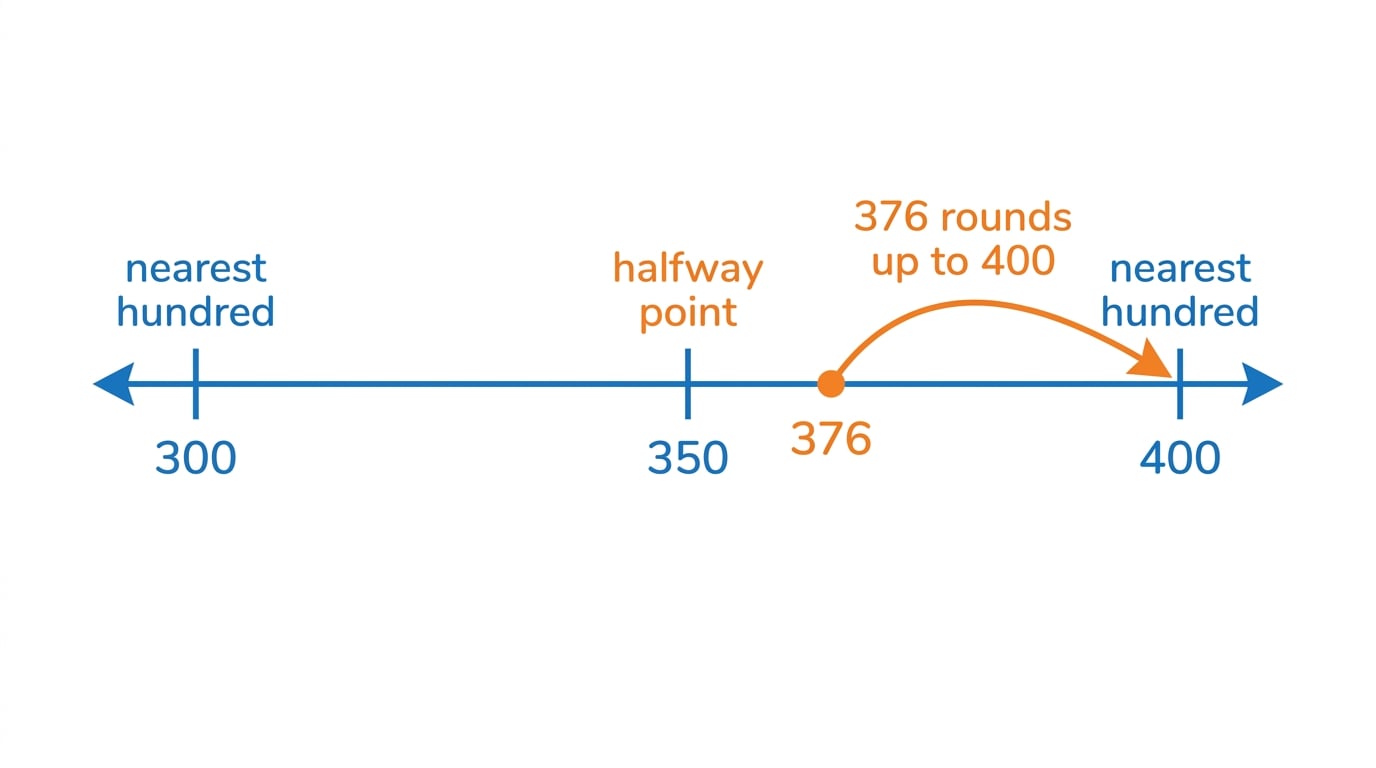
A number line helps you see why numbers round up or down. For example, when rounding to the nearest hundred, the halfway point between 300 and 400 is 350. Any number from 350 upwards is closer to 400 than to 300.
Example
Rounding a whole number to the nearest hundred
Round 468 to the nearest hundred.
-
The hundreds digit in 468 is 4.
-
Look at the digit immediately after it. The tens digit is 6.
-
Since 6 is 5 or more, round the hundreds digit up from 4 to 5.
-
Replace the digits after the hundreds column with zeros:
468→500468 \to 500468→500
Example
Rounding a whole number to the nearest thousand
Round 5274 to the nearest thousand.
-
The thousands digit in 5274 is 5.
-
Look at the digit immediately after it. The hundreds digit is 2.
-
Since 2 is less than 5, keep the thousands digit as 5.
-
Replace the digits after the thousands column with zeros:
5274→50005274 \to 50005274→5000
Common Mistake
Forgetting the zeros
When rounding a whole number, do not just chop off the digits. For example, 7518 rounded to the nearest hundred is 7500, not 75.
Rounding decimals to decimal places
A decimal place is a position after the decimal point.
Definition
Decimal place
A decimal place is one digit after the decimal point. For example, in 3.847, the 8 is the 1st decimal place, the 4 is the 2nd decimal place, and the 7 is the 3rd decimal place.
If a question says “correct to 1 decimal place”, it means your answer should have exactly one digit after the decimal point.
If a question says “correct to 3 decimal places”, your answer should have exactly three digits after the decimal point.
Decimal place names
After the decimal point:
- 1st decimal place = tenths
- 2nd decimal place = hundredths
- 3rd decimal place = thousandths
The method
To round to decimal places:
- Count the required number of digits after the decimal point.
- Look at the next digit.
- Use the usual rule: 5 or more rounds up, 4 or less rounds down.
Example
Rounding to 1 decimal place
Write 2.83 correct to 1 decimal place.
-
For 1 decimal place, keep one digit after the decimal point.
-
In 2.83, the tenths digit is 8.
-
Look at the next digit, which is 3.
-
Since 3 is less than 5, keep the 8 the same:
2.83→2.82.83 \to 2.82.83→2.8
Example
Rounding to 2 decimal places
Write 23.1681 correct to 2 decimal places.
-
For 2 decimal places, keep two digits after the decimal point.
-
In 23.1681, the first two decimal places are 1 and 6, so start with 23.16.
-
Look at the next digit, which is 8.
-
Since 8 is 5 or more, round the hundredths digit up from 6 to 7:
23.1681→23.1723.1681 \to 23.1723.1681→23.17
Example
Rounding to 3 decimal places
Write 5.4096 correct to 3 decimal places.
-
For 3 decimal places, keep three digits after the decimal point.
-
In 5.4096, the first three decimal places are 4, 0 and 9.
-
Look at the next digit, which is 6.
-
Since 6 is 5 or more, the 9 must round up. This causes a carry into the previous decimal place:
5.4096→5.4105.4096 \to 5.4105.4096→5.410
Common Mistake
Keep trailing zeros when needed
If a question asks for 3 decimal places, your answer must show 3 digits after the decimal point. So 5.410 is correct to 3 decimal places, even though it has a zero at the end.
Rounding to significant figures
Significant figures are about the important digits in a number, not just the digits after the decimal point.
Definition
Significant figures
Significant figures are counted from the first non-zero digit in a number. Zeros before the first non-zero digit are not significant.
For example:
- In 37.62, the first significant figure is 3.
- In 0.4726, the first significant figure is 4.
- In 90437, the first significant figure is 9.
- In 0.00681, the first significant figure is 6.
The method
- Find the first non-zero digit.
- Count the number of significant figures required.
- Look at the next digit.
- Round using the 5 or more rule.
- If it is a whole number, replace later place values with zeros.
Example
Rounding to 1 significant figure
Write 58.165 correct to 1 significant figure.
-
The first significant figure is 5.
-
Look at the next digit, which is 8.
-
Since 8 is 5 or more, round the 5 up to 6.
-
The number 58.165 is therefore closer to 60 than to 50:
58.165→6058.165 \to 6058.165→60
Example
Rounding a small decimal to 2 significant figures
Write 0.06849 correct to 2 significant figures.
-
Ignore the zeros before the 6. They only show the size of the number.
-
The first two significant figures are 6 and 8.
-
Look at the next digit, which is 4.
-
Since 4 is less than 5, keep the 8 the same:
0.06849→0.0680.06849 \to 0.0680.06849→0.068
Example
Rounding a large number to 2 significant figures
Write 90 437 correct to 2 significant figures.
-
The first significant figure is 9.
-
The second significant figure is 0, because it comes after the first non-zero digit.
-
Look at the next digit, which is 4.
-
Since 4 is less than 5, keep the second significant figure the same and replace the remaining digits with zeros:
90437→9000090437 \to 9000090437→90000
Tip
Decimal places vs significant figures
Decimal places always count digits after the decimal point. Significant figures start at the first non-zero digit, wherever it is.
“Correct to” means rounded to
You will often see wording like:
- “correct to 1 decimal place”
- “correct to 3 decimal places”
- “correct to 1 significant figure”
- “correct to 2 significant figures”
The phrase “correct to” means “round to this level of accuracy”.
Common Mistake
Mixing up decimal places and significant figures
For 0.4726, correct to 2 decimal places gives 0.47, but correct to 2 significant figures also gives 0.47 by coincidence. This will not always happen, so always check which type of rounding is being asked for.
Quick rounding checklist
Before you write your answer, ask yourself:
- What am I rounding to: nearest hundred, decimal places, or significant figures?
- Which digit am I keeping?
- Which digit decides whether I round up or down?
- Do I need zeros at the end to show the correct place value or number of decimal places?
Exam technique
In the exam
-
Underline the accuracy asked for, such as nearest thousand, 2 decimal places, or 1 significant figure.
-
Circle the digit you are keeping, then check the digit immediately to its right.
-
After rounding, make sure your answer has the correct place value or the correct number of decimal places.
Self review
Check yourself
-
Can you round 6438 to the nearest hundred?
-
Can you write 7.386 correct to 2 decimal places?
-
Can you explain the difference between 2 decimal places and 2 significant figures?

Recap questions
Test yourself with 5 quick questions on this guide. Answer them all correctly to complete it.
You've reached the end
Test yourself on this topic, or move on to the next guide.
How was this guide?