Revision notes for Edexcel IGCSE Maths The Sine Rule. Open the guide for explanations and worked examples. Written against the Edexcel IGCSE Maths (4MA1) specification, so the content matches what's examinable rather than general Maths background.
The Sine Rule
What you'll learn
- When the sine rule is useful for non-right-angled triangles.
- How to match each side with its opposite angle.
- How to find missing sides and missing angles using the sine rule.
- How to combine the sine rule with perimeter and area questions.
Before you start: the triangle facts you need
The sine rule is used in triangles that are not necessarily right-angled. You do not need a 90° angle, and you usually cannot use SOHCAHTOA directly.
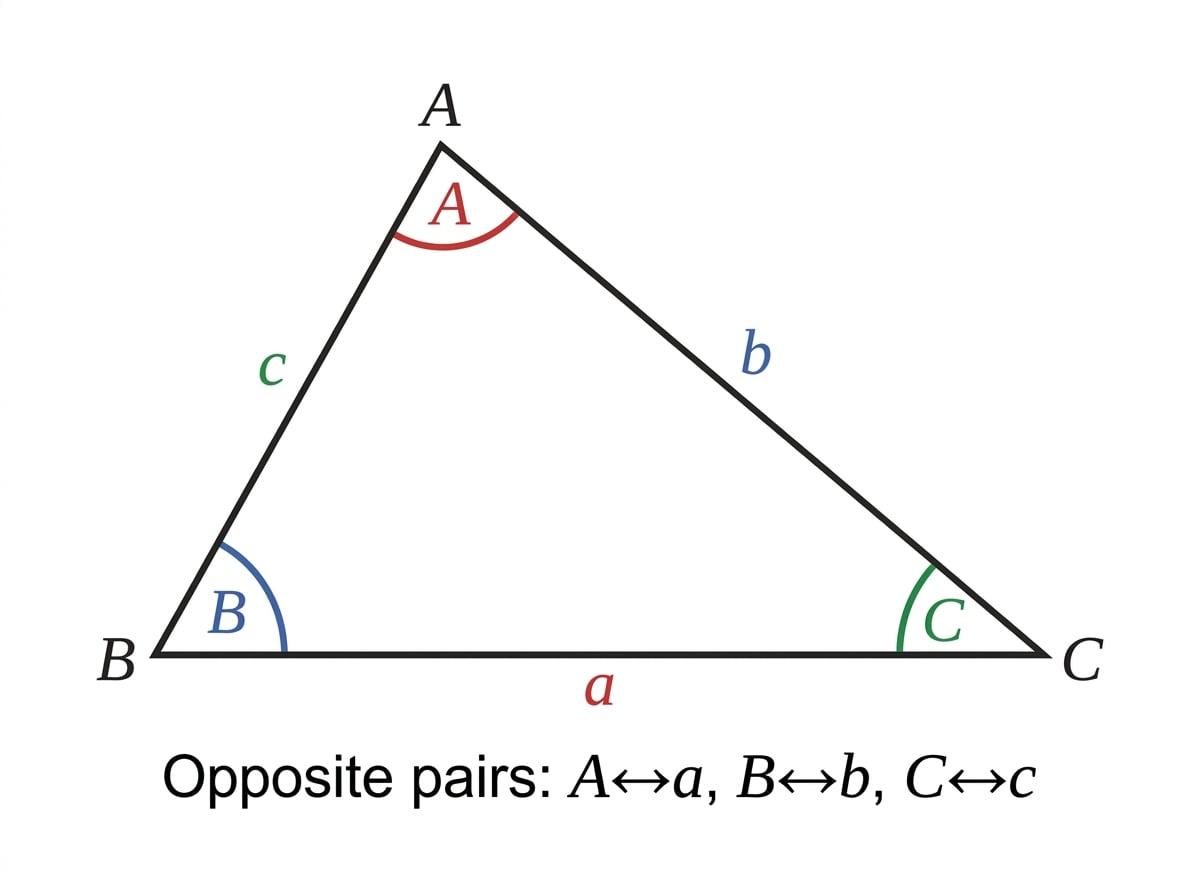
The most important skill is spotting opposite pairs: an angle and the side directly across from it.
Definition
Opposite side
In a triangle, the opposite side to an angle is the side across the triangle from that angle. In triangle ABC, side aaa is opposite angle AAA, side bbb is opposite angle BBB, and side ccc is opposite angle CCC.
You will also use the angle sum of a triangle:
A+B+C=180∘A + B + C = 180^\circA+B+C=180∘Example
Finding the missing angle and an opposite pair
A triangle has angles 37° and 98°. A side of length 9 cm is opposite the 98° angle. Find the third angle and identify the side-angle pair.
-
Use the fact that angles in a triangle add to 180°:
37∘+98∘=135∘37^\circ + 98^\circ = 135^\circ37∘+98∘=135∘ -
Subtract from 180°:
180∘−135∘=45∘180^\circ - 135^\circ = 45^\circ180∘−135∘=45∘ -
The third angle is 45°.
-
The side of length 9 cm is paired with the 98° angle, because they are opposite each other.
Common Mistake
Do not pair an angle with a touching side
The sine rule only works with opposite pairs. If an angle touches a side, that does not mean they are paired for the sine rule.
The sine rule
The sine rule links the sides and angles of any triangle.
Definition
The sine rule
For triangle ABC, where sides aaa, bbb, and ccc are opposite angles AAA, BBB, and CCC:
asinA=bsinB=csinC\frac{a}{\sin A} = \frac{b}{\sin B} = \frac{c}{\sin C}sinAa=sinBb=sinCcYou can also write it as:
sinAa=sinBb=sinCc\frac{\sin A}{a} = \frac{\sin B}{b} = \frac{\sin C}{c}asinA=bsinB=csinCKey Idea
The big idea
Use the sine rule when you know one complete opposite pair, and you want another side or angle from a second opposite pair.
A complete opposite pair means you know both the side and the angle opposite it.
Finding a missing side
When finding a side, it is usually easiest to put the side lengths on top:
sidesin(opposite angle)\frac{\text{side}}{\sin(\text{opposite angle})}sin(opposite angle)sideYou need:
- one known side with its opposite angle;
- the angle opposite the side you want.
Example
Finding a missing length
In a triangle, a side of length 12 cm is opposite an angle of 44°. Another side, yyy cm, is opposite an angle of 101°. Find yyy to 1 decimal place.
-
Match the opposite pairs:
- 12 cm is opposite 44°.
- yyy cm is opposite 101°.
-
Set up the sine rule with sides on top:
ysin101∘=12sin44∘\frac{y}{\sin 101^\circ} = \frac{12}{\sin 44^\circ}sin101∘y=sin44∘12 -
Multiply both sides by sin101∘\sin 101^\circsin101∘:
y=12sin101∘sin44∘y = \frac{12 \sin 101^\circ}{\sin 44^\circ}y=sin44∘12sin101∘ -
Calculate:
y=16.96…y = 16.96\ldotsy=16.96… -
Round to 1 decimal place: y=17.0y = 17.0y=17.0 cm.
Tip
Calculator mode
Make sure your calculator is in degrees mode, not radians. In degrees mode, sin44∘\sin 44^\circsin44∘ means the sine of 44°.
Finding a missing angle
When finding an angle, it is usually easier to put the sine parts on top:
sinAa=sinBb\frac{\sin A}{a} = \frac{\sin B}{b}asinA=bsinBAfter finding sinA\sin AsinA, use the inverse sine button on your calculator. This is often written as sin−1\sin^{-1}sin−1.
Definition
Inverse sine
The inverse sine, sin−1\sin^{-1}sin−1, finds the angle when you already know its sine value.
Example
Finding a missing angle
In a triangle, a side of length 8.1 cm is opposite angle xxx. A side of length 12.6 cm is opposite an angle of 72°. Find xxx to 3 significant figures.
-
Match the opposite pairs:
- 8.1 cm is opposite angle xxx.
- 12.6 cm is opposite 72°.
-
Use the sine rule with sine parts on top:
sinx8.1=sin72∘12.6\frac{\sin x}{8.1} = \frac{\sin 72^\circ}{12.6}8.1sinx=12.6sin72∘ -
Multiply both sides by 8.1:
sinx=8.1sin72∘12.6\sin x = \frac{8.1 \sin 72^\circ}{12.6}sinx=12.68.1sin72∘ -
Calculate the sine value:
sinx=0.611…\sin x = 0.611\ldotssinx=0.611… -
Use inverse sine:
x=sin−1(0.611…)x = \sin^{-1}(0.611\ldots)x=sin−1(0.611…) -
Round to 3 significant figures: x=37.7∘x = 37.7^\circx=37.7∘.
Common Mistake
Rounding too early
Do not round the sine value halfway through the question. Keep the full calculator value until the final answer, then round as requested.
Sometimes you must find a missing angle first
Some questions give two angles and one side. If the angle opposite the known side is not directly given, find the third angle first.
Example
Using the angle sum before the sine rule
In triangle ABC, angle AAA is 36°, angle BBB is 82°, and side AB is 7 m. Find side AC to 3 significant figures.
-
Work out angle CCC because side AB is opposite angle CCC:
C=180∘−36∘−82∘=62∘C = 180^\circ - 36^\circ - 82^\circ = 62^\circC=180∘−36∘−82∘=62∘ -
Match the pairs:
- AB = 7 m is opposite angle C=62∘C = 62^\circC=62∘.
- AC is opposite angle B=82∘B = 82^\circB=82∘.
-
Use the sine rule:
ACsin82∘=7sin62∘\frac{AC}{\sin 82^\circ} = \frac{7}{\sin 62^\circ}sin82∘AC=sin62∘7 -
Rearrange and calculate:
AC=7sin82∘sin62∘=7.85…AC = \frac{7 \sin 82^\circ}{\sin 62^\circ} = 7.85\ldotsAC=sin62∘7sin82∘=7.85… -
To 3 significant figures, AC = 7.85 m.
Perimeter questions
A perimeter is the total distance around the outside of a shape. For a triangle, add the three side lengths.
In sine rule perimeter questions, you may need to find two missing sides first.
Example
Finding the perimeter of a triangle
Triangle ABC has AC = 14.2 m, angle BBB is 102°, and angle CCC is 44°. Find the perimeter to 3 significant figures.
-
First find angle AAA:
A=180∘−102∘−44∘=34∘A = 180^\circ - 102^\circ - 44^\circ = 34^\circA=180∘−102∘−44∘=34∘ -
Match the known pair:
- AC = 14.2 m is opposite angle B=102∘B = 102^\circB=102∘.
-
Find BC, which is opposite angle A=34∘A = 34^\circA=34∘:
BC=14.2sin34∘sin102∘=8.12…BC = \frac{14.2 \sin 34^\circ}{\sin 102^\circ} = 8.12\ldotsBC=sin102∘14.2sin34∘=8.12… -
Find AB, which is opposite angle C=44∘C = 44^\circC=44∘:
AB=14.2sin44∘sin102∘=10.08…AB = \frac{14.2 \sin 44^\circ}{\sin 102^\circ} = 10.08\ldotsAB=sin102∘14.2sin44∘=10.08… -
Add the three sides:
14.2+8.12…+10.08…=32.40…14.2 + 8.12\ldots + 10.08\ldots = 32.40\ldots14.2+8.12…+10.08…=32.40… -
To 3 significant figures, the perimeter is 32.4 m.
Area questions using the sine rule
For a triangle, the area formula using two sides and the included angle is:
Area=12absinC\text{Area} = \frac{1}{2}ab\sin CArea=21absinCThe included angle is the angle between the two sides you are using.
Example
Using sine rule before area
Triangle ABC has AB = 10 m, angle AAA is 76°, and angle CCC is 44°. Find the area to 1 decimal place.
-
Find angle BBB:
B=180∘−76∘−44∘=60∘B = 180^\circ - 76^\circ - 44^\circ = 60^\circB=180∘−76∘−44∘=60∘ -
AB is opposite angle C=44∘C = 44^\circC=44∘. To use the area formula with angle AAA, find AC, which is opposite angle B=60∘B = 60^\circB=60∘:
AC=10sin60∘sin44∘=12.47…AC = \frac{10 \sin 60^\circ}{\sin 44^\circ} = 12.47\ldotsAC=sin44∘10sin60∘=12.47… -
Use the area formula with sides AB and AC, and included angle A=76∘A = 76^\circA=76∘:
Area=12×10×12.47…×sin76∘\text{Area} = \frac{1}{2} \times 10 \times 12.47\ldots \times \sin 76^\circArea=21×10×12.47…×sin76∘ -
Calculate and round:
Area=60.5…\text{Area} = 60.5\ldotsArea=60.5… -
To 1 decimal place, the area is 60.5 m².
The obtuse angle issue
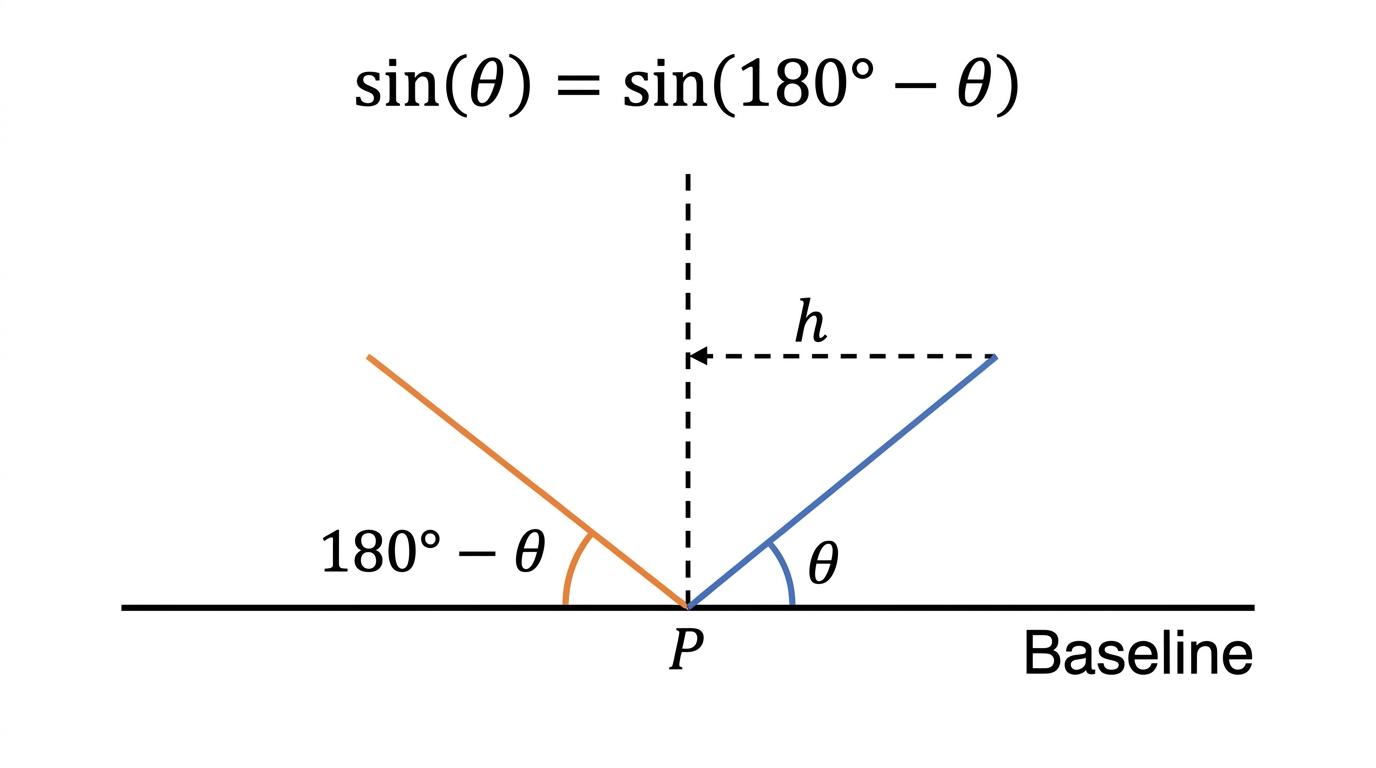
When you use inverse sine, your calculator gives the acute angle first. But sine has the same value for an angle and its supplement:
sinθ=sin(180∘−θ)\sin \theta = \sin(180^\circ - \theta)sinθ=sin(180∘−θ)This matters when a question says an angle is obtuse, meaning it is greater than 90° and less than 180°.
Common Mistake
Check for an obtuse angle
If the question says the angle is obtuse, do not stop at the calculator’s acute answer. Subtract it from 180°.
Example
Finding an obtuse angle
Triangle ABC has AC = 18 cm, AB = 11 cm, and angle CCC is 32°. Angle BBB is obtuse. Find angle BBB to 3 significant figures.
-
Match the opposite pairs:
- AB = 11 cm is opposite angle C=32∘C = 32^\circC=32∘.
- AC = 18 cm is opposite angle BBB.
-
Set up the sine rule:
sinB18=sin32∘11\frac{\sin B}{18} = \frac{\sin 32^\circ}{11}18sinB=11sin32∘ -
Multiply both sides by 18:
sinB=18sin32∘11\sin B = \frac{18 \sin 32^\circ}{11}sinB=1118sin32∘ -
Calculate:
sinB=0.867…\sin B = 0.867\ldotssinB=0.867… -
Use inverse sine to get the acute angle:
sin−1(0.867…)=60.1…∘\sin^{-1}(0.867\ldots) = 60.1\ldots^\circsin−1(0.867…)=60.1…∘ -
Since angle BBB is obtuse, subtract from 180°:
B=180∘−60.1…∘=119.8…∘B = 180^\circ - 60.1\ldots^\circ = 119.8\ldots^\circB=180∘−60.1…∘=119.8…∘ -
To 3 significant figures, B=120∘B = 120^\circB=120∘.
Exam technique
In the exam
-
Mark the opposite pairs clearly before writing the formula.
-
If finding a side, use sidesin(angle)\frac{\text{side}}{\sin(\text{angle})}sin(angle)side. If finding an angle, use sin(angle)side\frac{\sin(\text{angle})}{\text{side}}sidesin(angle).
-
Check whether the question asks for decimal places or significant figures, and only round at the end.
-
If using sin−1\sin^{-1}sin−1, check whether an obtuse angle is required.
Self review
Check yourself
- Can you identify the side opposite a given angle without guessing?
- Do you know which version of the sine rule is easier for finding a side?
- If your calculator gives an acute angle, when might you need to subtract from 180°?

Recap questions
Test yourself with 5 quick questions on this guide. Answer them all correctly to complete it.
You've reached the end
Test yourself on this topic, or move on to the next guide.
How was this guide?