Revision notes for Edexcel IGCSE Maths Probability Trees. Open the guide for explanations and worked examples. Written against the Edexcel IGCSE Maths (4MA1) specification, so the content matches what's examinable rather than general Maths background.
Probability Trees
What you'll learn
- How to draw a probability tree for two-stage situations.
- How to use complements, such as “not red” or “not late”.
- When to multiply probabilities and when to add probabilities.
- How to handle questions like “both”, “different”, and “at least one”.
Probability basics you need first
A probability is a number from 0 to 1 that tells you how likely something is.
- 0 means impossible.
- 1 means certain.
- A probability of 12\frac{1}{2}21 means equally likely to happen or not happen.
- Probabilities can be written as fractions, decimals or percentages.
For counters, balls and cards, probability is usually:
number of successful outcomestotal number of outcomes\frac{\text{number of successful outcomes}}{\text{total number of outcomes}}total number of outcomesnumber of successful outcomesDefinition
Complement
The complement of an event means “the event does not happen”. If the probability of an event is ppp, then the probability it does not happen is 1−p1 - p1−p.
For example, if the probability that a bus is late is 0.2, then the probability that it is not late is 0.8, because 0.2 + 0.8 = 1.
Example
Finding a missing probability
A spinner lands on green with probability 38\frac{3}{8}83. It otherwise lands on purple. Find the probability it lands on purple.
-
The two outcomes are green and purple, so their probabilities must add to 1.
-
Subtract the green probability from 1:
1−38=581 - \frac{3}{8} = \frac{5}{8}1−83=85 -
The probability of purple is 58\frac{5}{8}85.
Common Mistake
Forgetting the total
If a bag has 5 red counters and 3 blue counters, the total is 8 counters. The probability of red is 58\frac{5}{8}85, not 53\frac{5}{3}35 or 55\frac{5}{5}55.
What is a probability tree?
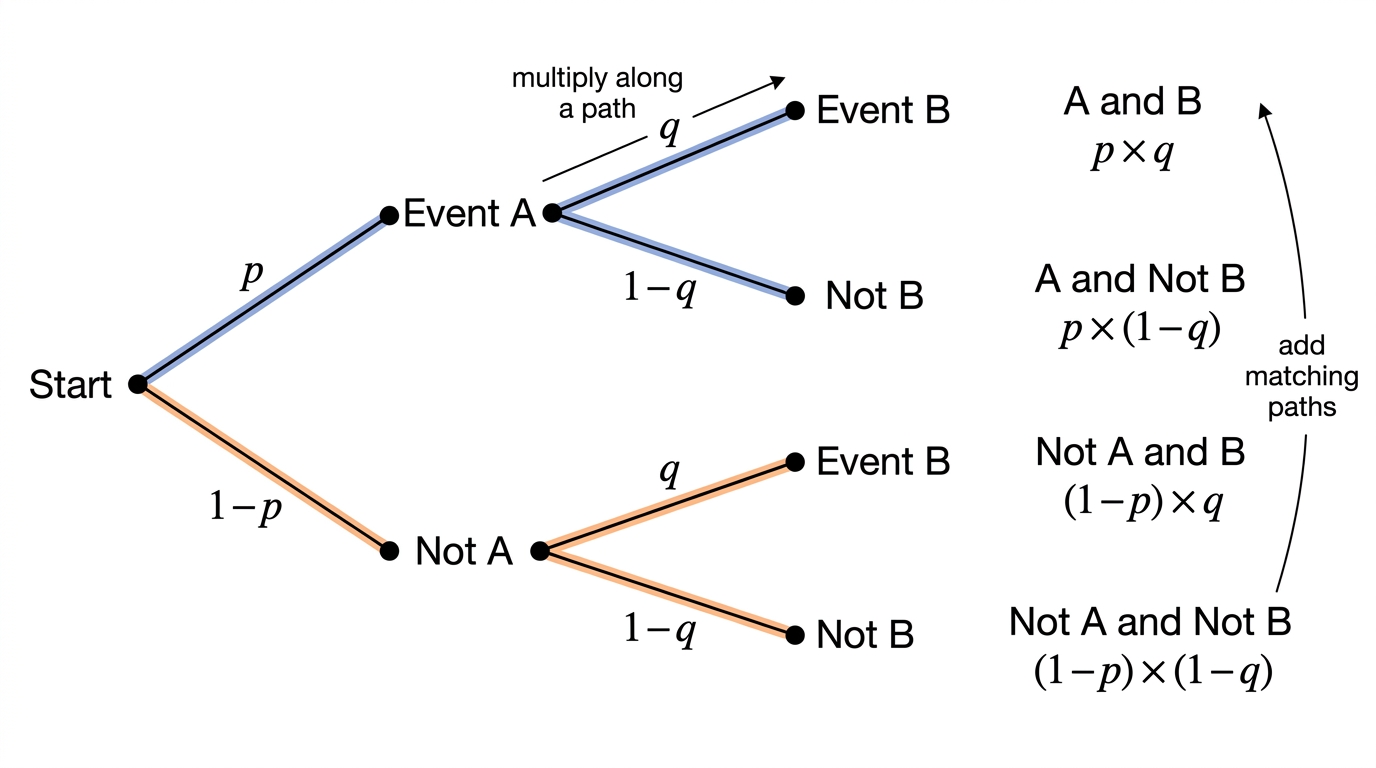
A probability tree is a diagram that shows a sequence of events. Each split shows the possible outcomes at that stage.
Definition
Probability tree
A probability tree is a branching diagram used for probability questions with more than one stage. A branch is one line on the tree, and each branch is labelled with the probability of that outcome.
At every split, the probabilities on the branches coming out must add to 1.
A two-stage tree is especially useful when something happens twice, such as choosing from two bags, playing two games, or checking two days.
Drawing a two-stage tree from bags
Suppose one item is chosen from Bag A, and then one item is chosen from Bag B. The first split is for Bag A. From each of those branches, draw a second split for Bag B.
Example
Two bags of coloured counters
Bag A contains 6 red counters and 4 blue counters. Bag B contains 2 red counters and 3 blue counters. One counter is chosen from each bag. Find the probability of choosing two blue counters.
-
Find the probabilities for Bag A. There are 10 counters in Bag A:
P(blue from A)=410=25P(\text{blue from A}) = \frac{4}{10} = \frac{2}{5}P(blue from A)=104=52 -
Find the probabilities for Bag B. There are 5 counters in Bag B:
P(blue from B)=35P(\text{blue from B}) = \frac{3}{5}P(blue from B)=53 -
On the tree, the first split is red from A or blue from A. The second split, from both branches, is red from B or blue from B.
-
To get two blue counters, follow the path “blue from A, then blue from B”.
-
Multiply along that path:
25×35=625\frac{2}{5} \times \frac{3}{5} = \frac{6}{25}52×53=256 -
The probability of choosing two blue counters is 625\frac{6}{25}256.
Key Idea
Multiply along a path
When you want one complete route through the tree, multiply the probabilities on the branches in that route.
Independent events
Two events are independent if the first event does not affect the probability of the second event.
For example, if someone plays a chess game and a backgammon game, winning the chess game does not change the given probability of winning the backgammon game.
Definition
Independent events
Events are independent when the outcome of one event does not change the probabilities for the next event.
Example
Winning two independent games
Amir plays one game of table tennis and one game of darts. The probability he wins table tennis is 0.6. The probability he wins darts is 0.75. Find the probability he wins both games.
-
The first split is table tennis: win or not win.
-
Since P(win table tennis)=0.6P(\text{win table tennis}) = 0.6P(win table tennis)=0.6, the probability of not winning table tennis is 0.4.
-
The second split is darts: win or not win.
-
Since P(win darts)=0.75P(\text{win darts}) = 0.75P(win darts)=0.75, the probability of not winning darts is 0.25.
-
The event “wins both games” follows the path win, then win.
-
Multiply along the path:
0.6×0.75=0.450.6 \times 0.75 = 0.450.6×0.75=0.45 -
The probability Amir wins both games is 0.45.
Common Mistake
When probabilities can change
If the question says an item is taken and not replaced, the second set of probabilities may change. For example, after taking one red counter from a bag, there is one fewer red counter and one fewer counter in total.
Adding paths for “either” events
Sometimes there is more than one way for the required event to happen.
For example, “different colours on two days” can happen in two ways:
- black then red
- red then black
These are different paths through the tree.
Key Idea
Add different successful paths
Multiply along each successful path first. Then add the path probabilities together.
Example
Different choices on two days
Each morning, Sofia wears either a blue scarf or a white scarf. On any day, the probability she wears a blue scarf is 37\frac{3}{7}73. Find the probability she wears different coloured scarves on Monday and Tuesday.
-
First find the complement. The probability of wearing a white scarf is:
1−37=471 - \frac{3}{7} = \frac{4}{7}1−73=74 -
There are two successful paths for “different colours”: blue then white, or white then blue.
-
Multiply along the blue then white path:
37×47=1249\frac{3}{7} \times \frac{4}{7} = \frac{12}{49}73×74=4912 -
Multiply along the white then blue path:
47×37=1249\frac{4}{7} \times \frac{3}{7} = \frac{12}{49}74×73=4912 -
Add the two successful paths:
1249+1249=2449\frac{12}{49} + \frac{12}{49} = \frac{24}{49}4912+4912=4924 -
The probability she wears different coloured scarves is 2449\frac{24}{49}4924.
Common Mistake
Adding too early
Do not add branch probabilities before you have found complete paths. For tree diagrams, usually multiply first along each path, then add the paths that match the question.
“At least one” questions
“At least one” means one or more. If there are two days, “late on at least one day” means:
- late on the first day only
- late on the second day only
- late on both days
You could add all three paths. But there is often a faster method: use the complement.
The opposite of “at least one late” is “none late”.
Tip
Fast method for at least one
For “at least one”, it is often quicker to calculate 1−P(none)1 - P(\text{none})1−P(none).
Example
Late on at least one day
A train has probability 0.3 of being delayed on any day. Find the probability it is delayed on at least one of Saturday and Sunday.
-
Find the probability it is not delayed on a day:
1−0.3=0.71 - 0.3 = 0.71−0.3=0.7 -
The complement of “delayed on at least one day” is “not delayed on either day”.
-
Multiply the probability of not delayed on Saturday by not delayed on Sunday:
0.7×0.7=0.490.7 \times 0.7 = 0.490.7×0.7=0.49 -
Subtract from 1:
1−0.49=0.511 - 0.49 = 0.511−0.49=0.51 -
The probability the train is delayed on at least one day is 0.51.
Trees with three outcomes
Not every split has only two branches. A game might have three possible outcomes: win, draw or lose.
The probabilities from one split must still add to 1.
Example
Win, draw or lose
Nina plays two games. In any game, the probability she wins is 0.5, and the probability she draws is 0.2. Find the probability she wins both games.
-
Find the probability she loses one game. The three outcomes are win, draw and lose:
1−0.5−0.2=0.31 - 0.5 - 0.2 = 0.31−0.5−0.2=0.3 -
For each game, the tree has three branches: win, draw and lose.
-
The event “wins both games” follows only one path: win in game 1, then win in game 2.
-
Multiply along this path:
0.5×0.5=0.250.5 \times 0.5 = 0.250.5×0.5=0.25 -
The probability Nina wins both games is 0.25.
Tip
Check your branches
At each split, check that the branch probabilities add to 1. This catches many drawing errors before you start calculating.
Choosing the right operation
Here is the main idea:
- AND usually means multiply along one path.
- OR usually means add separate paths after multiplying.
- At least one is often easiest using the complement.
For example:
- “blue and blue” means multiply the blue branch from the first stage and the blue branch from the second stage.
- “red then blue or blue then red” means calculate both paths and add them.
- “late at least once” can be done by finding 1 minus the probability of never late.
Exam technique
In the exam
-
Draw the tree neatly and label every branch with a probability.
-
Check each set of branches adds to 1 before calculating.
-
Circle or trace the successful path or paths.
-
Multiply along each path, then add if there is more than one successful path.
-
For “at least one”, consider using the complement: none.
Self review
Check yourself
-
Can you explain why the branches from the same point must add to 1?
-
If two paths both satisfy the question, do you multiply them together or add them after finding each path probability?
-
What is the complement of “at least one success”?

Recap questions
Test yourself with 5 quick questions on this guide. Answer them all correctly to complete it.
You've reached the end
Test yourself on this topic, or move on to the next guide.
How was this guide?