Revision notes for Edexcel IGCSE Maths Circle Theorems. Open the guide for explanations and worked examples. Written against the Edexcel IGCSE Maths (4MA1) specification, so the content matches what's examinable rather than general Maths background.
Circle Theorems
What you'll learn
- Use a radius (from the centre to the edge) and a tangent (a line touching a circle once) to spot right angles.
- Connect angles at the centre and on the circumference of a circle.
- Use cyclic quadrilaterals and the alternate segment theorem to find missing angles.
- Solve length problems using intersecting chords and secants.
The language of circle diagrams
Definition
Key circle words
- The centre is the middle point of the circle, often labelled O.
- The circumference is the curved edge of the circle.
- A radius is a line from the centre to the circumference. All radii in the same circle are equal.
- A chord is a straight line joining two points on the circumference.
- A tangent is a straight line that touches the circle at exactly one point.
- A cyclic quadrilateral is a four-sided shape with all four vertices on the circumference.
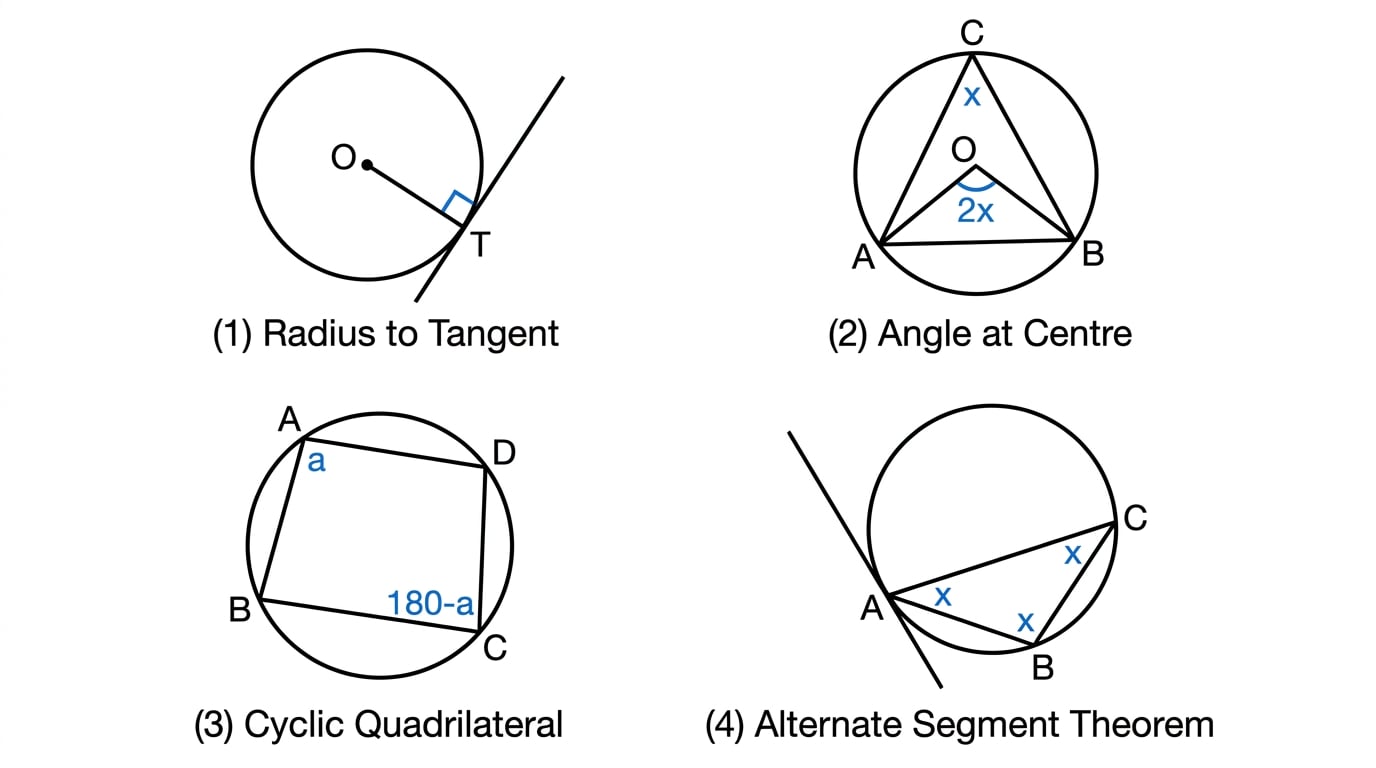
Here are the main angle facts you will use again and again:
Prerequisite: triangles made from radii
Because all radii in the same circle are equal, triangles containing two radii are often isosceles triangles.
Definition
Isosceles triangle
An isosceles triangle has two equal sides, so the two base angles are equal.
Example
Using two radii
A and B are points on a circle with centre O. Angle ABO is 48°. Find angle AOB.
-
OA and OB are both radii, so OA = OB.
-
Triangle AOB is isosceles, so the base angles are equal:
∠OAB=∠ABO=48∘\angle OAB = \angle ABO = 48^\circ∠OAB=∠ABO=48∘ -
Angles in a triangle add to 180°:
∠AOB=180∘−48∘−48∘=84∘\angle AOB = 180^\circ - 48^\circ - 48^\circ = 84^\circ∠AOB=180∘−48∘−48∘=84∘
Tip
Look for hidden isosceles triangles
If a triangle has the centre O and two points on the circumference, it probably has two equal sides.
The tangent-radius theorem
Key Idea
Radius to tangent
A radius drawn to the point where a tangent touches a circle is perpendicular to the tangent. That means it makes a 90° angle.
Example
Finding an angle with a tangent
A tangent touches a circle at B. The centre is O, and angle BOA is 72°. Find angle BAO.
-
OB is a radius and AB is a tangent at B, so angle ABO is 90°.
-
In triangle AOB, the angles add to 180°.
-
Subtract the two known angles:
∠BAO=180∘−90∘−72∘=18∘\angle BAO = 180^\circ - 90^\circ - 72^\circ = 18^\circ∠BAO=180∘−90∘−72∘=18∘
The same 90° fact can also create a right-angled triangle, so Pythagoras may appear.
Example
A tangent length problem
OA is a radius of 5 cm. AC is a tangent of 12 cm at A. O, B and C lie on a straight line, with B on the circle. Find BC.
-
OA is perpendicular to AC, so triangle OAC is right-angled.
-
Use Pythagoras to find OC:
OC2=52+122=25+144=169OC^2 = 5^2 + 12^2 = 25 + 144 = 169OC2=52+122=25+144=169 -
So OC = 13 cm.
-
OB is also a radius, so OB = 5 cm.
-
Since O, B and C are in a straight line:
BC=13−5=8BC = 13 - 5 = 8BC=13−5=8
Common Mistake
Putting the 90° angle in the wrong place
The right angle is between the tangent and the radius drawn to the point of contact. It is not automatically between the tangent and any chord.
Two tangents from the same point
If two tangents are drawn from the same external point, the diagram is very symmetrical.
Key Idea
Two tangent facts
- The two tangent lengths from the same point are equal.
- The two radii to the points of contact make 90° angles with the tangents.
Example
Two tangents and a centre angle
AB and AC are tangents to a circle with centre O. They touch the circle at B and C. Angle BAC is 40°. Find angle BOC.
-
OB is perpendicular to AB, so angle ABO is 90°.
-
OC is perpendicular to AC, so angle ACO is 90°.
-
In quadrilateral ABOC, the angles add to 360°.
-
Subtract the three known angles:
∠BOC=360∘−90∘−90∘−40∘=140∘\angle BOC = 360^\circ - 90^\circ - 90^\circ - 40^\circ = 140^\circ∠BOC=360∘−90∘−90∘−40∘=140∘
Angle at the centre and angle at the circumference
Definition
Subtended angle
An angle is subtended by a chord when its two arms meet the endpoints of that chord. For example, angles standing on chord AB are made using lines to A and B.
Key Idea
Centre is double circumference
The angle at the centre is twice the angle at the circumference when both angles stand on the same chord or arc.
Example
Halving a centre angle
B and C are points on a circle with centre O. Angle BOC is 66°. A is another point on the circumference. Find angle BAC.
-
Angle BOC is at the centre.
-
Angle BAC is at the circumference.
-
They stand on the same chord BC, so the circumference angle is half the centre angle:
∠BAC=66∘2=33∘\angle BAC = \frac{66^\circ}{2} = 33^\circ∠BAC=266∘=33∘
Common Mistake
Watch for the reflex centre angle
If the angle at the circumference is obtuse, the matching angle at the centre may be the reflex angle. For example, a circumference angle of 118° gives a reflex centre angle of 236°, so the smaller centre angle is 360° − 236° = 124°.
Angles in the same segment
A segment is the part of a circle cut off by a chord.
Key Idea
Same segment rule
Angles in the same segment are equal. In other words, angles standing on the same chord are equal when they are on the same side of that chord.
Example
Spotting equal angles
A, B, C and D lie on a circle. Angle ADB is 51°. Find angle ACB.
-
Angle ADB stands on chord AB.
-
Angle ACB also stands on chord AB.
-
Angles in the same segment are equal:
∠ACB=51∘\angle ACB = 51^\circ∠ACB=51∘
Cyclic quadrilaterals
If four points lie on the circumference, they form a cyclic quadrilateral.
Key Idea
Opposite angles in a cyclic quadrilateral
Opposite angles in a cyclic quadrilateral add to 180°.
Example
Using opposite angles
A, B, C and D lie on a circle. Angle ADC is 83°. Find angle ABC.
-
ABCD is a cyclic quadrilateral.
-
Angles ABC and ADC are opposite angles.
-
Opposite angles add to 180°:
∠ABC=180∘−83∘=97∘\angle ABC = 180^\circ - 83^\circ = 97^\circ∠ABC=180∘−83∘=97∘
The alternate segment theorem
The alternate segment theorem links a tangent with a chord.
Key Idea
Alternate segment theorem
The angle between a tangent and a chord is equal to the angle in the opposite segment.
Example
Tangent-chord angle
A, B and C lie on a circle. A tangent touches the circle at C. Angle ABC is 61° and angle ACB is 73°. Find the angle between the tangent at C and chord CB.
-
First find angle BAC using the triangle angle sum:
∠BAC=180∘−61∘−73∘=46∘\angle BAC = 180^\circ - 61^\circ - 73^\circ = 46^\circ∠BAC=180∘−61∘−73∘=46∘ -
The angle between the tangent at C and chord CB equals the angle in the opposite segment.
-
That opposite angle is angle BAC, so the tangent-chord angle is 46°.
Tip
Name the chord
For the alternate segment theorem, first ask: “Which chord is touching the tangent angle?” Then look for the angle standing on that same chord on the other side of the circle.
Circle length theorems
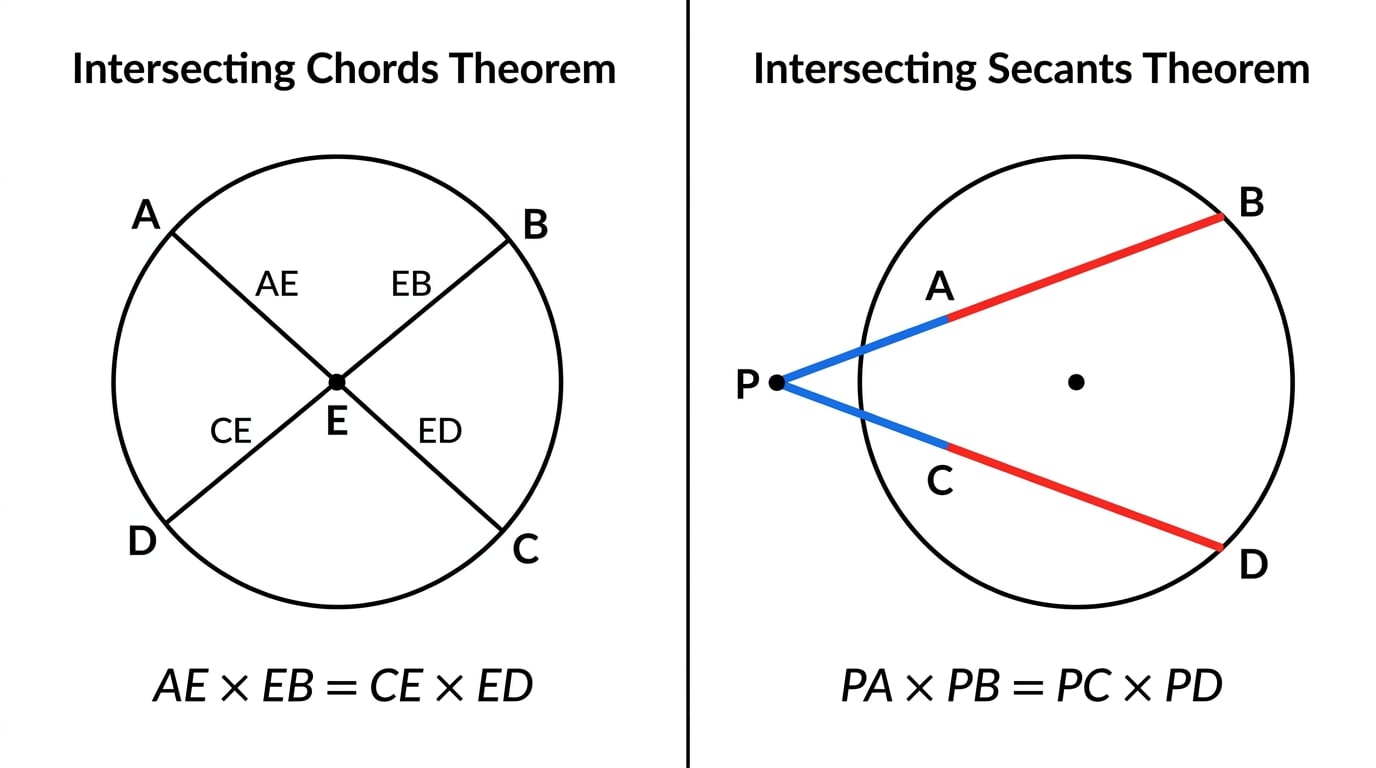
Some IGCSE questions use products of lengths. These are sometimes called power of a point results.
Key Idea
Intersecting chords
When two chords intersect inside a circle, the products of the two parts are equal:
AE×BE=CE×DEAE \times BE = CE \times DEAE×BE=CE×DEExample
Intersecting chords
Two chords AB and CD intersect at E. AE = 5 cm, BE = 9 cm, CE = 6 cm and DE = x cm. Find x.
-
Use the intersecting chords theorem:
AE×BE=CE×DEAE \times BE = CE \times DEAE×BE=CE×DE -
Substitute the lengths:
5×9=6x5 \times 9 = 6x5×9=6x -
Solve for x:
x=456=7.5x = \frac{45}{6} = 7.5x=645=7.5
Key Idea
External secants
When two secants meet outside a circle, use:
external part×whole length=external part×whole length\text{external part} \times \text{whole length} = \text{external part} \times \text{whole length}external part×whole length=external part×whole lengthExample
Two secants from an external point
From point E, one secant goes through C then A, with CE = 4 cm and CA = x cm. Another secant goes through D then B, with DE = 3 cm and DB = 10 cm. Find x.
-
The whole first secant is:
EA=x+4EA = x + 4EA=x+4 -
The whole second secant is:
EB=3+10=13EB = 3 + 10 = 13EB=3+10=13 -
Apply external part times whole length:
4(x+4)=3×134(x + 4) = 3 \times 134(x+4)=3×13 -
Solve:
4x+16=394x + 16 = 394x+16=39 -
Continue solving:
4x=234x = 234x=23 -
Finish:
x=5.75x = 5.75x=5.75
Common Mistake
Using only the inside part
For external secants, do not multiply the two inside pieces. The formula uses the outside piece and the whole length from the external point.
Exam technique
In the exam
- Mark every 90° angle from a radius to a tangent before doing anything else.
- Circle the chord or arc the angle is standing on; this helps you choose the correct theorem.
- Give reasons such as “angles in the same segment are equal” or “opposite angles in a cyclic quadrilateral add to 180°” to earn method marks.
Self review
Check yourself
- Can you explain why a triangle with two radii is isosceles?
- When do you halve an angle, and when do you double it?
- For two secants from an external point, can you identify the external part and the whole length?

Recap questions
Test yourself with 5 quick questions on this guide. Answer them all correctly to complete it.
You've reached the end
Test yourself on this topic, or move on to the next guide.
How was this guide?