Revision notes for Edexcel IGCSE Maths Solving Quadratics. Open the guide for explanations and worked examples. Written against the Edexcel IGCSE Maths (4MA1) specification, so the content matches what's examinable rather than general Maths background.
Solving Quadratics
What you'll learn
- How to recognise a quadratic equation.
- How to factorise quadratics of the form x2+bx+cx^2+bx+cx2+bx+c.
- How to use factorised brackets to solve a quadratic equation.
- How to avoid the most common sign mistakes.
1. What is a quadratic?
A quadratic is an expression or equation where the highest power of the variable is squared, such as x2+5x+6x^2+5x+6x2+5x+6 or a2−4a−12=0a^2-4a-12=0a2−4a−12=0.
Definition
Quadratic equation
A quadratic equation is an equation where the highest power of the variable is 2, usually written in the form ax2+bx+c=0ax^2+bx+c=0ax2+bx+c=0, where a≠0a \neq 0a=0.
In this topic, most questions have coefficient 1 in front of the squared term, for example:
x2+7x+12=0x^2+7x+12=0x2+7x+12=0These are usually solved by factorising.
Definition
Factorising
To factorise means to rewrite an expression as a product of brackets. For example, x2+5x+6x^2+5x+6x2+5x+6 factorises to (x+2)(x+3)(x+2)(x+3)(x+2)(x+3).
2. Why factorising helps you solve
If a quadratic is written as two brackets multiplied together, you can use a very important fact:
Key Idea
The zero product rule
If two things multiply to make zero, then at least one of them must be zero. So if (x+4)(x−7)=0(x+4)(x-7)=0(x+4)(x−7)=0, then either x+4=0x+4=0x+4=0 or x−7=0x-7=0x−7=0.
This is why solving quadratics by factorising has two parts:
- Factorise the quadratic.
- Set each bracket equal to zero.
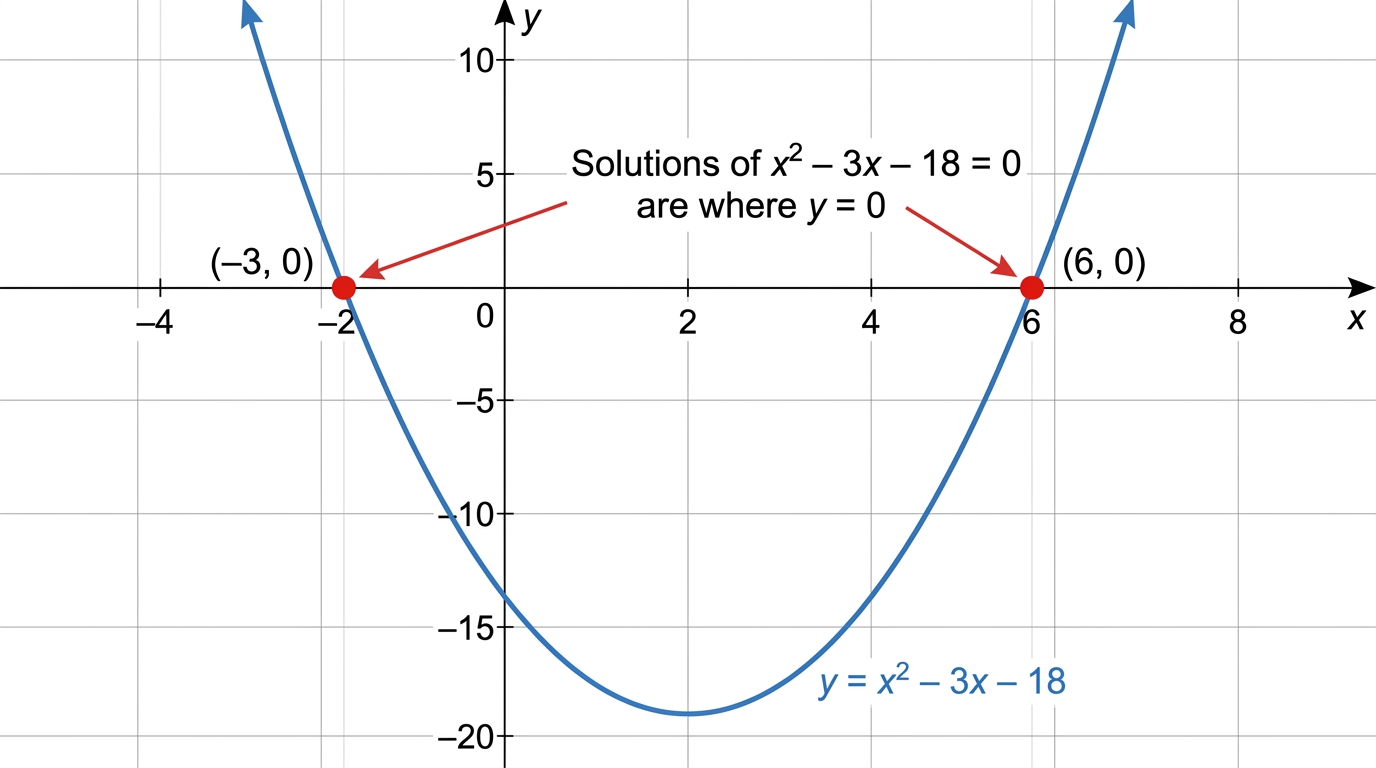
A quadratic graph can cross the x-axis twice. These crossing points are the solutions, also called roots.
Definition
Root or solution
A root or solution of a quadratic equation is a value of the variable that makes the equation true.
3. Recap: expanding double brackets
Before factorising, it helps to remember how brackets expand.
For example:
(x+4)(x+3)(x+4)(x+3)(x+4)(x+3)Multiply each term in the first bracket by each term in the second bracket:
(x+4)(x+3)=x2+3x+4x+12=x2+7x+12\begin{aligned} (x+4)(x+3) &= x^2+3x+4x+12 \\ &= x^2+7x+12 \end{aligned}(x+4)(x+3)=x2+3x+4x+12=x2+7x+12So factorising goes backwards:
x2+7x+12=(x+4)(x+3)x^2+7x+12=(x+4)(x+3)x2+7x+12=(x+4)(x+3)Tip
Think backwards
Expanding asks, “What do these brackets make?” Factorising asks, “Which brackets made this expression?”
4. Factorising x2+bx+cx^2+bx+cx2+bx+c
For a quadratic like x2+bx+cx^2+bx+cx2+bx+c, you need two numbers that:
- multiply to give the constant term ccc;
- add to give the coefficient of xxx, which is bbb.
For example, in x2+9x+20x^2+9x+20x2+9x+20:
- the two numbers multiply to 20;
- the two numbers add to 9.
The numbers are 4 and 5, so:
x2+9x+20=(x+4)(x+5)x^2+9x+20=(x+4)(x+5)x2+9x+20=(x+4)(x+5)Example
Factorise then solve a positive quadratic
Factorise and solve u2+8u+15=0u^2+8u+15=0u2+8u+15=0.
-
Find two numbers that multiply to 15 and add to 8.
-
The numbers are 3 and 5, because 3 × 5 = 15 and 3 + 5 = 8.
-
Write the quadratic as two brackets.
u2+8u+15=(u+3)(u+5)u^2+8u+15=(u+3)(u+5)u2+8u+15=(u+3)(u+5) -
Now solve the equation.
(u+3)(u+5)=0(u+3)(u+5)=0(u+3)(u+5)=0 -
Set each bracket equal to zero.
u+3=0oru+5=0u+3=0 \quad \text{or} \quad u+5=0u+3=0oru+5=0 -
Solve each simple equation.
u=−3oru=−5u=-3 \quad \text{or} \quad u=-5u=−3oru=−5
Common Mistake
Forgetting the final solve step
If the question says “solve”, factorising alone is not enough. After writing the brackets, you must give the values of the variable.
5. When the constant is positive
If the constant term is positive, the two bracket numbers must have the same sign.
Positive middle term
For x2+bx+cx^2+bx+cx2+bx+c, where both bbb and ccc are positive, both bracket numbers are positive.
Example:
x2+11x+30=(x+5)(x+6)x^2+11x+30=(x+5)(x+6)x2+11x+30=(x+5)(x+6)Negative middle term
For x2−bx+cx^2-bx+cx2−bx+c, where the constant is positive but the middle term is negative, both bracket numbers are negative.
Example:
x2−9x+20=(x−4)(x−5)x^2-9x+20=(x-4)(x-5)x2−9x+20=(x−4)(x−5)Example
Solve when both bracket signs are negative
Solve p2−7p+12=0p^2-7p+12=0p2−7p+12=0.
-
Find two numbers that multiply to 12 and add to -7.
-
The numbers are -3 and -4, because (−3)×(−4)=12(-3)\times(-4)=12(−3)×(−4)=12 and −3+(−4)=−7-3+(-4)=-7−3+(−4)=−7.
-
Factorise the quadratic.
p2−7p+12=(p−3)(p−4)p^2-7p+12=(p-3)(p-4)p2−7p+12=(p−3)(p−4) -
Set the factorised form equal to zero.
(p−3)(p−4)=0(p-3)(p-4)=0(p−3)(p−4)=0 -
Set each bracket equal to zero.
p−3=0orp−4=0p-3=0 \quad \text{or} \quad p-4=0p−3=0orp−4=0 -
Solve.
p=3orp=4p=3 \quad \text{or} \quad p=4p=3orp=4
Tip
Check the signs
If the constant is positive, your two signs should match: both plus or both minus.
6. When the constant is negative
If the constant term is negative, the two bracket numbers must have opposite signs.
For example, in x2+4x−21x^2+4x-21x2+4x−21:
- the numbers multiply to -21;
- the numbers add to 4.
The pair is 7 and -3, because 7×(−3)=−217\times(-3)=-217×(−3)=−21 and 7+(−3)=47+(-3)=47+(−3)=4.
So:
x2+4x−21=(x+7)(x−3)x^2+4x-21=(x+7)(x-3)x2+4x−21=(x+7)(x−3)Example
Solve with one plus bracket and one minus bracket
Solve x2+2x−48=0x^2+2x-48=0x2+2x−48=0.
-
Find two numbers that multiply to -48 and add to 2.
-
List useful factor pairs of 48: 1 and 48, 2 and 24, 3 and 16, 4 and 12, 6 and 8.
-
Since the product is negative, one number is positive and one is negative.
-
The pair that gives a sum of 2 is 8 and -6.
-
Factorise the quadratic.
x2+2x−48=(x+8)(x−6)x^2+2x-48=(x+8)(x-6)x2+2x−48=(x+8)(x−6) -
Set the brackets equal to zero.
x+8=0orx−6=0x+8=0 \quad \text{or} \quad x-6=0x+8=0orx−6=0 -
Solve each one.
x=−8orx=6x=-8 \quad \text{or} \quad x=6x=−8orx=6
Common Mistake
Choosing the right pair but wrong signs
For x2+2x−48x^2+2x-48x2+2x−48, the numbers 6 and 8 are useful, but the signs matter. You need +8 and -6, not +6 and -8, because the middle term must be +2.
7. Solving directly from the equation
Sometimes the question only asks you to solve, not factorise first. You still usually factorise as your method.
Example
Solve a quadratic directly
Solve m2+13m+36=0m^2+13m+36=0m2+13m+36=0.
-
Look for two numbers that multiply to 36 and add to 13.
-
The pair is 4 and 9.
-
Factorise.
m2+13m+36=(m+4)(m+9)m^2+13m+36=(m+4)(m+9)m2+13m+36=(m+4)(m+9) -
Rewrite the equation in factorised form.
(m+4)(m+9)=0(m+4)(m+9)=0(m+4)(m+9)=0 -
Use the zero product rule.
m+4=0orm+9=0m+4=0 \quad \text{or} \quad m+9=0m+4=0orm+9=0 -
Solve both equations.
m=−4orm=−9m=-4 \quad \text{or} \quad m=-9m=−4orm=−9
8. Quick checking by expanding
You can check your factorisation by expanding the brackets again.
Suppose you think:
x2−5x−24=(x−8)(x+3)x^2-5x-24=(x-8)(x+3)x2−5x−24=(x−8)(x+3)Expand to check:
(x−8)(x+3)=x2+3x−8x−24=x2−5x−24\begin{aligned} (x-8)(x+3) &= x^2+3x-8x-24 \\ &= x^2-5x-24 \end{aligned}(x−8)(x+3)=x2+3x−8x−24=x2−5x−24So the factorisation is correct.
Tip
A fast mental check
For brackets like (x+a)(x+b)(x+a)(x+b)(x+a)(x+b), the middle term comes from adding aaa and bbb, and the final term comes from multiplying aaa and bbb.
9. Why there are usually two answers
A quadratic can often have two solutions because either bracket can be zero.
For example:
(x−2)(x+5)=0(x-2)(x+5)=0(x−2)(x+5)=0This is true when:
x−2=0x-2=0x−2=0or when:
x+5=0x+5=0x+5=0So the two solutions are:
x=2orx=−5x=2 \quad \text{or} \quad x=-5x=2orx=−5Common Mistake
Do not divide by a bracket containing the variable
If you have (x−2)(x+5)=0(x-2)(x+5)=0(x−2)(x+5)=0, do not divide by x−2x-2x−2 or x+5x+5x+5. One of those brackets might be zero, and division by zero is not allowed.
10. Mini method summary
For quadratics in the form x2+bx+c=0x^2+bx+c=0x2+bx+c=0:
- Find two numbers that multiply to ccc.
- Make sure they add to $b`.
- Put them into brackets.
- Set each bracket equal to zero.
- Solve the two simple linear equations.
Common Mistake
Sign slip in the method
The add number is the coefficient of xxx, including its sign. For x2−10x+16x^2-10x+16x2−10x+16, the target sum is -10, not 10.
Example
Full exam-style example
Solve z2−4z−45=0z^2-4z-45=0z2−4z−45=0.
-
The constant is -45, so the two numbers must have opposite signs.
-
Find a factor pair of 45 with a difference of 4.
-
The useful pair is 9 and 5. To make the sum -4, use -9 and +5.
-
Factorise.
z2−4z−45=(z−9)(z+5)z^2-4z-45=(z-9)(z+5)z2−4z−45=(z−9)(z+5) -
Write the equation in factorised form.
(z−9)(z+5)=0(z-9)(z+5)=0(z−9)(z+5)=0 -
Set each bracket equal to zero.
z−9=0orz+5=0z-9=0 \quad \text{or} \quad z+5=0z−9=0orz+5=0 -
Solve.
z=9orz=−5z=9 \quad \text{or} \quad z=-5z=9orz=−5
Exam technique
In the exam
-
First decide whether the constant is positive or negative; this tells you whether the bracket signs match or differ.
-
If you are stuck, list factor pairs of the constant and test which pair gives the middle coefficient.
-
After finding the two answers, substitute them back into the original equation mentally if time allows.
Self review
Check yourself
-
Can you explain why (x+6)(x−2)=0(x+6)(x-2)=0(x+6)(x−2)=0 gives two possible equations to solve?
-
If the constant term is negative, what must be true about the signs in the two brackets?
-
How would you check whether (x−7)(x+4)(x-7)(x+4)(x−7)(x+4) really expands to x2−3x−28x^2-3x-28x2−3x−28?

Recap questions
Test yourself with 5 quick questions on this guide. Answer them all correctly to complete it.
You've reached the end
Test yourself on this topic, or move on to the next guide.
How was this guide?